

Part II: The Answers
424
Answers
601–700
683.
256 3
Recall the definition of volume: Let S be a solid that lies between x = a and x = b. If A(x)
is the cross-sectional area of S in the plane P x that goes through x and is perpendicular
to the x-axis, where A is a continuous function, then the volume of S is
V
A x dx
a
b
= ∫ ( )
Here, you want to find an expression for A(x).
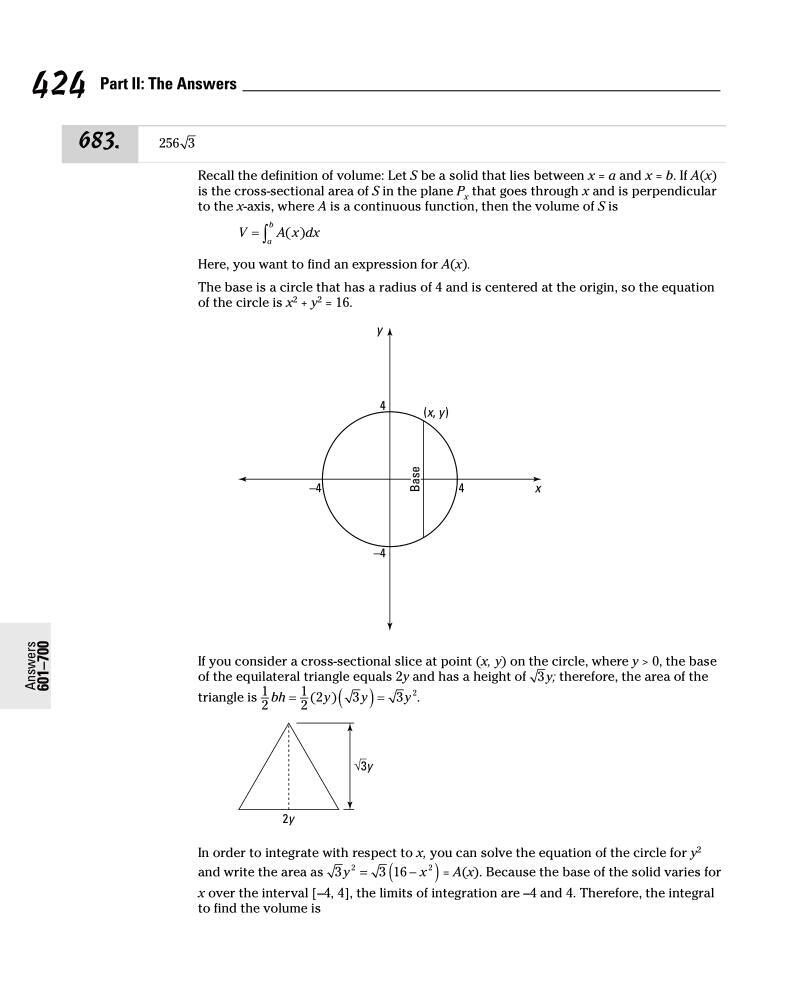
The base is a circle that has a radius of 4 and is centered at the origin, so the equation
of the circle is x
2
+ y
2
= 16.
If you consider a cross-sectional slice at point (x, y) on the circle, where y > 0, the base
of the equilateral triangle equals 2y and has a height of 3 y; therefore, the area of the
triangle is 1
2
1
2
2
3
3
2
bh
y
y
y
=
( ) =
( )
.
In order to integrate with respect to x, you can solve the equation of the circle for y
2
and write the area as 3
3 16
2
2
y
x
=
−
(
) = A(x). Because the base of the solid varies for
x over the interval [–4, 4], the limits of integration are –4 and 4. Therefore, the integral
to find the volume is
424
Answers
601–700
683.
256 3
Recall the definition of volume: Let S be a solid that lies between x = a and x = b. If A(x)
is the cross-sectional area of S in the plane P x that goes through x and is perpendicular
to the x-axis, where A is a continuous function, then the volume of S is
V
A x dx
a
b
= ∫ ( )
Here, you want to find an expression for A(x).
The base is a circle that has a radius of 4 and is centered at the origin, so the equation
of the circle is x
2
+ y
2
= 16.
If you consider a cross-sectional slice at point (x, y) on the circle, where y > 0, the base
of the equilateral triangle equals 2y and has a height of 3 y; therefore, the area of the
triangle is 1
2
1
2
2
3
3
2
bh
y
y
y
=
( ) =
( )
.
In order to integrate with respect to x, you can solve the equation of the circle for y
2
and write the area as 3
3 16
2
2
y
x
=
−
(
) = A(x). Because the base of the solid varies for
x over the interval [–4, 4], the limits of integration are –4 and 4. Therefore, the integral
to find the volume is