

419
Answers
601–700
Answers and Explanations
678.
21
20
π
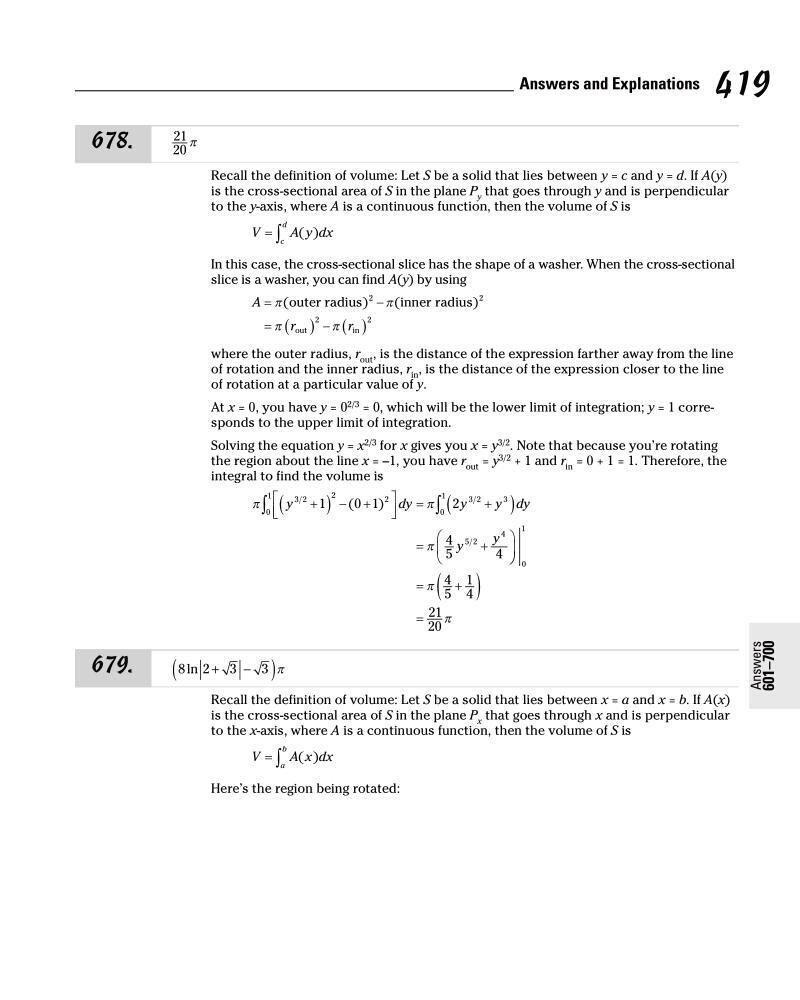
Recall the definition of volume: Let S be a solid that lies between y = c and y = d. If A(y)
is the cross-sectional area of S in the plane P y that goes through y and is perpendicular
to the y-axis, where A is a continuous function, then the volume of S is
V
A y dx
c
d
= ∫ ( )
In this case, the cross-sectional slice has the shape of a washer. When the cross-sectional
slice is a washer, you can find A(y) by using
A
r
r
=
= ( )
( )
π
π
π
π
(
)
(
)
outer radius
inner radius
out
i n
2
2
2
2
−
−
where the outer radius, r out , is the distance of the expression farther away from the line
of rotation and the inner radius, r in , is the distance of the expression closer to the line
of rotation at a particular value of y.
At x = 0, you have y = 0
2/3
= 0, which will be the lower limit of integration; y = 1 corresponds to the upper limit of integration.
Solving the equation y = x
2/3
for x gives you x = y
3/2
. Note that because you’re rotating
the region about the line x = –1, you have r out = y
3/2
+ 1 and r in = 0 + 1 = 1. Therefore, the
integral to find the volume is
π
π
π
y
d y
y
y dy
y
y
3 2
2
2
0
1
3 2
3
0
1
5 2
4
1
0 1
2
4
5
4
+
(
) − +
=
+
(
)
=
+
∫
∫
(
)
=
+
( )
=
0
1
4
5
1
4
21
20
π
π
679.
8 2
3
3
ln +
−
(
) π
Recall the definition of volume: Let S be a solid that lies between x = a and x = b. If A(x)
is the cross-sectional area of S in the plane P x that goes through x and is perpendicular
to the x-axis, where A is a continuous function, then the volume of S is
V
A x dx
a
b
= ∫ ( )
Here’s the region being rotated:
Answers
601–700
Answers and Explanations
678.
21
20
π
Recall the definition of volume: Let S be a solid that lies between y = c and y = d. If A(y)
is the cross-sectional area of S in the plane P y that goes through y and is perpendicular
to the y-axis, where A is a continuous function, then the volume of S is
V
A y dx
c
d
= ∫ ( )
In this case, the cross-sectional slice has the shape of a washer. When the cross-sectional
slice is a washer, you can find A(y) by using
A
r
r
=
= ( )
( )
π
π
π
π
(
)
(
)
outer radius
inner radius
out
i n
2
2
2
2
−
−
where the outer radius, r out , is the distance of the expression farther away from the line
of rotation and the inner radius, r in , is the distance of the expression closer to the line
of rotation at a particular value of y.
At x = 0, you have y = 0
2/3
= 0, which will be the lower limit of integration; y = 1 corresponds to the upper limit of integration.
Solving the equation y = x
2/3
for x gives you x = y
3/2
. Note that because you’re rotating
the region about the line x = –1, you have r out = y
3/2
+ 1 and r in = 0 + 1 = 1. Therefore, the
integral to find the volume is
π
π
π
y
d y
y
y dy
y
y
3 2
2
2
0
1
3 2
3
0
1
5 2
4
1
0 1
2
4
5
4
+
(
) − +
=
+
(
)
=
+
∫
∫
(
)
=
+
( )
=
0
1
4
5
1
4
21
20
π
π
679.
8 2
3
3
ln +
−
(
) π
Recall the definition of volume: Let S be a solid that lies between x = a and x = b. If A(x)
is the cross-sectional area of S in the plane P x that goes through x and is perpendicular
to the x-axis, where A is a continuous function, then the volume of S is
V
A x dx
a
b
= ∫ ( )
Here’s the region being rotated: