

417
Answers
601–700
Answers and Explanations
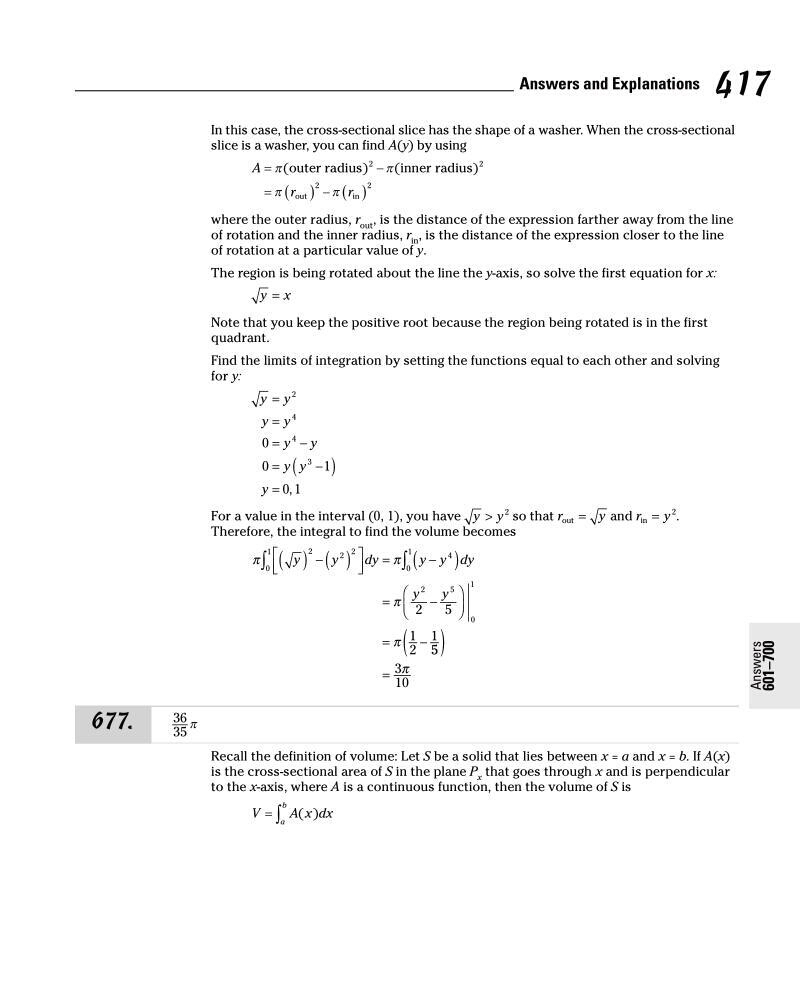
In this case, the cross-sectional slice has the shape of a washer. When the cross-sectional
slice is a washer, you can find A(y) by using
A
r
r
=
= ( )
( )
π
π
π
π
(
)
(
)
outer radius
inner radius
out
i n
2
2
2
2
−
−
where the outer radius, r out , is the distance of the expression farther away from the line
of rotation and the inner radius, r in , is the distance of the expression closer to the line
of rotation at a particular value of y.
The region is being rotated about the line the y-axis, so solve the first equation for x:
y x
=
Note that you keep the positive root because the region being rotated is in the first
quadrant.
Find the limits of integration by setting the functions equal to each other and solving
for y:
y y
y y
y
y
y y
y
=
=
=
−
=
−
(
)
=
2
4
4
3
0
0
1
0 1
,
For a value in the interval (0, 1), you have y y
>
2 so that r
y
out =
and r
y
in =
2
.
Therefore, the integral to find the volume becomes
π
π
π
π
y
y
dy
y y dy
y
y
( ) − ( )
=
−
(
)
=
−
=
−
∫
∫
2
2
2
0
1
4
0
1
2
5
0
1
2
5
1
2
1
5 5
3
10
( )
= π
677.
36
35
π
Recall the definition of volume: Let S be a solid that lies between x = a and x = b. If A(x)
is the cross-sectional area of S in the plane P x that goes through x and is perpendicular
to the x-axis, where A is a continuous function, then the volume of S is
V
A x dx
a
b
= ∫ ( )
Answers
601–700
Answers and Explanations
In this case, the cross-sectional slice has the shape of a washer. When the cross-sectional
slice is a washer, you can find A(y) by using
A
r
r
=
= ( )
( )
π
π
π
π
(
)
(
)
outer radius
inner radius
out
i n
2
2
2
2
−
−
where the outer radius, r out , is the distance of the expression farther away from the line
of rotation and the inner radius, r in , is the distance of the expression closer to the line
of rotation at a particular value of y.
The region is being rotated about the line the y-axis, so solve the first equation for x:
y x
=
Note that you keep the positive root because the region being rotated is in the first
quadrant.
Find the limits of integration by setting the functions equal to each other and solving
for y:
y y
y y
y
y
y y
y
=
=
=
−
=
−
(
)
=
2
4
4
3
0
0
1
0 1
,
For a value in the interval (0, 1), you have y y
>
2 so that r
y
out =
and r
y
in =
2
.
Therefore, the integral to find the volume becomes
π
π
π
π
y
y
dy
y y dy
y
y
( ) − ( )
=
−
(
)
=
−
=
−
∫
∫
2
2
2
0
1
4
0
1
2
5
0
1
2
5
1
2
1
5 5
3
10
( )
= π
677.
36
35
π
Recall the definition of volume: Let S be a solid that lies between x = a and x = b. If A(x)
is the cross-sectional area of S in the plane P x that goes through x and is perpendicular
to the x-axis, where A is a continuous function, then the volume of S is
V
A x dx
a
b
= ∫ ( )