

Part II: The Answers
412
Answers
601–700
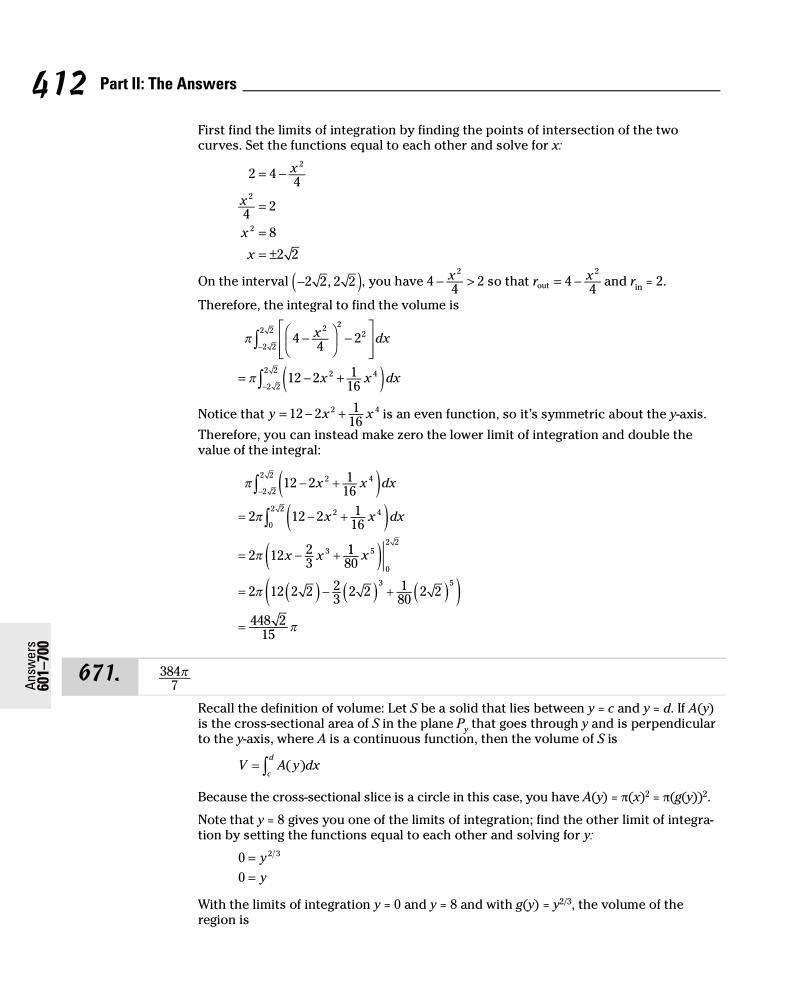
First find the limits of integration by finding the points of intersection of the two
curves. Set the functions equal to each other and solve for x:
2 4 4
4
2
8
2 2
2
2
2
= −
=
=
= ±
x
x
x
x
On the interval −
(
)
2 2 2 2
,
, you have 4 4
2
2
−
>
x
so that r
x
out = −
4 4
2 and r in = 2.
Therefore, the integral to find the volume is
π
π
4 4
2
12 2
1
16
2
2
2
2 2
2 2
2
4
2 2
2 2
−
−
=
−
+
(
)
−
−
∫
∫
x
dx
x
x dx
Notice that y
x
x
= −
+
12 2
1
16
2
4 is an even function, so it’s symmetric about the y-axis.
Therefore, you can instead make zero the lower limit of integration and double the
value of the integral:
π
π
π
12 2
1
16
2
12 2
1
16
2 12
2
3
2
4
2 2
2 2
2
4
0
2 2
3
−
+
(
)
=
−
+
(
)
=
−
+
−
∫
∫
x
x dx
x
x dx
x
x
1 1
80
2 12 2 2
2
3
2 2
1
80
2 2
448 2
15
5
0
2 2
3
5
x
(
)
=
( ) − ( ) + ( ) )
(
=
π
π
671.
384
7
π
Recall the definition of volume: Let S be a solid that lies between y = c and y = d. If A(y)
is the cross-sectional area of S in the plane P y that goes through y and is perpendicular
to the y-axis, where A is a continuous function, then the volume of S is
V
A y dx
c
d
= ∫ ( )
Because the cross-sectional slice is a circle in this case, you have A(y) = π(x)
2
= π(g(y))
2
.
Note that y = 8 gives you one of the limits of integration; find the other limit of integration by setting the functions equal to each other and solving for y:
0
0
2 3
=
=
y
y
With the limits of integration y = 0 and y = 8 and with g(y) = y
2/3
, the volume of the
region is
412
Answers
601–700
First find the limits of integration by finding the points of intersection of the two
curves. Set the functions equal to each other and solve for x:
2 4 4
4
2
8
2 2
2
2
2
= −
=
=
= ±
x
x
x
x
On the interval −
(
)
2 2 2 2
,
, you have 4 4
2
2
−
>
x
so that r
x
out = −
4 4
2 and r in = 2.
Therefore, the integral to find the volume is
π
π
4 4
2
12 2
1
16
2
2
2
2 2
2 2
2
4
2 2
2 2
−
−
=
−
+
(
)
−
−
∫
∫
x
dx
x
x dx
Notice that y
x
x
= −
+
12 2
1
16
2
4 is an even function, so it’s symmetric about the y-axis.
Therefore, you can instead make zero the lower limit of integration and double the
value of the integral:
π
π
π
12 2
1
16
2
12 2
1
16
2 12
2
3
2
4
2 2
2 2
2
4
0
2 2
3
−
+
(
)
=
−
+
(
)
=
−
+
−
∫
∫
x
x dx
x
x dx
x
x
1 1
80
2 12 2 2
2
3
2 2
1
80
2 2
448 2
15
5
0
2 2
3
5
x
(
)
=
( ) − ( ) + ( ) )
(
=
π
π
671.
384
7
π
Recall the definition of volume: Let S be a solid that lies between y = c and y = d. If A(y)
is the cross-sectional area of S in the plane P y that goes through y and is perpendicular
to the y-axis, where A is a continuous function, then the volume of S is
V
A y dx
c
d
= ∫ ( )
Because the cross-sectional slice is a circle in this case, you have A(y) = π(x)
2
= π(g(y))
2
.
Note that y = 8 gives you one of the limits of integration; find the other limit of integration by setting the functions equal to each other and solving for y:
0
0
2 3
=
=
y
y
With the limits of integration y = 0 and y = 8 and with g(y) = y
2/3
, the volume of the
region is