

409
Answers
601–700
Answers and Explanations
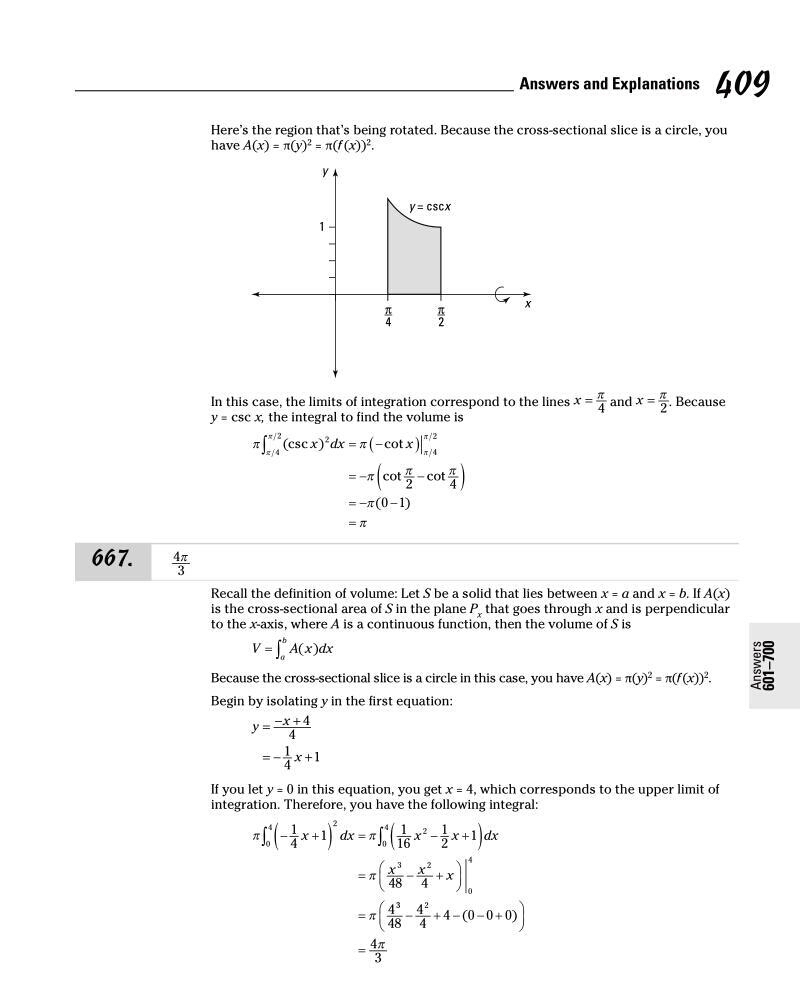
Here’s the region that’s being rotated. Because the cross-sectional slice is a circle, you
have A(x) = π(y)
2
= π(f
(x))
2
.
In this case, the limits of integration correspond to the lines x = π
4 and x = π
2 . Because
y = csc x, the integral to find the volume is
π
π
π
π
π
π
π
π
π
π
π
(csc )
c ot
cot
cot
(
)
x dx
x
2
4
2
4
2
2
4
0 1
∫
= −
(
)
= −
−
(
)
= −
−
=
667.
4
3
π
Recall the definition of volume: Let S be a solid that lies between x = a and x = b. If A(x)
is the cross-sectional area of S in the plane P x that goes through x and is perpendicular
to the x-axis, where A is a continuous function, then the volume of S is
V
A x dx
a
b
= ∫ ( )
Because the cross-sectional slice is a circle in this case, you have A(x) = π(y)
2
= π(f
(x))
2
.
Begin by isolating y in the first equation:
y
x
x
= − +
= −
+
4
4
1
4
1
If you let y = 0 in this equation, you get x = 4, which corresponds to the upper limit of
integration. Therefore, you have the following integral:
π
π
π
π
−
+
(
) =
−
+
(
)
=
−
+
=
∫
∫
1
4
1
1
16
1
2
1
48 4
4
2
0
4
2
0
4
3
2
0
4
x
dx
x
x
dx
x
x
x
3 3
2
48
4
4
4 0 0 0
4
3
−
+ − − +
=
(
)
π
Answers
601–700
Answers and Explanations
Here’s the region that’s being rotated. Because the cross-sectional slice is a circle, you
have A(x) = π(y)
2
= π(f
(x))
2
.
In this case, the limits of integration correspond to the lines x = π
4 and x = π
2 . Because
y = csc x, the integral to find the volume is
π
π
π
π
π
π
π
π
π
π
π
(csc )
c ot
cot
cot
(
)
x dx
x
2
4
2
4
2
2
4
0 1
∫
= −
(
)
= −
−
(
)
= −
−
=
667.
4
3
π
Recall the definition of volume: Let S be a solid that lies between x = a and x = b. If A(x)
is the cross-sectional area of S in the plane P x that goes through x and is perpendicular
to the x-axis, where A is a continuous function, then the volume of S is
V
A x dx
a
b
= ∫ ( )
Because the cross-sectional slice is a circle in this case, you have A(x) = π(y)
2
= π(f
(x))
2
.
Begin by isolating y in the first equation:
y
x
x
= − +
= −
+
4
4
1
4
1
If you let y = 0 in this equation, you get x = 4, which corresponds to the upper limit of
integration. Therefore, you have the following integral:
π
π
π
π
−
+
(
) =
−
+
(
)
=
−
+
=
∫
∫
1
4
1
1
16
1
2
1
48 4
4
2
0
4
2
0
4
3
2
0
4
x
dx
x
x
dx
x
x
x
3 3
2
48
4
4
4 0 0 0
4
3
−
+ − − +
=
(
)
π