

391
Answers
601–700
Answers and Explanations
642.
1
6
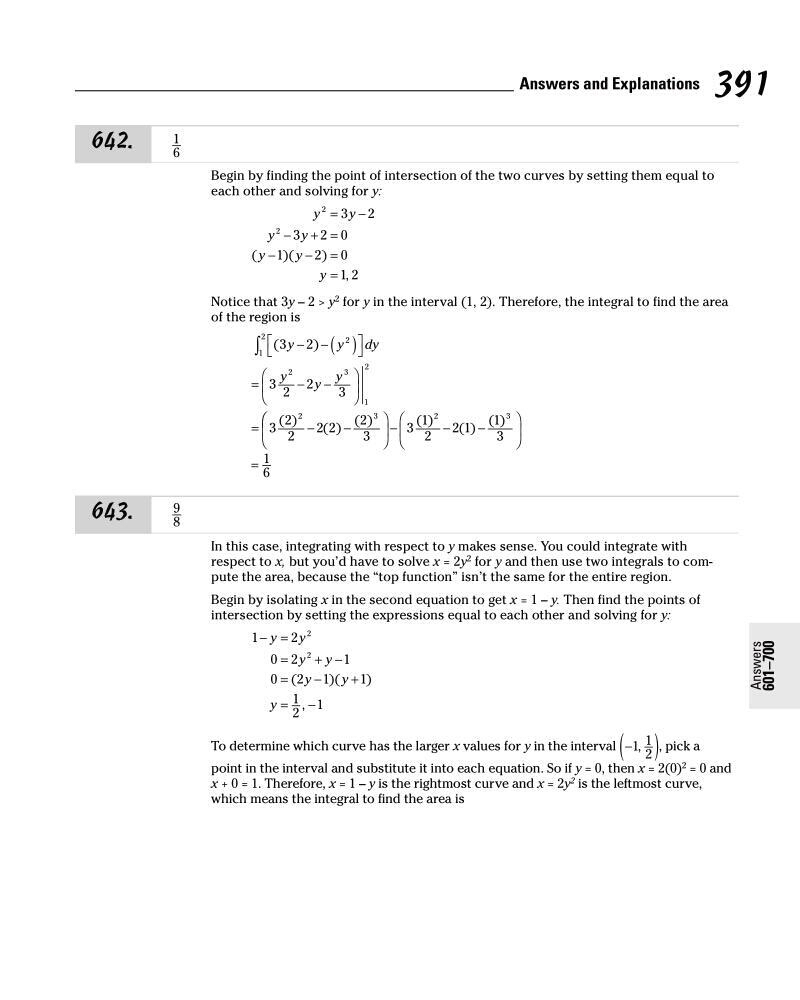
Begin by finding the point of intersection of the two curves by setting them equal to
each other and solving for y:
y
y
y
y
y
y
y
2
2
3
2
3
2 0
1
2 0
1 2
=
−
−
+ =
−
− =
=
(
)(
)
,
Notice that 3y – 2 > y
2
for y in the interval (1, 2). Therefore, the integral to find the area
of the region is
(
)
( )
( )
( )
3
2
3 2
2
3
3
2
2
2 2
2
3
2
1
2
2
3
1
2
2
3
y
y
dy
y
y
y
− − ( )
=
− −
=
−
−
∫
−
−
−
=
3
1
2
2 1
1
3
1
6
2
3
( )
( )
( )
643.
9
8
In this case, integrating with respect to y makes sense. You could integrate with
respect to x, but you’d have to solve x = 2y
2
for y and then use two integrals to compute the area, because the “top function” isn’t the same for the entire region.
Begin by isolating x in the second equation to get x = 1 – y. Then find the points of
intersection by setting the expressions equal to each other and solving for y:
1
2
0 2
1
0 2 1
1
1
2
1
2
2
− =
=
+ −
=
−
+
=
−
y
y
y
y
y
y
y
(
)(
)
,
To determine which curve has the larger x values for y in the interval −
( )
1 1
2
, , pick a
point in the interval and substitute it into each equation. So if y = 0, then x = 2(0)
2
= 0 and
x + 0 = 1. Therefore, x = 1 – y is the rightmost curve and x = 2y
2
is the leftmost curve,
which means the integral to find the area is
Answers
601–700
Answers and Explanations
642.
1
6
Begin by finding the point of intersection of the two curves by setting them equal to
each other and solving for y:
y
y
y
y
y
y
y
2
2
3
2
3
2 0
1
2 0
1 2
=
−
−
+ =
−
− =
=
(
)(
)
,
Notice that 3y – 2 > y
2
for y in the interval (1, 2). Therefore, the integral to find the area
of the region is
(
)
( )
( )
( )
3
2
3 2
2
3
3
2
2
2 2
2
3
2
1
2
2
3
1
2
2
3
y
y
dy
y
y
y
− − ( )
=
− −
=
−
−
∫
−
−
−
=
3
1
2
2 1
1
3
1
6
2
3
( )
( )
( )
643.
9
8
In this case, integrating with respect to y makes sense. You could integrate with
respect to x, but you’d have to solve x = 2y
2
for y and then use two integrals to compute the area, because the “top function” isn’t the same for the entire region.
Begin by isolating x in the second equation to get x = 1 – y. Then find the points of
intersection by setting the expressions equal to each other and solving for y:
1
2
0 2
1
0 2 1
1
1
2
1
2
2
− =
=
+ −
=
−
+
=
−
y
y
y
y
y
y
y
(
)(
)
,
To determine which curve has the larger x values for y in the interval −
( )
1 1
2
, , pick a
point in the interval and substitute it into each equation. So if y = 0, then x = 2(0)
2
= 0 and
x + 0 = 1. Therefore, x = 1 – y is the rightmost curve and x = 2y
2
is the leftmost curve,
which means the integral to find the area is