

Part II: The Answers
384
Answers
601–700
633.
344
3
Because the derivative of the position function is the rate of change in position with
respect to time, the derivative of the position function gives you the velocity function.
Likewise, the derivative of the velocity function is the rate of change in velocity with
respect to time, so the derivative of the velocity function gives you the acceleration
function. It follows that the antiderivative of the acceleration function is the velocity
function and that the antiderivative of the velocity function is the position function.
Note that displacement, or change in position, can be positive or negative or zero. You
can think of the particle moving to the left if the displacement is negative and moving
to the right if the displacement is positive. But unlike displacement, distance can’t be
negative. To find the distance traveled, you can integrate the absolute value of the
velocity function because you’re then integrating a function that’s greater than or
equal to zero on the given interval.
Begin by finding the velocity function by evaluating the antiderivative of the acceleration function, a(t) = t + 2:
v t
t
dt
t
t C
( )
(
)
=
+
= + +
∫ 2
2
2
2
Next, use the initial condition, v(0) = –6, to solve for the arbitrary constant of
integration:
v
C
C
C
( )
( )
0
0
2
20
6 0
2
2 0
6
2
2
=
+ +
− =
+
+
− =
Therefore, the velocity function is
v t
t
t
( ) = + −
2
2
2 6
To find the distance traveled, integrate the absolute value of the velocity function
over the given interval:
t
t
dt
2
0
8
2
2 6
+ −
∫
Find any zeros of the function on the given interval so that you can determine where the
velocity function is positive or negative: t
t
2
2
2 6 0
+ − = , or t
2
+ 4t – 12 = 0, which factors as
(t + 6)(t – 2) = 0 and has the solutions of t = –6, t = 2. Notice that on the interval (0, 2), the
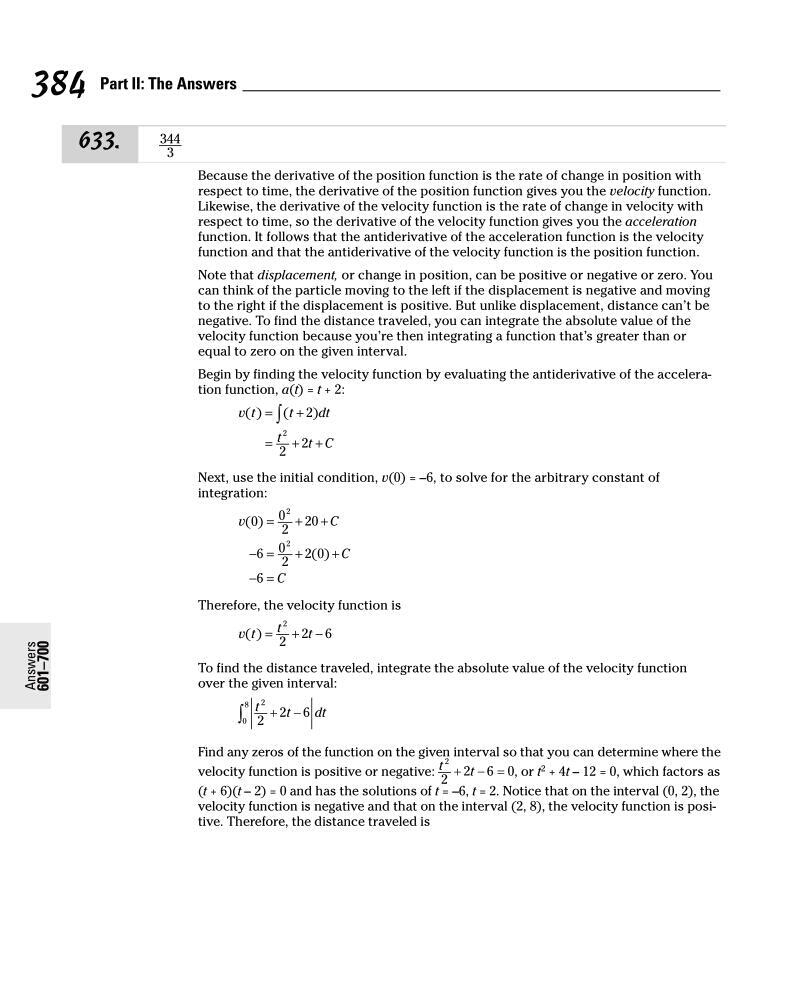
velocity function is negative and that on the interval (2, 8), the velocity function is positive. Therefore, the distance traveled is
384
Answers
601–700
633.
344
3
Because the derivative of the position function is the rate of change in position with
respect to time, the derivative of the position function gives you the velocity function.
Likewise, the derivative of the velocity function is the rate of change in velocity with
respect to time, so the derivative of the velocity function gives you the acceleration
function. It follows that the antiderivative of the acceleration function is the velocity
function and that the antiderivative of the velocity function is the position function.
Note that displacement, or change in position, can be positive or negative or zero. You
can think of the particle moving to the left if the displacement is negative and moving
to the right if the displacement is positive. But unlike displacement, distance can’t be
negative. To find the distance traveled, you can integrate the absolute value of the
velocity function because you’re then integrating a function that’s greater than or
equal to zero on the given interval.
Begin by finding the velocity function by evaluating the antiderivative of the acceleration function, a(t) = t + 2:
v t
t
dt
t
t C
( )
(
)
=
+
= + +
∫ 2
2
2
2
Next, use the initial condition, v(0) = –6, to solve for the arbitrary constant of
integration:
v
C
C
C
( )
( )
0
0
2
20
6 0
2
2 0
6
2
2
=
+ +
− =
+
+
− =
Therefore, the velocity function is
v t
t
t
( ) = + −
2
2
2 6
To find the distance traveled, integrate the absolute value of the velocity function
over the given interval:
t
t
dt
2
0
8
2
2 6
+ −
∫
Find any zeros of the function on the given interval so that you can determine where the
velocity function is positive or negative: t
t
2
2
2 6 0
+ − = , or t
2
+ 4t – 12 = 0, which factors as
(t + 6)(t – 2) = 0 and has the solutions of t = –6, t = 2. Notice that on the interval (0, 2), the
velocity function is negative and that on the interval (2, 8), the velocity function is positive. Therefore, the distance traveled is