

Part II: The Answers
382
Answers
601–700
630.
304
3
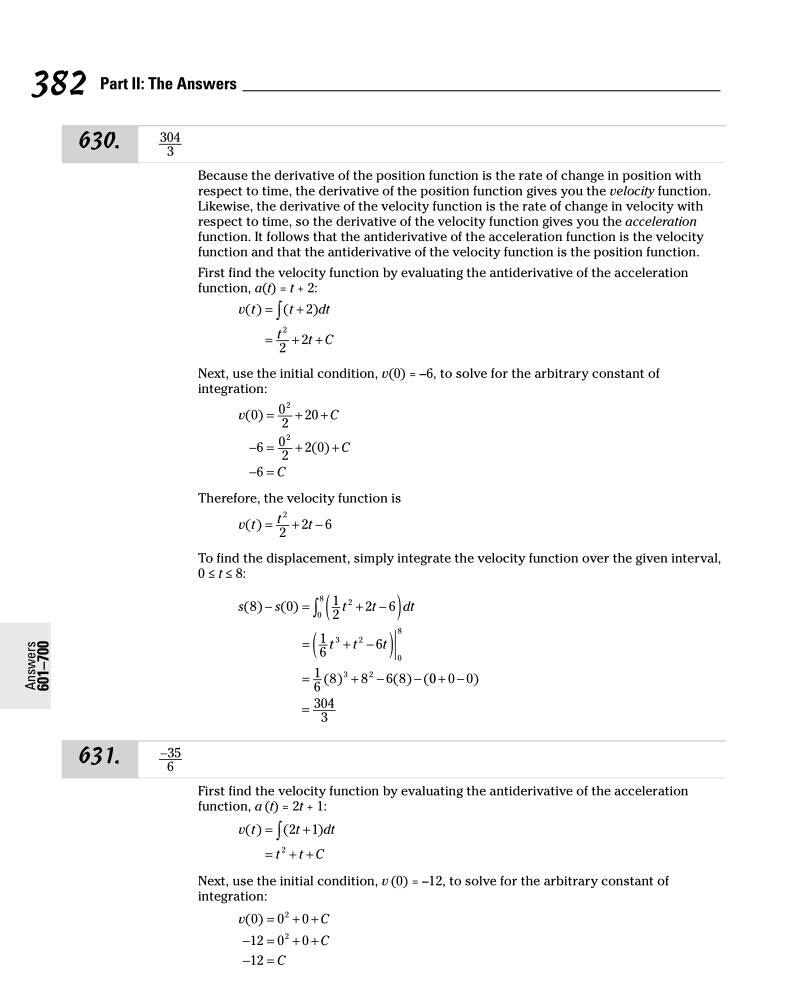
Because the derivative of the position function is the rate of change in position with
respect to time, the derivative of the position function gives you the velocity function.
Likewise, the derivative of the velocity function is the rate of change in velocity with
respect to time, so the derivative of the velocity function gives you the acceleration
function. It follows that the antiderivative of the acceleration function is the velocity
function and that the antiderivative of the velocity function is the position function.
First find the velocity function by evaluating the antiderivative of the acceleration
function, a(t) = t + 2:
v t
t
dt
t
t C
( )
(
)
=
+
= + +
∫ 2
2
2
2
Next, use the initial condition, v(0) = –6, to solve for the arbitrary constant of
integration:
v
C
C
C
( )
( )
0
0
2
20
6 0
2
2 0
6
2
2
=
+ +
− =
+
+
− =
Therefore, the velocity function is
v t
t
t
( ) = + −
2
2
2 6
To find the displacement, simply integrate the velocity function over the given interval,
0 ≤ t ≤ 8:
s
s
t
t
dt
t t
t
( ) ( )
( )
( ) (
8
0
1
2
2 6
1
6
6
1
6
8
8 6 8
2
0
8
3
2
0
8
3
2
−
=
+ −
(
)
=
+ −
(
)
=
+ −
−
∫
0 0 0 0
304
3
+ −
=
)
631.
−35
6
First find the velocity function by evaluating the antiderivative of the acceleration
function, a
(t) = 2t + 1:
v t
t
dt
t t C
( )
(
)
=
+
= + +
∫ 2 1
2
Next, use the initial condition, v
(0) = –12, to solve for the arbitrary constant of
integration:
v
C
C
C
( )
0 0 0
12 0 0
12
2
2
= + +
− = + +
− =
382
Answers
601–700
630.
304
3
Because the derivative of the position function is the rate of change in position with
respect to time, the derivative of the position function gives you the velocity function.
Likewise, the derivative of the velocity function is the rate of change in velocity with
respect to time, so the derivative of the velocity function gives you the acceleration
function. It follows that the antiderivative of the acceleration function is the velocity
function and that the antiderivative of the velocity function is the position function.
First find the velocity function by evaluating the antiderivative of the acceleration
function, a(t) = t + 2:
v t
t
dt
t
t C
( )
(
)
=
+
= + +
∫ 2
2
2
2
Next, use the initial condition, v(0) = –6, to solve for the arbitrary constant of
integration:
v
C
C
C
( )
( )
0
0
2
20
6 0
2
2 0
6
2
2
=
+ +
− =
+
+
− =
Therefore, the velocity function is
v t
t
t
( ) = + −
2
2
2 6
To find the displacement, simply integrate the velocity function over the given interval,
0 ≤ t ≤ 8:
s
s
t
t
dt
t t
t
( ) ( )
( )
( ) (
8
0
1
2
2 6
1
6
6
1
6
8
8 6 8
2
0
8
3
2
0
8
3
2
−
=
+ −
(
)
=
+ −
(
)
=
+ −
−
∫
0 0 0 0
304
3
+ −
=
)
631.
−35
6
First find the velocity function by evaluating the antiderivative of the acceleration
function, a
(t) = 2t + 1:
v t
t
dt
t t C
( )
(
)
=
+
= + +
∫ 2 1
2
Next, use the initial condition, v
(0) = –12, to solve for the arbitrary constant of
integration:
v
C
C
C
( )
0 0 0
12 0 0
12
2
2
= + +
− = + +
− =