

377
Answers
601–700
Answers and Explanations
618.
the net change in income in dollars during the first 10 years at the job
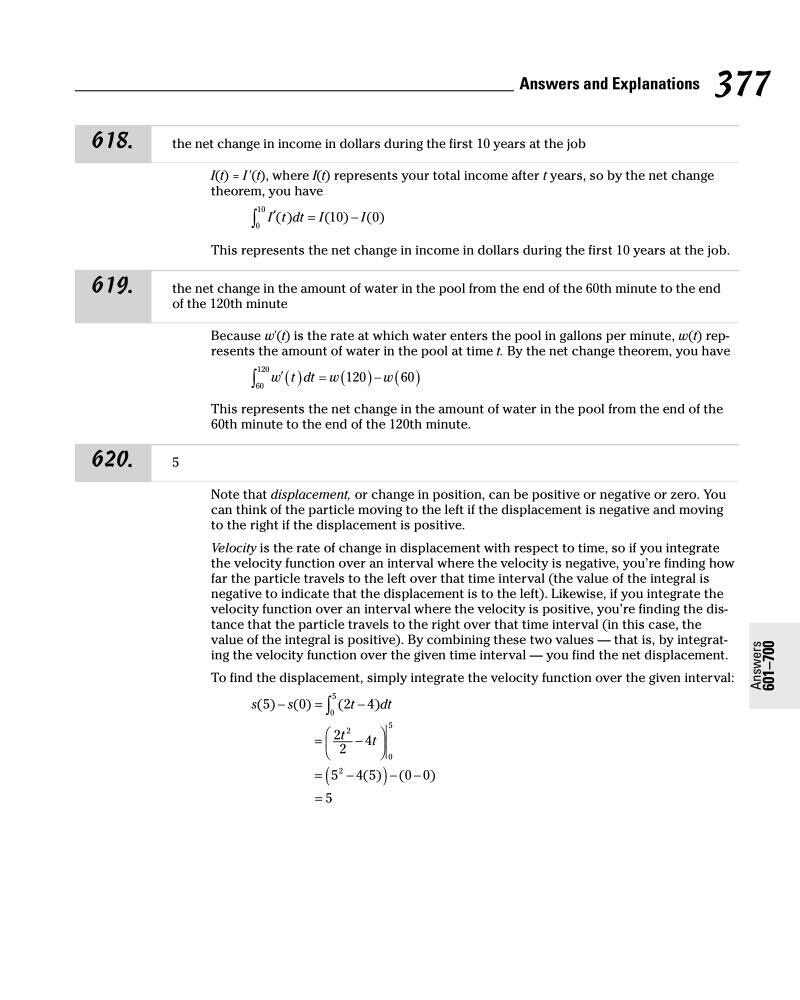
I(t) = I'(t), where I(t) represents your total income after t years, so by the net change
theorem, you have
′
=
−
∫ I t dt I
I
( )
( ) ( )
0
10
10
0
This represents the net change in income in dollars during the first 10 years at the job.
619.
the net change in the amount of water in the pool from the end of the 60th minute to the end
of the 120th minute
Because w'(t) is the rate at which water enters the pool in gallons per minute, w(t) represents the amount of water in the pool at time t. By the net change theorem, you have
′ ( ) = ( )− ( )
∫ w t dt w
w
60
120
120
60
This represents the net change in the amount of water in the pool from the end of the
60th minute to the end of the 120th minute.
620.
5
Note that displacement, or change in position, can be positive or negative or zero. You
can think of the particle moving to the left if the displacement is negative and moving
to the right if the displacement is positive.
Velocity is the rate of change in displacement with respect to time, so if you integrate
the velocity function over an interval where the velocity is negative, you’re finding how
far the particle travels to the left over that time interval (the value of the integral is
negative to indicate that the displacement is to the left). Likewise, if you integrate the
velocity function over an interval where the velocity is positive, you’re finding the distance that the particle travels to the right over that time interval (in this case, the
value of the integral is positive). By combining these two values — that is, by integrating the velocity function over the given time interval — you find the net displacement.
To find the displacement, simply integrate the velocity function over the given interval:
s
s
t
dt
t
t
( ) ( )
(
)
( ) (
)
5
0
2 4
2
2
4
5 4 5
0 0
5
0
5
2
0
5
2
−
=
−
=
−
=
−
(
) − −
=
∫
Answers
601–700
Answers and Explanations
618.
the net change in income in dollars during the first 10 years at the job
I(t) = I'(t), where I(t) represents your total income after t years, so by the net change
theorem, you have
′
=
−
∫ I t dt I
I
( )
( ) ( )
0
10
10
0
This represents the net change in income in dollars during the first 10 years at the job.
619.
the net change in the amount of water in the pool from the end of the 60th minute to the end
of the 120th minute
Because w'(t) is the rate at which water enters the pool in gallons per minute, w(t) represents the amount of water in the pool at time t. By the net change theorem, you have
′ ( ) = ( )− ( )
∫ w t dt w
w
60
120
120
60
This represents the net change in the amount of water in the pool from the end of the
60th minute to the end of the 120th minute.
620.
5
Note that displacement, or change in position, can be positive or negative or zero. You
can think of the particle moving to the left if the displacement is negative and moving
to the right if the displacement is positive.
Velocity is the rate of change in displacement with respect to time, so if you integrate
the velocity function over an interval where the velocity is negative, you’re finding how
far the particle travels to the left over that time interval (the value of the integral is
negative to indicate that the displacement is to the left). Likewise, if you integrate the
velocity function over an interval where the velocity is positive, you’re finding the distance that the particle travels to the right over that time interval (in this case, the
value of the integral is positive). By combining these two values — that is, by integrating the velocity function over the given time interval — you find the net displacement.
To find the displacement, simply integrate the velocity function over the given interval:
s
s
t
dt
t
t
( ) ( )
(
)
( ) (
)
5
0
2 4
2
2
4
5 4 5
0 0
5
0
5
2
0
5
2
−
=
−
=
−
=
−
(
) − −
=
∫