

Part II: The Answers
364
Answers
501–600
568.
7
6
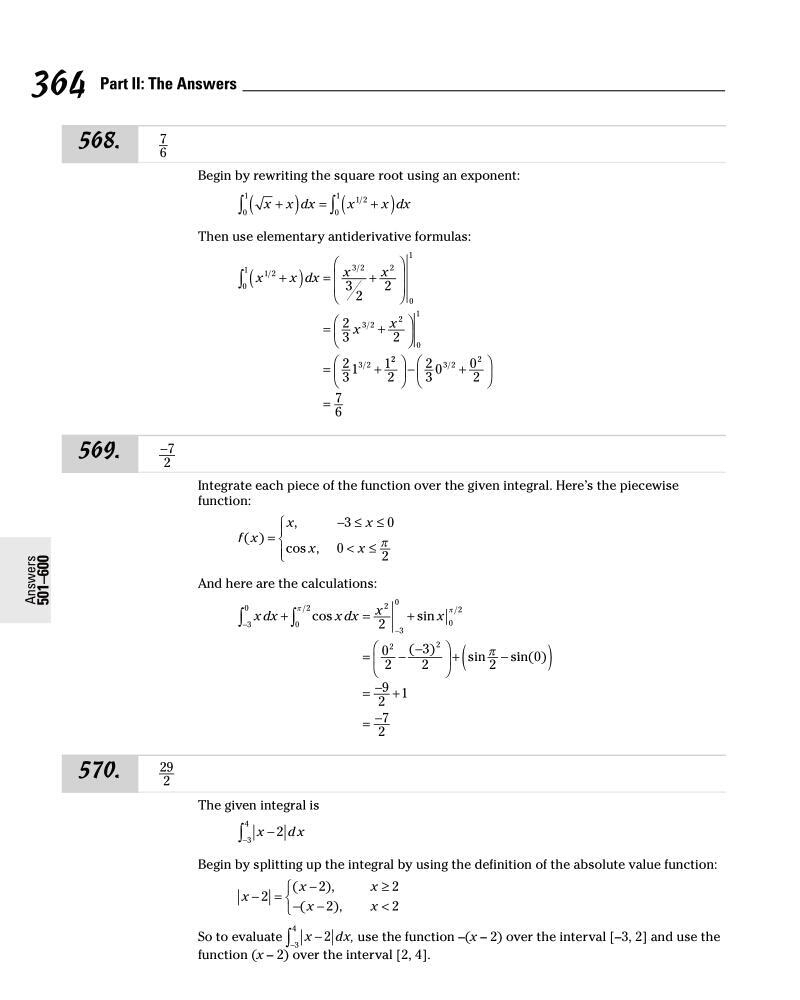
Begin by rewriting the square root using an exponent:
x x dx
x
x dx
+
(
) =
+
(
)
∫
∫
0
1
1 2
0
1
Then use elementary antiderivative formulas:
x
x dx
x
x
x
x
1 2
0
1
3 2
2
0
1
3 2
2
0
1
3 2
3 2
2
2
3
2
2
3
1
1
+
(
) =
+
=
+
=
+
∫
2 2
3 2
2
2
2
3
0
0
2
7
6
−
+
=
569.
−7
2
Integrate each piece of the function over the given integral. Here’s the piecewise
function:
f x
x
x
x
x
( )
,
cos ,
=
− ≤ ≤
< ≤
3
0
0
2
π
And here are the calculations:
x dx
xdx x
x
+
=
+
=
−
−
+
−
∫
∫ −
−
cos
s in
( )
sin
s
0
2
3
0
2
3
0
0
2
2
2
2
0
2
3
2
2
π
π
π
i in( )
0
9
2
1
7
2
(
)
= − +
= −
570.
29
2
The given integral is
x
dx
−
−
∫
2
3
4
Begin by splitting up the integral by using the definition of the absolute value function:
x
x
x
x
x
− =
−
≥
− −
<
2
2
2
2
2
(
),
(
),
So to evaluate
x
dx
−
−
∫
2
3
4
, use the function –(x – 2) over the interval [–3, 2] and use the
function (x – 2) over the interval [2, 4].
364
Answers
501–600
568.
7
6
Begin by rewriting the square root using an exponent:
x x dx
x
x dx
+
(
) =
+
(
)
∫
∫
0
1
1 2
0
1
Then use elementary antiderivative formulas:
x
x dx
x
x
x
x
1 2
0
1
3 2
2
0
1
3 2
2
0
1
3 2
3 2
2
2
3
2
2
3
1
1
+
(
) =
+
=
+
=
+
∫
2 2
3 2
2
2
2
3
0
0
2
7
6
−
+
=
569.
−7
2
Integrate each piece of the function over the given integral. Here’s the piecewise
function:
f x
x
x
x
x
( )
,
cos ,
=
− ≤ ≤
< ≤
3
0
0
2
π
And here are the calculations:
x dx
xdx x
x
+
=
+
=
−
−
+
−
∫
∫ −
−
cos
s in
( )
sin
s
0
2
3
0
2
3
0
0
2
2
2
2
0
2
3
2
2
π
π
π
i in( )
0
9
2
1
7
2
(
)
= − +
= −
570.
29
2
The given integral is
x
dx
−
−
∫
2
3
4
Begin by splitting up the integral by using the definition of the absolute value function:
x
x
x
x
x
− =
−
≥
− −
<
2
2
2
2
2
(
),
(
),
So to evaluate
x
dx
−
−
∫
2
3
4
, use the function –(x – 2) over the interval [–3, 2] and use the
function (x – 2) over the interval [2, 4].