

Part II: The Answers
348
Answers
501–600
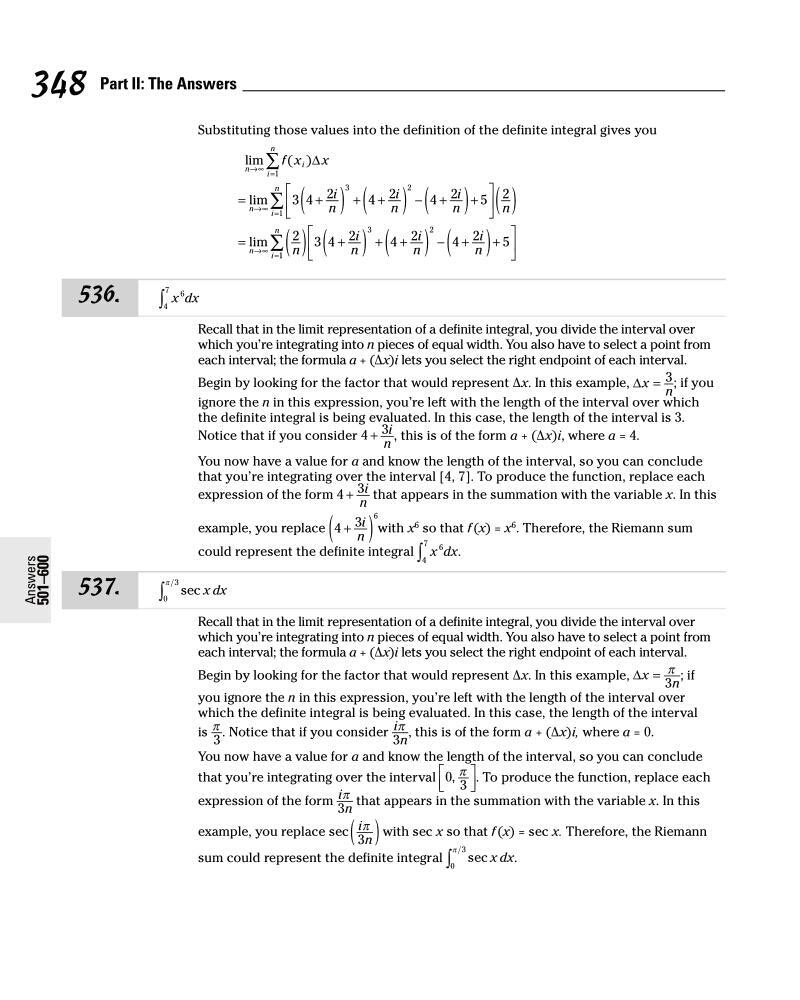
Substituting those values into the definition of the definite integral gives you
lim
( )
lim
n
i
i
n
n
f x
x
i
n
i
n
i
n
→∞ =
→∞
∑
=
+
( ) + +
( ) − +
( ) +
∆
1
3
2
3 4 2
4 2
4 2
5 ( )
=
( ) +
( ) + +
( ) − +
( ) +
=
→∞ =
∑
2
2 3 4 2
4 2
4 2
5
1
3
2
n
n
i
n
i
n
i
n
i
n
n
i
lim
1 1
n
∑
536.
x dx
6
4
7
∫
Recall that in the limit representation of a definite integral, you divide the interval over
which you’re integrating into n pieces of equal width. You also have to select a point from
each interval; the formula a + (Δ x)i lets you select the right endpoint of each interval.
Begin by looking for the factor that would represent Δ x. In this example, ∆x n
= 3 ; if you
ignore the n in this expression, you’re left with the length of the interval over which
the definite integral is being evaluated. In this case, the length of the interval is 3.
Notice that if you consider 4 3
+ i
n
, this is of the form a + (Δ x)i, where a = 4.
You now have a value for a and know the length of the interval, so you can conclude
that you’re integrating over the interval [4, 7]. To produce the function, replace each
expression of the form 4 3
+ i
n
that appears in the summation with the variable x. In this
example, you replace 4 3
6
+
( )
i
n
with x
6
so that f
(x) = x
6
. Therefore, the Riemann sum
could represent the definite integral x dx
6
4
7
∫
.
537.
sec x dx
0
3
π
∫
Recall that in the limit representation of a definite integral, you divide the interval over
which you’re integrating into n pieces of equal width. You also have to select a point from
each interval; the formula a + (Δ x)i lets you select the right endpoint of each interval.
Begin by looking for the factor that would represent Δ x. In this example, ∆x
n
= π
3
; if
you ignore the n in this expression, you’re left with the length of the interval over
which the definite integral is being evaluated. In this case, the length of the interval
is π
3
. Notice that if you consider i
n
π
3
, this is of the form a + (Δ x)i, where a = 0.
You now have a value for a and know the length of the interval, so you can conclude
that you’re integrating over the interval 0 3
, π
. To produce the function, replace each
expression of the form i
n
π
3
that appears in the summation with the variable x. In this
example, you replace sec i
n
π
3
( ) with sec x so that f
(x) = sec x. Therefore, the Riemann
sum could represent the definite integral
sec x dx
0
3
π
∫
.
348
Answers
501–600
Substituting those values into the definition of the definite integral gives you
lim
( )
lim
n
i
i
n
n
f x
x
i
n
i
n
i
n
→∞ =
→∞
∑
=
+
( ) + +
( ) − +
( ) +
∆
1
3
2
3 4 2
4 2
4 2
5 ( )
=
( ) +
( ) + +
( ) − +
( ) +
=
→∞ =
∑
2
2 3 4 2
4 2
4 2
5
1
3
2
n
n
i
n
i
n
i
n
i
n
n
i
lim
1 1
n
∑
536.
x dx
6
4
7
∫
Recall that in the limit representation of a definite integral, you divide the interval over
which you’re integrating into n pieces of equal width. You also have to select a point from
each interval; the formula a + (Δ x)i lets you select the right endpoint of each interval.
Begin by looking for the factor that would represent Δ x. In this example, ∆x n
= 3 ; if you
ignore the n in this expression, you’re left with the length of the interval over which
the definite integral is being evaluated. In this case, the length of the interval is 3.
Notice that if you consider 4 3
+ i
n
, this is of the form a + (Δ x)i, where a = 4.
You now have a value for a and know the length of the interval, so you can conclude
that you’re integrating over the interval [4, 7]. To produce the function, replace each
expression of the form 4 3
+ i
n
that appears in the summation with the variable x. In this
example, you replace 4 3
6
+
( )
i
n
with x
6
so that f
(x) = x
6
. Therefore, the Riemann sum
could represent the definite integral x dx
6
4
7
∫
.
537.
sec x dx
0
3
π
∫
Recall that in the limit representation of a definite integral, you divide the interval over
which you’re integrating into n pieces of equal width. You also have to select a point from
each interval; the formula a + (Δ x)i lets you select the right endpoint of each interval.
Begin by looking for the factor that would represent Δ x. In this example, ∆x
n
= π
3
; if
you ignore the n in this expression, you’re left with the length of the interval over
which the definite integral is being evaluated. In this case, the length of the interval
is π
3
. Notice that if you consider i
n
π
3
, this is of the form a + (Δ x)i, where a = 0.
You now have a value for a and know the length of the interval, so you can conclude
that you’re integrating over the interval 0 3
, π
. To produce the function, replace each
expression of the form i
n
π
3
that appears in the summation with the variable x. In this
example, you replace sec i
n
π
3
( ) with sec x so that f
(x) = sec x. Therefore, the Riemann
sum could represent the definite integral
sec x dx
0
3
π
∫
.