

345
Answers
501–600
Answers and Explanations
x = 9
4
, x = 11
4
, x = 13
4
, and x = 15
4
. The height of each rectangle is f
(x). To find the
Riemann sum, multiply the width of each rectangle by f
(x) and add the areas:
1
2
5
4
1
2
7
4
1
2
9
4
1
2
11
4
1
2
13
4
1
2
15
4
1
2
3
5 4
f
f
f
f
f
f
e
( ) + ( ) + ( ) + ( ) + ( ) + ( )
=
+2 2
1
2
3
2
1
2
3
2
1
2
3
2
1
2
3
2
7 4
9 4
11 4
1 3 4
+
+
+
+
+
+
+
+
e
e
e
e
+
+
≈
1
2
3
2
160 03
15 4
e
.
530.
18.79
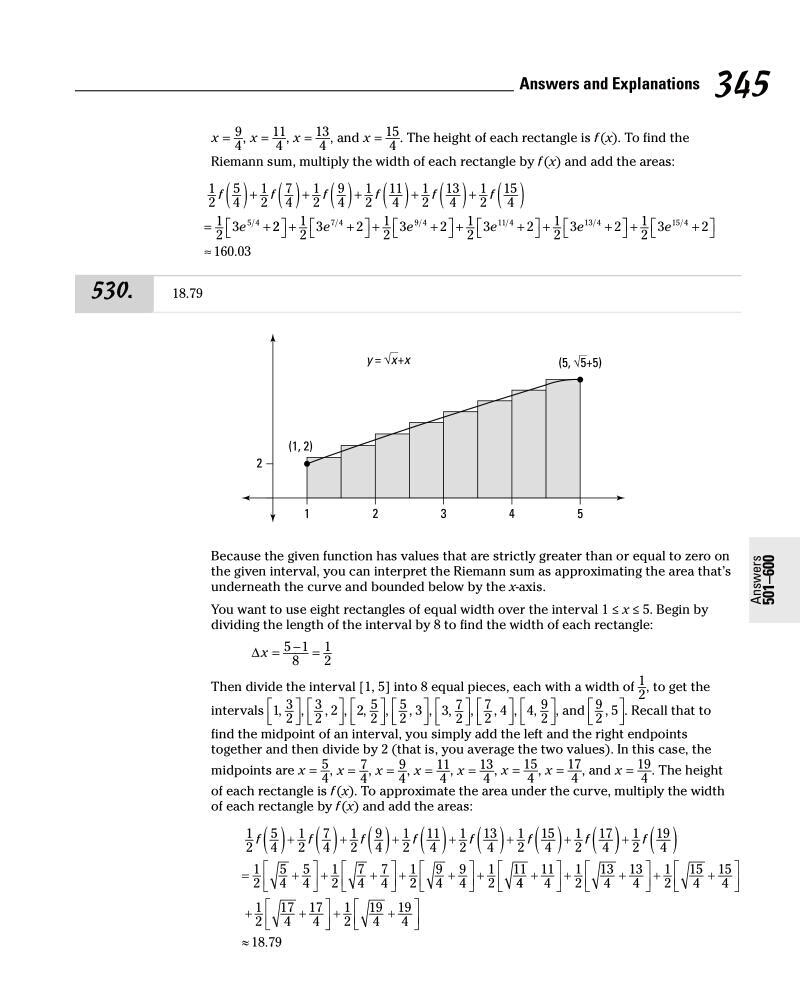
Because the given function has values that are strictly greater than or equal to zero on
the given interval, you can interpret the Riemann sum as approximating the area that’s
underneath the curve and bounded below by the x-axis.
You want to use eight rectangles of equal width over the interval 1 ≤ x ≤ 5. Begin by
dividing the length of the interval by 8 to find the width of each rectangle:
∆ x = − =
5 1
8
1
2
Then divide the interval [1, 5] into 8 equal pieces, each with a width of 1
2
, to get the
intervals 1 3
2
,
, 3
2
2
,
, 2 5
2
,
, 5
2
3
,
, 3 7
2
,
, 7
2
4
,
, 4 9
2
,
, and 9
2
5
,
. Recall that to
find the midpoint of an interval, you simply add the left and the right endpoints
together and then divide by 2 (that is, you average the two values). In this case, the
midpoints are x = 5
4
, x = 7
4
, x = 9
4
, x = 11
4
, x = 13
4
, x = 15
4
, x = 17
4
, and x = 19
4
. The height
of each rectangle is f
(x). To approximate the area under the curve, multiply the width
of each rectangle by f
(x) and add the areas:
1
2
5
4
1
2
7
4
1
2
9
4
1
2
11
4
1
2
13
4
1
2
15
4
1
2
17
4
f
f
f
f
f
f
f
( ) + ( ) + ( ) + ( ) + ( ) + ( ) + ( ) ) + ( )
=
+
+
+
+
+
+
1
2
19
4
1
2
5
4
5
4
1
2
7
4
7
4
1
2
9
4
9
4
1
2
11
f
4 4
11
4
1
2
13
4
13
4
1
2
15
4
15
4
1
2
17
4
17
4
+
+
+
+
+
+
+
+
+
≈
1
2
19
4
19
4
18 79
.
Answers
501–600
Answers and Explanations
x = 9
4
, x = 11
4
, x = 13
4
, and x = 15
4
. The height of each rectangle is f
(x). To find the
Riemann sum, multiply the width of each rectangle by f
(x) and add the areas:
1
2
5
4
1
2
7
4
1
2
9
4
1
2
11
4
1
2
13
4
1
2
15
4
1
2
3
5 4
f
f
f
f
f
f
e
( ) + ( ) + ( ) + ( ) + ( ) + ( )
=
+2 2
1
2
3
2
1
2
3
2
1
2
3
2
1
2
3
2
7 4
9 4
11 4
1 3 4
+
+
+
+
+
+
+
+
e
e
e
e
+
+
≈
1
2
3
2
160 03
15 4
e
.
530.
18.79
Because the given function has values that are strictly greater than or equal to zero on
the given interval, you can interpret the Riemann sum as approximating the area that’s
underneath the curve and bounded below by the x-axis.
You want to use eight rectangles of equal width over the interval 1 ≤ x ≤ 5. Begin by
dividing the length of the interval by 8 to find the width of each rectangle:
∆ x = − =
5 1
8
1
2
Then divide the interval [1, 5] into 8 equal pieces, each with a width of 1
2
, to get the
intervals 1 3
2
,
, 3
2
2
,
, 2 5
2
,
, 5
2
3
,
, 3 7
2
,
, 7
2
4
,
, 4 9
2
,
, and 9
2
5
,
. Recall that to
find the midpoint of an interval, you simply add the left and the right endpoints
together and then divide by 2 (that is, you average the two values). In this case, the
midpoints are x = 5
4
, x = 7
4
, x = 9
4
, x = 11
4
, x = 13
4
, x = 15
4
, x = 17
4
, and x = 19
4
. The height
of each rectangle is f
(x). To approximate the area under the curve, multiply the width
of each rectangle by f
(x) and add the areas:
1
2
5
4
1
2
7
4
1
2
9
4
1
2
11
4
1
2
13
4
1
2
15
4
1
2
17
4
f
f
f
f
f
f
f
( ) + ( ) + ( ) + ( ) + ( ) + ( ) + ( ) ) + ( )
=
+
+
+
+
+
+
1
2
19
4
1
2
5
4
5
4
1
2
7
4
7
4
1
2
9
4
9
4
1
2
11
f
4 4
11
4
1
2
13
4
13
4
1
2
15
4
15
4
1
2
17
4
17
4
+
+
+
+
+
+
+
+
+
≈
1
2
19
4
19
4
18 79
.