

Part II: The Answers
308
Answers
401–500
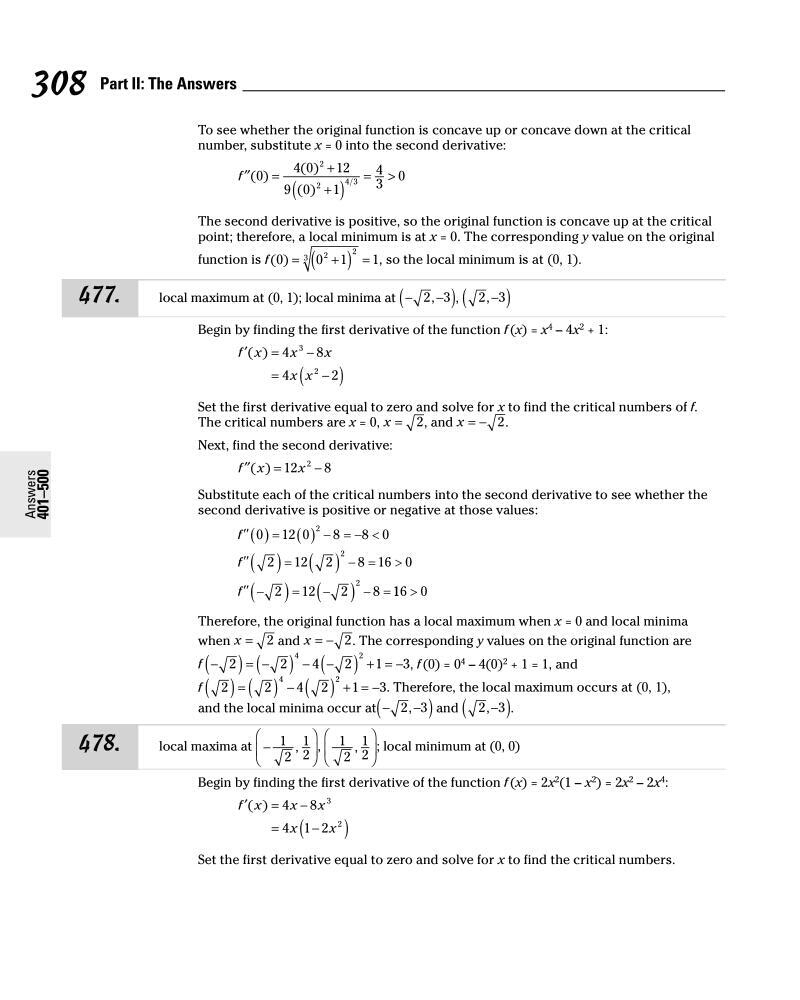
To see whether the original function is concave up or concave down at the critical
number, substitute x = 0 into the second derivative:
′′
(
)
f ( )
( )
( )
0
4 0
12
9 0
1
4
3
0
2
2
4 3
=
+
+
= >
The second derivative is positive, so the original function is concave up at the critical
point; therefore, a local minimum is at x = 0. The corresponding y value on the original
function is f ( )
0
0 1
1
2
2
3
=
+
=
( ) , so the local minimum is at (0, 1).
477.
local maximum at (0, 1); local minima at −
−
2 3
,
(
) , 2 3
, −
(
)
Begin by finding the first derivative of the function f
(x) = x
4
– 4x
2
+ 1:
′
(
)
f x
x
x
x x
( ) =
−
=
−
4
8
4
2
3
2
Set the first derivative equal to zero and solve for x to find the critical numbers of f.
The critical numbers are x = 0, x = 2, and x = − 2.
Next, find the second derivative:
′′
f x
x
( ) =
−
12
8
2
Substitute each of the critical numbers into the second derivative to see whether the
second derivative is positive or negative at those values:
′′ ( ) = ( ) − = − <
′′ ( ) = ( ) − = >
′′ −
( ) = −
( ) − =
f
f
f
0 12 0
8
8 0
2
12 2
8 16 0
2
12
2
8
2
2
2
1 16 0
>
Therefore, the original function has a local maximum when x = 0 and local minima
when x = 2 and x = − 2. The corresponding y values on the original function are
f −
= −
− −
+ = −
2
2
4
2
1
3
4
2
( ) ( ) ( )
, f
(0) = 0
4
– 4(0)
2
+ 1 = 1, and
f 2
2
4 2
1
3
4
2
( ) ( ) ( )
=
−
+ = − . Therefore, the local maximum occurs at (0, 1),
and the local minima occur at −
−
2 3
,
(
) and 2 3
, −
(
) .
478.
local maxima at − 1
2
1
2
,
, 1
2
1
2
,
; local minimum at (0, 0)
Begin by finding the first derivative of the function f
(x) = 2x
2
(1 – x
2
) = 2x
2
– 2x
4
:
′
(
)
f x
x
x
x
x
( ) =
−
=
−
4
8
4 1 2
3
2
Set the first derivative equal to zero and solve for x to find the critical numbers.
308
Answers
401–500
To see whether the original function is concave up or concave down at the critical
number, substitute x = 0 into the second derivative:
′′
(
)
f ( )
( )
( )
0
4 0
12
9 0
1
4
3
0
2
2
4 3
=
+
+
= >
The second derivative is positive, so the original function is concave up at the critical
point; therefore, a local minimum is at x = 0. The corresponding y value on the original
function is f ( )
0
0 1
1
2
2
3
=
+
=
( ) , so the local minimum is at (0, 1).
477.
local maximum at (0, 1); local minima at −
−
2 3
,
(
) , 2 3
, −
(
)
Begin by finding the first derivative of the function f
(x) = x
4
– 4x
2
+ 1:
′
(
)
f x
x
x
x x
( ) =
−
=
−
4
8
4
2
3
2
Set the first derivative equal to zero and solve for x to find the critical numbers of f.
The critical numbers are x = 0, x = 2, and x = − 2.
Next, find the second derivative:
′′
f x
x
( ) =
−
12
8
2
Substitute each of the critical numbers into the second derivative to see whether the
second derivative is positive or negative at those values:
′′ ( ) = ( ) − = − <
′′ ( ) = ( ) − = >
′′ −
( ) = −
( ) − =
f
f
f
0 12 0
8
8 0
2
12 2
8 16 0
2
12
2
8
2
2
2
1 16 0
>
Therefore, the original function has a local maximum when x = 0 and local minima
when x = 2 and x = − 2. The corresponding y values on the original function are
f −
= −
− −
+ = −
2
2
4
2
1
3
4
2
( ) ( ) ( )
, f
(0) = 0
4
– 4(0)
2
+ 1 = 1, and
f 2
2
4 2
1
3
4
2
( ) ( ) ( )
=
−
+ = − . Therefore, the local maximum occurs at (0, 1),
and the local minima occur at −
−
2 3
,
(
) and 2 3
, −
(
) .
478.
local maxima at − 1
2
1
2
,
, 1
2
1
2
,
; local minimum at (0, 0)
Begin by finding the first derivative of the function f
(x) = 2x
2
(1 – x
2
) = 2x
2
– 2x
4
:
′
(
)
f x
x
x
x
x
( ) =
−
=
−
4
8
4 1 2
3
2
Set the first derivative equal to zero and solve for x to find the critical numbers.