

Part II: The Answers
306
Answers
401–500
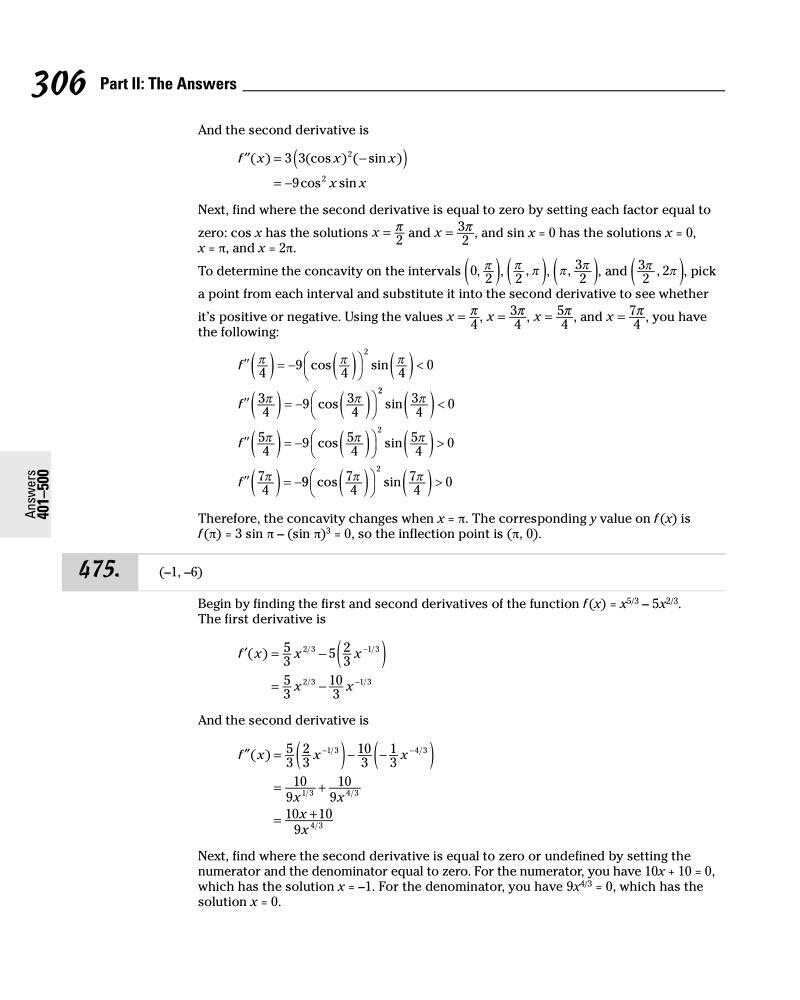
And the second derivative is
′′
(
)
f x
x
x
x
x
( )
(cos ) ( sin )
cos sin
=
−
= −
3 3
9
2
2
Next, find where the second derivative is equal to zero by setting each factor equal to
zero: cos x has the solutions x = π
2
and x = 3
2
π , and sin x = 0 has the solutions x = 0,
x = π, and x = 2π.
To determine the concavity on the intervals 0 2
, π
( ) , π π
2
,
( ) , π π
, 3
2
( ) , and 3
2
2
π π
,
( ) , pick
a point from each interval and substitute it into the second derivative to see whether
it’s positive or negative. Using the values x = π
4
, x = 3
4
π , x = 5
4
π , and x = 7
4
π , you have
the following:
′′ ( ) = − ( )
( ) <
′′ ( ) = − ( )
f
f
π
π
π
π
π
4
9
4
4
0
3
4
9
3
4
2
cos
s in
cos
2 2
2
3
4
0
5
4
9
5
4
5
4
0
7
4
sin
cos
s in
π
π
π
π
π
( ) <
′′ ( ) = − ( )
( ) >
′′ ( ) = −
f
f
9 9
7
4
7
4
0
2
cos
s in
π
π
( )
( ) >
Therefore, the concavity changes when x = π. The corresponding y value on f
(x) is
f
(π) = 3 sin π – (sin π)
3
= 0, so the inflection point is (π, 0).
475.
(–1, –6)
Begin by finding the first and second derivatives of the function f
(x) = x
5/3
– 5x
2/3
.
The first derivative is
′
( )
f x
x
x
x
x
( ) =
−
=
−
−
−
5
3
5 2
3
5
3
10
3
2 3
1 3
2 3
1 3
And the second derivative is
′′
( ) (
)
f x
x
x
x
x
x
x
( ) =
−
−
=
+
=
+
−
−
5
3
2
3
10
3
1
3
10
9
10
9
10 10
9
1 3
4 3
1 3
4 3
4 3
Next, find where the second derivative is equal to zero or undefined by setting the
numerator and the denominator equal to zero. For the numerator, you have 10x + 10 = 0,
which has the solution x = –1. For the denominator, you have 9x
4/3
= 0, which has the
solution x = 0.
306
Answers
401–500
And the second derivative is
′′
(
)
f x
x
x
x
x
( )
(cos ) ( sin )
cos sin
=
−
= −
3 3
9
2
2
Next, find where the second derivative is equal to zero by setting each factor equal to
zero: cos x has the solutions x = π
2
and x = 3
2
π , and sin x = 0 has the solutions x = 0,
x = π, and x = 2π.
To determine the concavity on the intervals 0 2
, π
( ) , π π
2
,
( ) , π π
, 3
2
( ) , and 3
2
2
π π
,
( ) , pick
a point from each interval and substitute it into the second derivative to see whether
it’s positive or negative. Using the values x = π
4
, x = 3
4
π , x = 5
4
π , and x = 7
4
π , you have
the following:
′′ ( ) = − ( )
( ) <
′′ ( ) = − ( )
f
f
π
π
π
π
π
4
9
4
4
0
3
4
9
3
4
2
cos
s in
cos
2 2
2
3
4
0
5
4
9
5
4
5
4
0
7
4
sin
cos
s in
π
π
π
π
π
( ) <
′′ ( ) = − ( )
( ) >
′′ ( ) = −
f
f
9 9
7
4
7
4
0
2
cos
s in
π
π
( )
( ) >
Therefore, the concavity changes when x = π. The corresponding y value on f
(x) is
f
(π) = 3 sin π – (sin π)
3
= 0, so the inflection point is (π, 0).
475.
(–1, –6)
Begin by finding the first and second derivatives of the function f
(x) = x
5/3
– 5x
2/3
.
The first derivative is
′
( )
f x
x
x
x
x
( ) =
−
=
−
−
−
5
3
5 2
3
5
3
10
3
2 3
1 3
2 3
1 3
And the second derivative is
′′
( ) (
)
f x
x
x
x
x
x
x
( ) =
−
−
=
+
=
+
−
−
5
3
2
3
10
3
1
3
10
9
10
9
10 10
9
1 3
4 3
1 3
4 3
4 3
Next, find where the second derivative is equal to zero or undefined by setting the
numerator and the denominator equal to zero. For the numerator, you have 10x + 10 = 0,
which has the solution x = –1. For the denominator, you have 9x
4/3
= 0, which has the
solution x = 0.