

Answers and Explanations 289
Answers
401–500
Taking the derivative of both sides of the equation with respect to time gives you
2
2
2 2
2
2 2
2
2
y
dy
dt
x dx
dt
dx
dt
dy
dt
x
y
dx
dt
dy
dt
x
y
dx
dt
=
+
=
+
= +
After 2 minutes, the jet has traveled x =
=
2 700
60
70
3
( ) kilometers, so the distance from
the radar station is
y =
+
+
70
3
2 2 70
3
4
2
( ) ( )
Enter the value of y in the
dy
dt
equation and solve:
dy
dt
=
+
+
+
≈
70
3
2
70
3
2 2 70
3
4
700 698 86
2
( ) ( )
(
)
. km/h
After 2 minutes, the jet is moving away from the radar station at a rate of about 698.86
kilometers per hour.
444.
348
5
π km/min
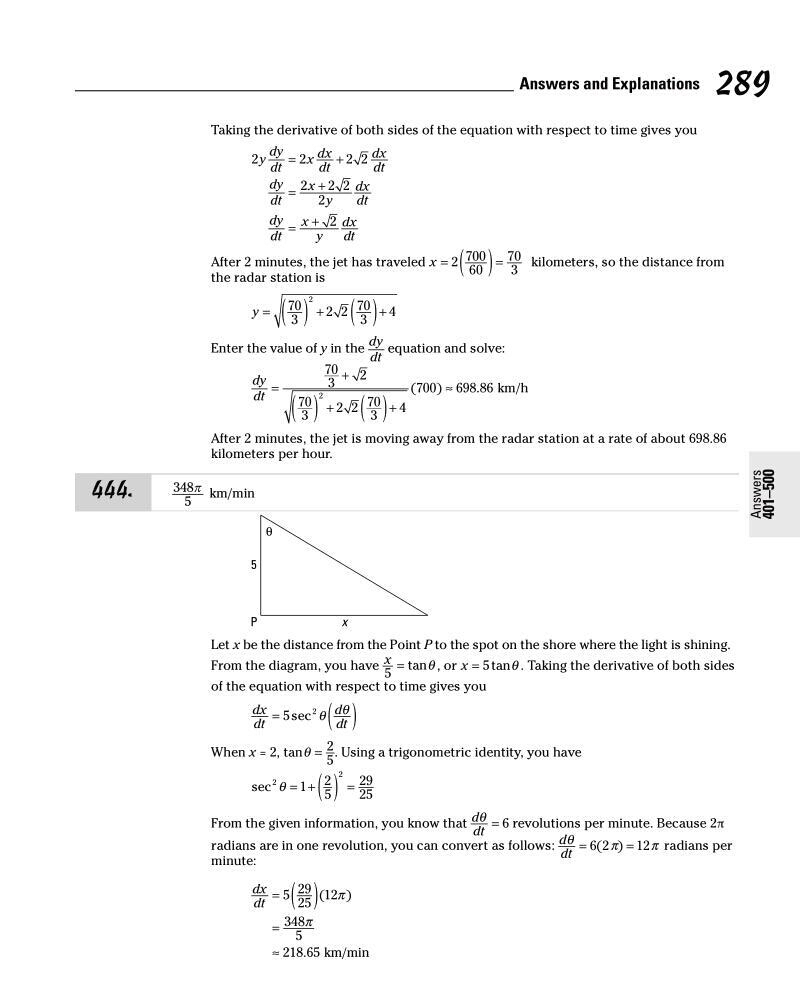
Let x be the distance from the Point P to the spot on the shore where the light is shining.
From the diagram, you have x
5
= tanθ , or x = 5 tanθ . Taking the derivative of both sides
of the equation with respect to time gives you
dx
dt
d
dt
= 5
2
sec θ θ
( )
When x = 2, tanθ = 2
5
. Using a trigonometric identity, you have
sec
2
2
1 2
5
29
25
θ = +
=
( )
From the given information, you know that d
dt
θ = 6 revolutions per minute. Because 2π
radians are in one revolution, you can convert as follows:
( )
d
dt
θ
π
π
=
=
6 2
12 radians per
minute:
dx
dt
=
=
≈
5 29
25
12
348
5
218 65
( ) ( )
.
π
π
km/min
Answers
401–500
Taking the derivative of both sides of the equation with respect to time gives you
2
2
2 2
2
2 2
2
2
y
dy
dt
x dx
dt
dx
dt
dy
dt
x
y
dx
dt
dy
dt
x
y
dx
dt
=
+
=
+
= +
After 2 minutes, the jet has traveled x =
=
2 700
60
70
3
( ) kilometers, so the distance from
the radar station is
y =
+
+
70
3
2 2 70
3
4
2
( ) ( )
Enter the value of y in the
dy
dt
equation and solve:
dy
dt
=
+
+
+
≈
70
3
2
70
3
2 2 70
3
4
700 698 86
2
( ) ( )
(
)
. km/h
After 2 minutes, the jet is moving away from the radar station at a rate of about 698.86
kilometers per hour.
444.
348
5
π km/min
Let x be the distance from the Point P to the spot on the shore where the light is shining.
From the diagram, you have x
5
= tanθ , or x = 5 tanθ . Taking the derivative of both sides
of the equation with respect to time gives you
dx
dt
d
dt
= 5
2
sec θ θ
( )
When x = 2, tanθ = 2
5
. Using a trigonometric identity, you have
sec
2
2
1 2
5
29
25
θ = +
=
( )
From the given information, you know that d
dt
θ = 6 revolutions per minute. Because 2π
radians are in one revolution, you can convert as follows:
( )
d
dt
θ
π
π
=
=
6 2
12 radians per
minute:
dx
dt
=
=
≈
5 29
25
12
348
5
218 65
( ) ( )
.
π
π
km/min