

Answers and Explanations 263
Answers
301–400
393.
2x
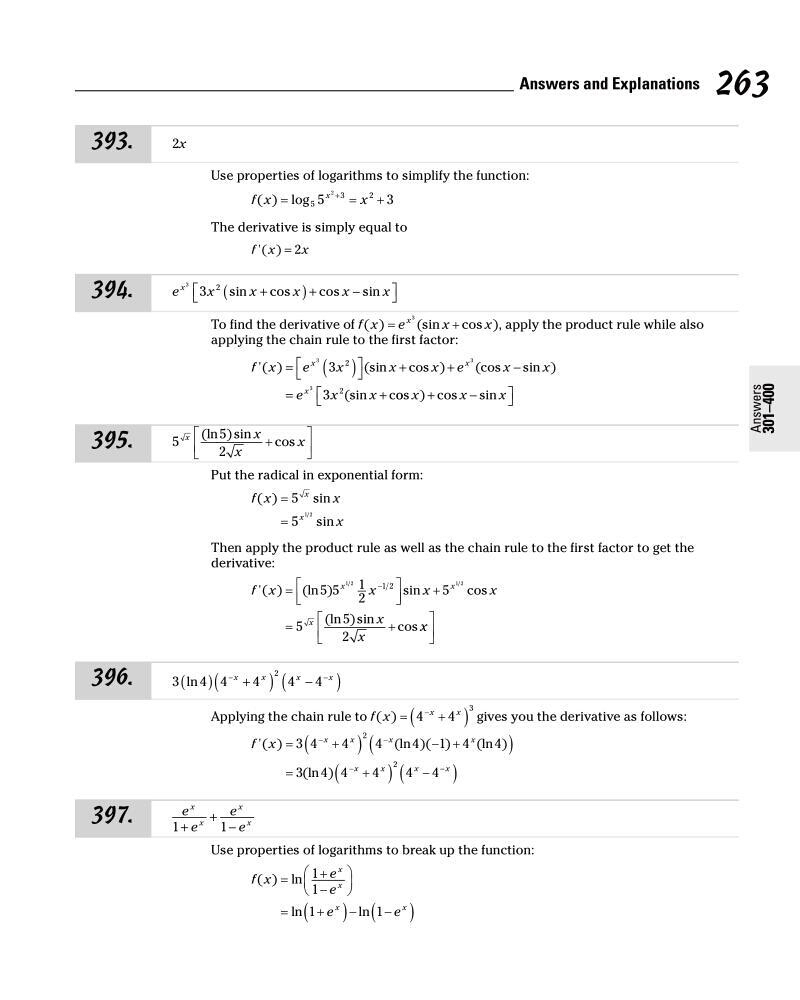
Use properties of logarithms to simplify the function:
f x
x
x
( ) log
=
=
+
+
5
3
2
5
3
2
The derivative is simply equal to
= x
2
( )
x
f '
394.
e
x
x
x
x
x
x
3
3
2 sin
cos
cos
sin
+
(
)+
−
To find the derivative of f x
e
x
x
x
( )
(sin
cos )
=
+
3
, apply the product rule while also
applying the chain rule to the first factor:
=
( )
+
+
−
=
+
e
x
x
x e
x
x
e
x
x
x
x
x
(sin
cos )
(cos
sin )
(sin
c
3
3
3
3
3
2
2
o os ) cos
sin
x
x
x
+
−
( )
x
f '
395.
5
5
2
x
x
x
x
(ln )sin
cos
+
Put the radical in exponential form:
f x
x
x
x
x
( )
sin
sin
=
=
5
5
1 2
Then apply the product rule as well as the chain rule to the first factor to get the
derivative:
=
+
=
+
−
x
x
x
x
x
x
x
x
(ln )
sin
c os
(ln )sin
cos
5 5 1
2
5
5
5
2
1 2
1 2
1 2
x x
( )
x
f '
396.
3
4 4
4
4
4
2
ln
( )
+
(
) −
(
)
−
− x
x
x
x
Applying the chain rule to f x
x
x
( ) =
+
(
)
−
4
4
3 gives you the derivative as follows:
=
+
(
)
− +
)
(
=
+
(
) −
−
−
−
x
x
x
x
x
x
x
(ln )( )
(ln )
(ln )
3 4
4
4
4
1 4
4
3 4 4
4
4 4
2
2
− −
(
)
x
( )
x
f '
397.
e
e
e
e
x
x
x
x
1
1
+
+ −
Use properties of logarithms to break up the function:
f x
e
e
e
e
x
x
x
x
( ) ln
ln
ln
=
+
−
=
+
(
) − −
(
)
1
1
1
1
Answers
301–400
393.
2x
Use properties of logarithms to simplify the function:
f x
x
x
( ) log
=
=
+
+
5
3
2
5
3
2
The derivative is simply equal to
= x
2
( )
x
f '
394.
e
x
x
x
x
x
x
3
3
2 sin
cos
cos
sin
+
(
)+
−
To find the derivative of f x
e
x
x
x
( )
(sin
cos )
=
+
3
, apply the product rule while also
applying the chain rule to the first factor:
=
( )
+
+
−
=
+
e
x
x
x e
x
x
e
x
x
x
x
x
(sin
cos )
(cos
sin )
(sin
c
3
3
3
3
3
2
2
o os ) cos
sin
x
x
x
+
−
( )
x
f '
395.
5
5
2
x
x
x
x
(ln )sin
cos
+
Put the radical in exponential form:
f x
x
x
x
x
( )
sin
sin
=
=
5
5
1 2
Then apply the product rule as well as the chain rule to the first factor to get the
derivative:
=
+
=
+
−
x
x
x
x
x
x
x
x
(ln )
sin
c os
(ln )sin
cos
5 5 1
2
5
5
5
2
1 2
1 2
1 2
x x
( )
x
f '
396.
3
4 4
4
4
4
2
ln
( )
+
(
) −
(
)
−
− x
x
x
x
Applying the chain rule to f x
x
x
( ) =
+
(
)
−
4
4
3 gives you the derivative as follows:
=
+
(
)
− +
)
(
=
+
(
) −
−
−
−
x
x
x
x
x
x
x
(ln )( )
(ln )
(ln )
3 4
4
4
4
1 4
4
3 4 4
4
4 4
2
2
− −
(
)
x
( )
x
f '
397.
e
e
e
e
x
x
x
x
1
1
+
+ −
Use properties of logarithms to break up the function:
f x
e
e
e
e
x
x
x
x
( ) ln
ln
ln
=
+
−
=
+
(
) − −
(
)
1
1
1
1