

Answers and Explanations 261
Answers
301–400
And replacing y with (ln )
cos
x
x gives you the answer:
dy
dx
x
x
x
x
x x
x
= ( )
−
[
]+
ln
( sin ) ln(ln ) cos
ln
cos
388.
−
−
+
(
)
8
4
4
2
2
3 2
x
x
x
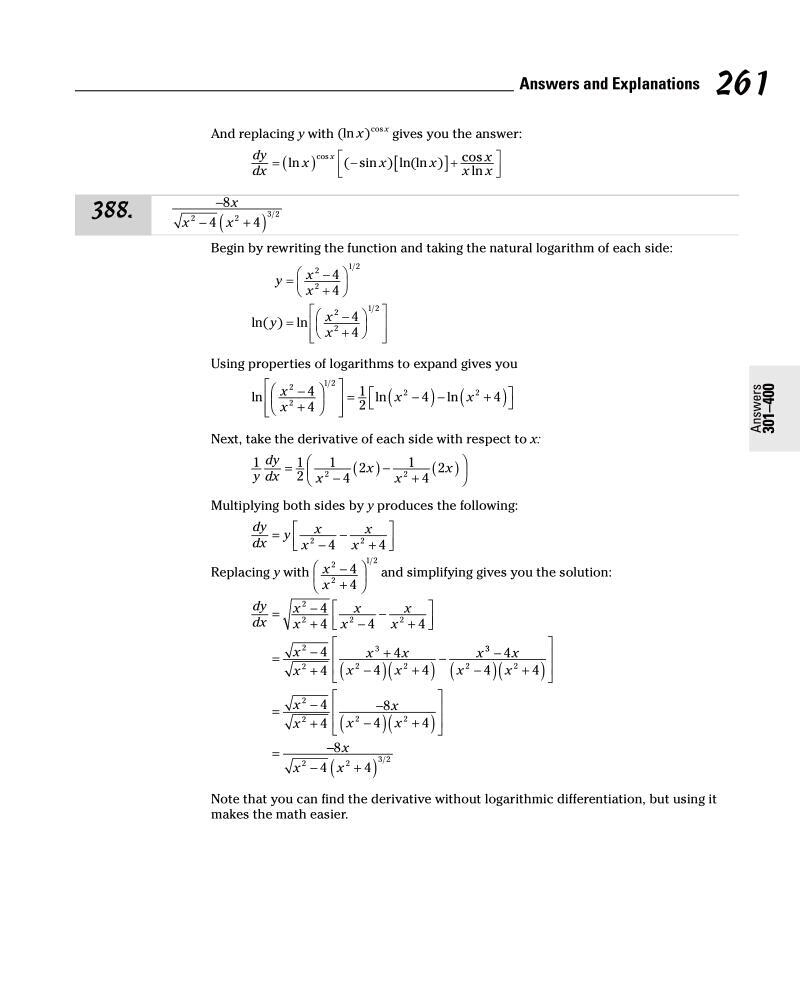
Begin by rewriting the function and taking the natural logarithm of each side:
y
x
x
y
x
x
=
−
+
=
−
+
2
2
1 2
2
2
1 2
4
4
4
4
ln( ) ln
Using properties of logarithms to expand gives you
ln
ln
ln
x
x
x
x
2
2
1 2
2
2
4
4
1
2
4
4
−
+
=
−
(
) −
+
(
)
Next, take the derivative of each side with respect to x:
1
1
2
1
4
2
1
4
2
2
2
y
dy
dx
x
x
x
x
=
−
( )− +
( )
Multiplying both sides by y produces the following:
dy
dx
y
x
x
x
x
=
−
−
+
2
2
4
4
Replacing y with x
x
2
2
1 2
4
4
−
+
and simplifying gives you the solution:
dy
dx
x
x
x
x
x
x
x
x
x
x
x
x
x
=
−
+
−
−
+
=
−
+
+
−
(
) +
(
)
−
2
2
2
2
2
2
3
2
2
4
4
4
4
4
4
4
4
4
3 3
2
2
2
2
2
2
4
4
4
4
4
8
4
4
−
−
(
) +
(
)
=
−
+
−
−
(
) +
(
)
=
x
x
x
x
x
x
x
x
− −
−
+
(
)
8
4
4
2
2
3 2
x
x
x
Note that you can find the derivative without logarithmic differentiation, but using it
makes the math easier.
Answers
301–400
And replacing y with (ln )
cos
x
x gives you the answer:
dy
dx
x
x
x
x
x x
x
= ( )
−
[
]+
ln
( sin ) ln(ln ) cos
ln
cos
388.
−
−
+
(
)
8
4
4
2
2
3 2
x
x
x
Begin by rewriting the function and taking the natural logarithm of each side:
y
x
x
y
x
x
=
−
+
=
−
+
2
2
1 2
2
2
1 2
4
4
4
4
ln( ) ln
Using properties of logarithms to expand gives you
ln
ln
ln
x
x
x
x
2
2
1 2
2
2
4
4
1
2
4
4
−
+
=
−
(
) −
+
(
)
Next, take the derivative of each side with respect to x:
1
1
2
1
4
2
1
4
2
2
2
y
dy
dx
x
x
x
x
=
−
( )− +
( )
Multiplying both sides by y produces the following:
dy
dx
y
x
x
x
x
=
−
−
+
2
2
4
4
Replacing y with x
x
2
2
1 2
4
4
−
+
and simplifying gives you the solution:
dy
dx
x
x
x
x
x
x
x
x
x
x
x
x
x
=
−
+
−
−
+
=
−
+
+
−
(
) +
(
)
−
2
2
2
2
2
2
3
2
2
4
4
4
4
4
4
4
4
4
3 3
2
2
2
2
2
2
4
4
4
4
4
8
4
4
−
−
(
) +
(
)
=
−
+
−
−
(
) +
(
)
=
x
x
x
x
x
x
x
x
− −
−
+
(
)
8
4
4
2
2
3 2
x
x
x
Note that you can find the derivative without logarithmic differentiation, but using it
makes the math easier.