

Answers and Explanations 205
222.
–∞
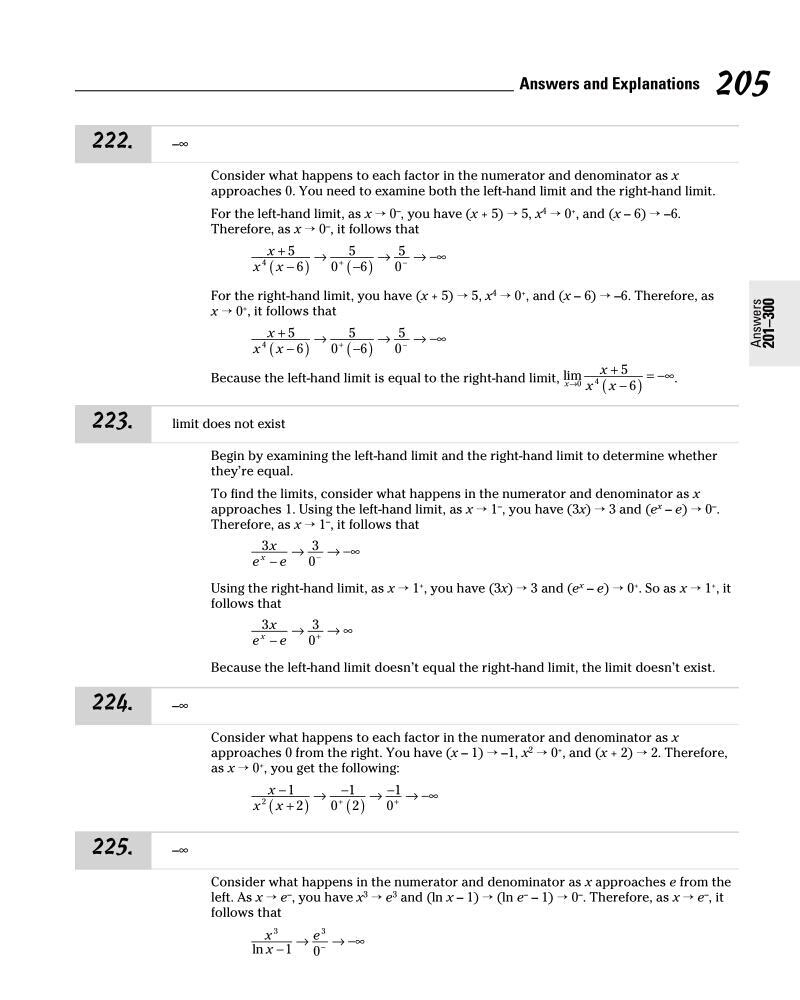
Consider what happens to each factor in the numerator and denominator as x
approaches 0. You need to examine both the left-hand limit and the right-hand limit.
For the left-hand limit, as x → 0
–
, you have (x + 5) → 5, x
4 → 0
+
, and (x – 6) → –6.
Therefore, as x → 0
–
, it follows that
x
x x
+
−
(
)
→
−
( )
→
→−∞
+
−
5
6
5
0
6
5
0
4
For the right-hand limit, you have (x + 5) → 5, x
4 → 0
+
, and (x – 6) → –6. Therefore, as
x → 0
+
, it follows that
x
x x
+
−
(
)
→
−
( )
→
→−∞
+
−
5
6
5
0
6
5
0
4
Because the left-hand limit is equal to the right-hand limit, lim
x
x
x x
→
+
−
(
)
= −∞
0
4
5
6
.
223.
limit does not exist
Begin by examining the left-hand limit and the right-hand limit to determine whether
they’re equal.
To find the limits, consider what happens in the numerator and denominator as x
approaches 1. Using the left-hand limit, as x → 1
–
, you have (3x) → 3 and (e
x
– e) → 0
–
.
Therefore, as x → 1
–
, it follows that
3
3
0
x
e
e
x
−
→
→−∞
−
Using the right-hand limit, as x → 1
+
, you have (3x) → 3 and (e
x
– e) → 0
+
. So as x → 1
+
, it
follows that
3
3
0
x
e
e
x
−
→
→∞
+
Because the left-hand limit doesn’t equal the right-hand limit, the limit doesn’t exist.
224.
–∞
Consider what happens to each factor in the numerator and denominator as x
approaches 0 from the right. You have (x – 1) → –1, x
2 → 0
+
, and (x + 2) → 2. Therefore,
as x → 0
+
, you get the following:
x
x x
−
+
(
)
→ −
( )
→ − → −∞
+
+
1
2
1
0 2
1
0
2
225.
–∞
Consider what happens in the numerator and denominator as x approaches e from the
left. As x → e
–
, you have x
3 → e
3
and (ln x – 1) → (ln e
–
– 1) → 0
–
. Therefore, as x → e
–
, it
follows that
x
x
e
3
3
1
0
ln −
→
→−∞
−
Answers
201–300
222.
–∞
Consider what happens to each factor in the numerator and denominator as x
approaches 0. You need to examine both the left-hand limit and the right-hand limit.
For the left-hand limit, as x → 0
–
, you have (x + 5) → 5, x
4 → 0
+
, and (x – 6) → –6.
Therefore, as x → 0
–
, it follows that
x
x x
+
−
(
)
→
−
( )
→
→−∞
+
−
5
6
5
0
6
5
0
4
For the right-hand limit, you have (x + 5) → 5, x
4 → 0
+
, and (x – 6) → –6. Therefore, as
x → 0
+
, it follows that
x
x x
+
−
(
)
→
−
( )
→
→−∞
+
−
5
6
5
0
6
5
0
4
Because the left-hand limit is equal to the right-hand limit, lim
x
x
x x
→
+
−
(
)
= −∞
0
4
5
6
.
223.
limit does not exist
Begin by examining the left-hand limit and the right-hand limit to determine whether
they’re equal.
To find the limits, consider what happens in the numerator and denominator as x
approaches 1. Using the left-hand limit, as x → 1
–
, you have (3x) → 3 and (e
x
– e) → 0
–
.
Therefore, as x → 1
–
, it follows that
3
3
0
x
e
e
x
−
→
→−∞
−
Using the right-hand limit, as x → 1
+
, you have (3x) → 3 and (e
x
– e) → 0
+
. So as x → 1
+
, it
follows that
3
3
0
x
e
e
x
−
→
→∞
+
Because the left-hand limit doesn’t equal the right-hand limit, the limit doesn’t exist.
224.
–∞
Consider what happens to each factor in the numerator and denominator as x
approaches 0 from the right. You have (x – 1) → –1, x
2 → 0
+
, and (x + 2) → 2. Therefore,
as x → 0
+
, you get the following:
x
x x
−
+
(
)
→ −
( )
→ − → −∞
+
+
1
2
1
0 2
1
0
2
225.
–∞
Consider what happens in the numerator and denominator as x approaches e from the
left. As x → e
–
, you have x
3 → e
3
and (ln x – 1) → (ln e
–
– 1) → 0
–
. Therefore, as x → e
–
, it
follows that
x
x
e
3
3
1
0
ln −
→
→−∞
−
Answers
201–300