

Part II: The Answers
196
Answers
101–200
192.
− 1
16
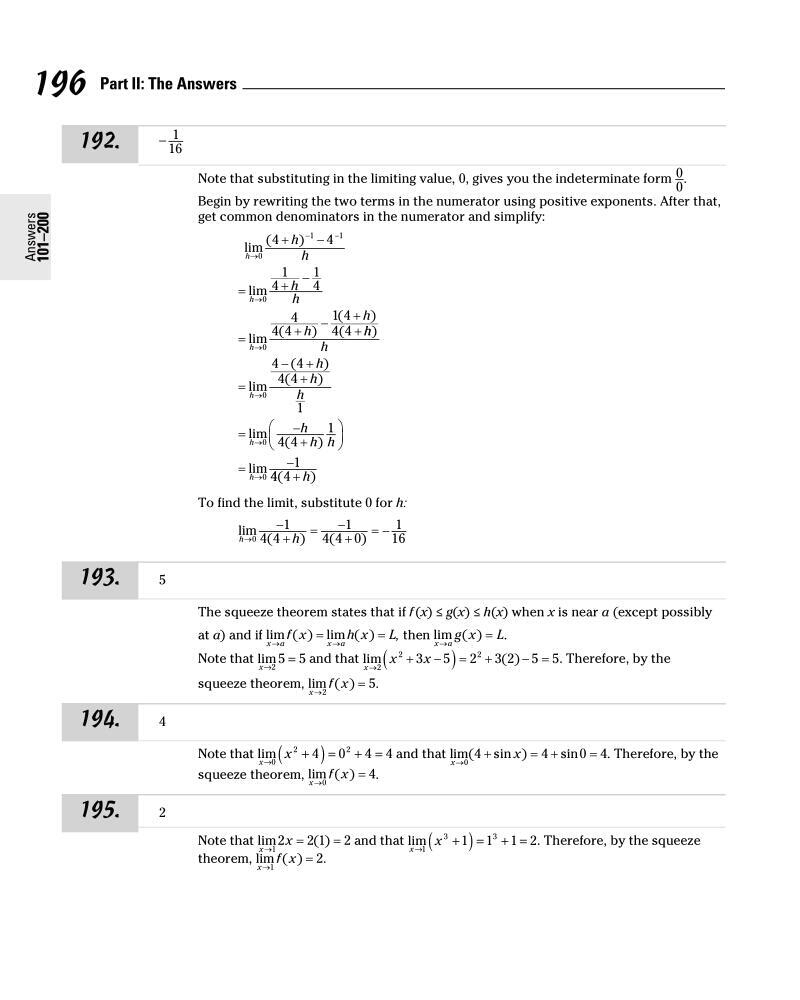
Note that substituting in the limiting value, 0, gives you the indeterminate form 0
0
.
Begin by rewriting the two terms in the numerator using positive exponents. After that,
get common denominators in the numerator and simplify:
lim
(
)
lim
lim
(
)
(
)
(
h
h
h
h
h
h
h
h
h
→
−
−
→
→
+
−
=
+
−
=
+
−
+
+
0
1
1
0
0
4
4
1
4
1
4
4
4 4
1 4
4 4 h h
h
h
h
h
h
h h
h
h
h
)
lim
(
)
(
)
lim (
)
lim
=
− +
+
=
−
+
=
−
→
→
→
0
0
0
4 4
4 4
1
4 4
1
1
4 4 4
(
)
+ h
To find the limit, substitute 0 for h:
lim (
)
(
)
h
h
→
−
+
=
−
+
= −
0
1
4 4
1
4 4 0
1
16
193.
5
The squeeze theorem states that if f
(x) ≤ g(x) ≤ h(x) when x is near a (except possibly
at a) and if lim ( ) lim ( )
x a
x a
f x
h x
L
→
→
=
= , then lim ( )
x a
g x
L
→
= .
Note that lim x→
=
2
5 5 and that lim
( )
x
x
x
→
+
−
(
) = + − =
2
2
2
3
5 2 3 2 5 5. Therefore, by the
squeeze theorem, lim ( )
x
f x
→
=
2
5.
194.
4
Note that lim
x
x
→
+
(
) = + =
0
2
2
4
0 4 4 and that lim(
sin )
sin
x
x
→
+
= +
=
0
4
4
0 4. Therefore, by the
squeeze theorem, lim ( )
x
f x
→
=
0
4.
195.
2
Note that lim
( )
x
x
→
=
=
1
2
2 1 2 and that lim
x
x
→
+
(
) = + =
1
3
3
1 1 1 2. Therefore, by the squeeze
theorem, lim ( )
x
f x
→
=
1
2.
196
Answers
101–200
192.
− 1
16
Note that substituting in the limiting value, 0, gives you the indeterminate form 0
0
.
Begin by rewriting the two terms in the numerator using positive exponents. After that,
get common denominators in the numerator and simplify:
lim
(
)
lim
lim
(
)
(
)
(
h
h
h
h
h
h
h
h
h
→
−
−
→
→
+
−
=
+
−
=
+
−
+
+
0
1
1
0
0
4
4
1
4
1
4
4
4 4
1 4
4 4 h h
h
h
h
h
h
h h
h
h
h
)
lim
(
)
(
)
lim (
)
lim
=
− +
+
=
−
+
=
−
→
→
→
0
0
0
4 4
4 4
1
4 4
1
1
4 4 4
(
)
+ h
To find the limit, substitute 0 for h:
lim (
)
(
)
h
h
→
−
+
=
−
+
= −
0
1
4 4
1
4 4 0
1
16
193.
5
The squeeze theorem states that if f
(x) ≤ g(x) ≤ h(x) when x is near a (except possibly
at a) and if lim ( ) lim ( )
x a
x a
f x
h x
L
→
→
=
= , then lim ( )
x a
g x
L
→
= .
Note that lim x→
=
2
5 5 and that lim
( )
x
x
x
→
+
−
(
) = + − =
2
2
2
3
5 2 3 2 5 5. Therefore, by the
squeeze theorem, lim ( )
x
f x
→
=
2
5.
194.
4
Note that lim
x
x
→
+
(
) = + =
0
2
2
4
0 4 4 and that lim(
sin )
sin
x
x
→
+
= +
=
0
4
4
0 4. Therefore, by the
squeeze theorem, lim ( )
x
f x
→
=
0
4.
195.
2
Note that lim
( )
x
x
→
=
=
1
2
2 1 2 and that lim
x
x
→
+
(
) = + =
1
3
3
1 1 1 2. Therefore, by the squeeze
theorem, lim ( )
x
f x
→
=
1
2.