

Answers and Explanations 167
Answers
101–200
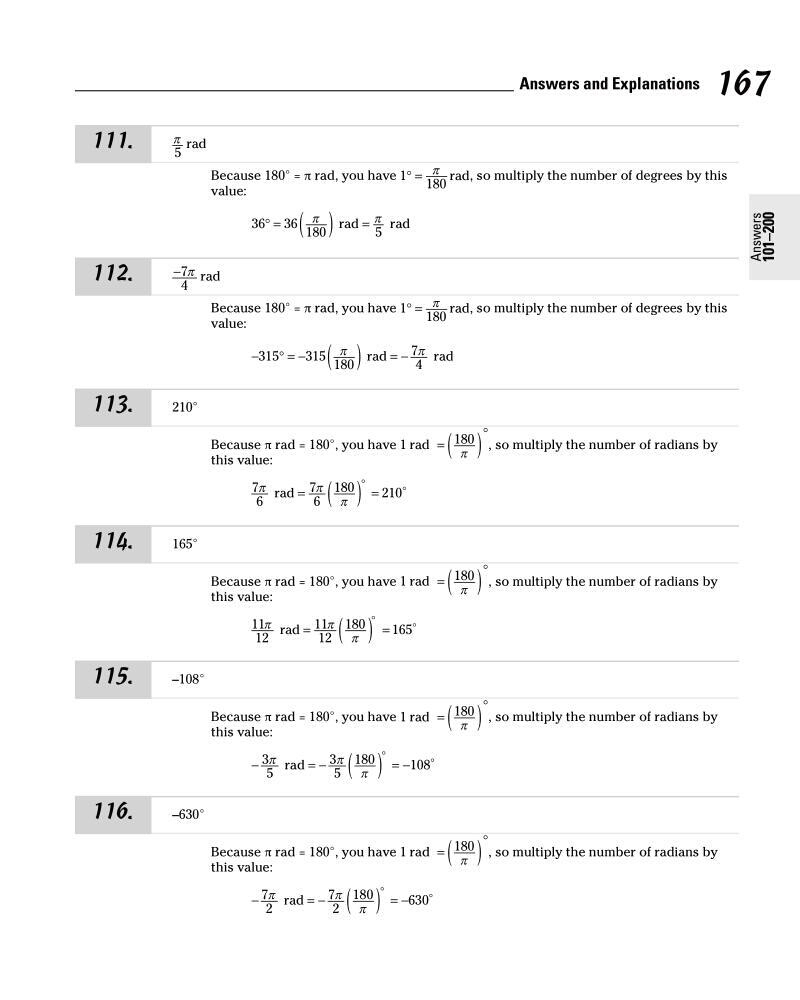
111.
π
5
rad
Because 180° = π rad, you have 1 180
° = π rad, so multiply the number of degrees by this
value:
36 36 180
5
° = ( ) =
π
π
rad
rad
112.
−7
4
π rad
Because 180° = π rad, you have 1 180
° = π rad, so multiply the number of degrees by this
value:
−
°= −
( ) = −
315
315 180
7
4
π
π
rad
rad
113.
210°
Because π rad = 180°, you have 1
180
rad = ( )
π
°
, so multiply the number of radians by
this value:
7
6
7
6
180
210 °
π
π
π
rad =
( )
° =
114.
165°
Because π rad = 180°, you have 1
180
rad = ( )
π
°
, so multiply the number of radians by
this value:
11
12
11
12
180
165 °
π
π
π
rad =
( )
° =
115.
–108°
Because π rad = 180°, you have 1
180
rad = ( )
π
°
, so multiply the number of radians by
this value:
−
=−
( )
° = −
3
5
3
5
180
108 °
π
π
π
rad
116.
–630°
Because π rad = 180°, you have 1
180
rad = ( )
π
°
, so multiply the number of radians by
this value:
−
=−
( )
° = −
7
2
7
2
180
630 °
π
π
π
rad
Answers
101–200
111.
π
5
rad
Because 180° = π rad, you have 1 180
° = π rad, so multiply the number of degrees by this
value:
36 36 180
5
° = ( ) =
π
π
rad
rad
112.
−7
4
π rad
Because 180° = π rad, you have 1 180
° = π rad, so multiply the number of degrees by this
value:
−
°= −
( ) = −
315
315 180
7
4
π
π
rad
rad
113.
210°
Because π rad = 180°, you have 1
180
rad = ( )
π
°
, so multiply the number of radians by
this value:
7
6
7
6
180
210 °
π
π
π
rad =
( )
° =
114.
165°
Because π rad = 180°, you have 1
180
rad = ( )
π
°
, so multiply the number of radians by
this value:
11
12
11
12
180
165 °
π
π
π
rad =
( )
° =
115.
–108°
Because π rad = 180°, you have 1
180
rad = ( )
π
°
, so multiply the number of radians by
this value:
−
=−
( )
° = −
3
5
3
5
180
108 °
π
π
π
rad
116.
–630°
Because π rad = 180°, you have 1
180
rad = ( )
π
°
, so multiply the number of radians by
this value:
−
=−
( )
° = −
7
2
7
2
180
630 °
π
π
π
rad