

Part II: The Answers
140
Answers
1–100
39.
x = − ±
4
33
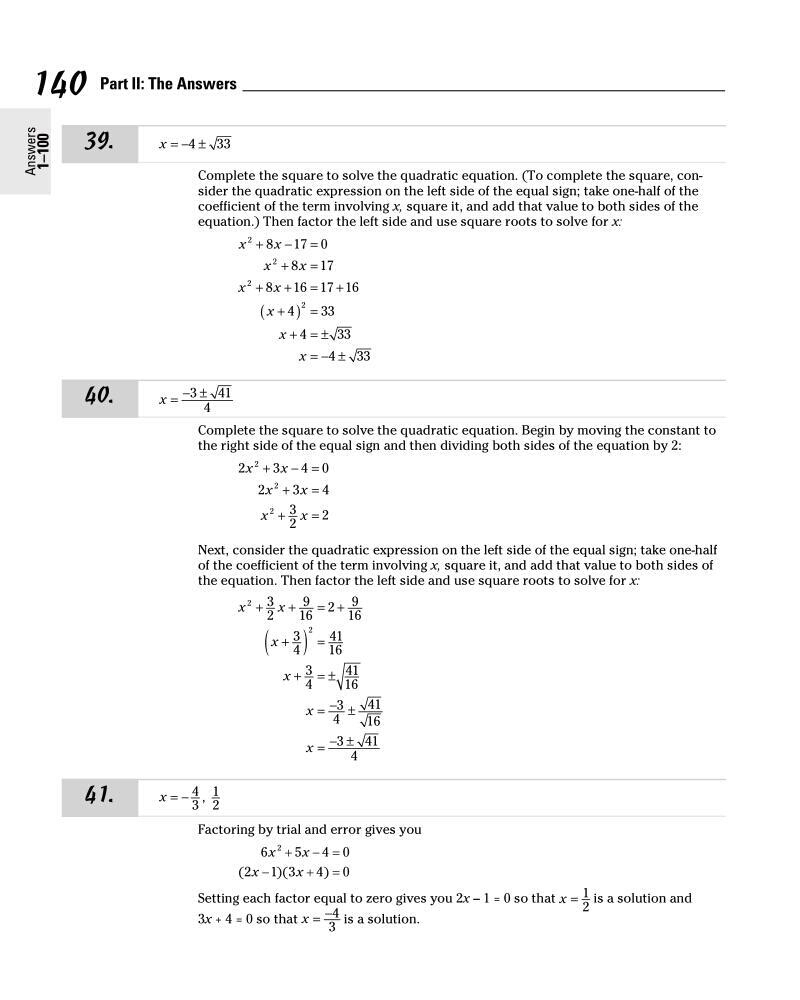
Complete the square to solve the quadratic equation. (To complete the square, consider the quadratic expression on the left side of the equal sign; take one-half of the
coefficient of the term involving x, square it, and add that value to both sides of the
equation.) Then factor the left side and use square roots to solve for x:
x
x
x
x
x
x
x
x
x
2
2
2
2
8
17 0
8
17
8
16 17 16
4
33
4
33
4
33
+
− =
+
=
+
+ = +
+
(
) =
+ = ±
= − ±
40.
x = − ±
3
41
4
Complete the square to solve the quadratic equation. Begin by moving the constant to
the right side of the equal sign and then dividing both sides of the equation by 2:
2
3
4 0
2
3
4
3
2
2
2
2
2
x
x
x
x
x
x
+
− =
+
=
+
=
Next, consider the quadratic expression on the left side of the equal sign; take one-half
of the coefficient of the term involving x, square it, and add that value to both sides of
the equation. Then factor the left side and use square roots to solve for x:
x
x
x
x
x
x
2
2
3
2
9
16
2 9
16
3
4
41
16
3
4
41
16
3
4
41
16
3
41
4
+
+
= +
+
( ) =
+ = ±
= − ±
= − ±
41.
x = − 4
3
1
2
,
Factoring by trial and error gives you
6
5
4 0
2 1 3
4 0
2
x
x
x
x
+
− =
−
+ =
(
)(
)
Setting each factor equal to zero gives you 2x – 1 = 0 so that x = 1
2
is a solution and
3x + 4 = 0 so that x = −4
3
is a solution.
140
Answers
1–100
39.
x = − ±
4
33
Complete the square to solve the quadratic equation. (To complete the square, consider the quadratic expression on the left side of the equal sign; take one-half of the
coefficient of the term involving x, square it, and add that value to both sides of the
equation.) Then factor the left side and use square roots to solve for x:
x
x
x
x
x
x
x
x
x
2
2
2
2
8
17 0
8
17
8
16 17 16
4
33
4
33
4
33
+
− =
+
=
+
+ = +
+
(
) =
+ = ±
= − ±
40.
x = − ±
3
41
4
Complete the square to solve the quadratic equation. Begin by moving the constant to
the right side of the equal sign and then dividing both sides of the equation by 2:
2
3
4 0
2
3
4
3
2
2
2
2
2
x
x
x
x
x
x
+
− =
+
=
+
=
Next, consider the quadratic expression on the left side of the equal sign; take one-half
of the coefficient of the term involving x, square it, and add that value to both sides of
the equation. Then factor the left side and use square roots to solve for x:
x
x
x
x
x
x
2
2
3
2
9
16
2 9
16
3
4
41
16
3
4
41
16
3
4
41
16
3
41
4
+
+
= +
+
( ) =
+ = ±
= − ±
= − ±
41.
x = − 4
3
1
2
,
Factoring by trial and error gives you
6
5
4 0
2 1 3
4 0
2
x
x
x
x
+
− =
−
+ =
(
)(
)
Setting each factor equal to zero gives you 2x – 1 = 0 so that x = 1
2
is a solution and
3x + 4 = 0 so that x = −4
3
is a solution.