

Answers and Explanations 137
Answers
1–100
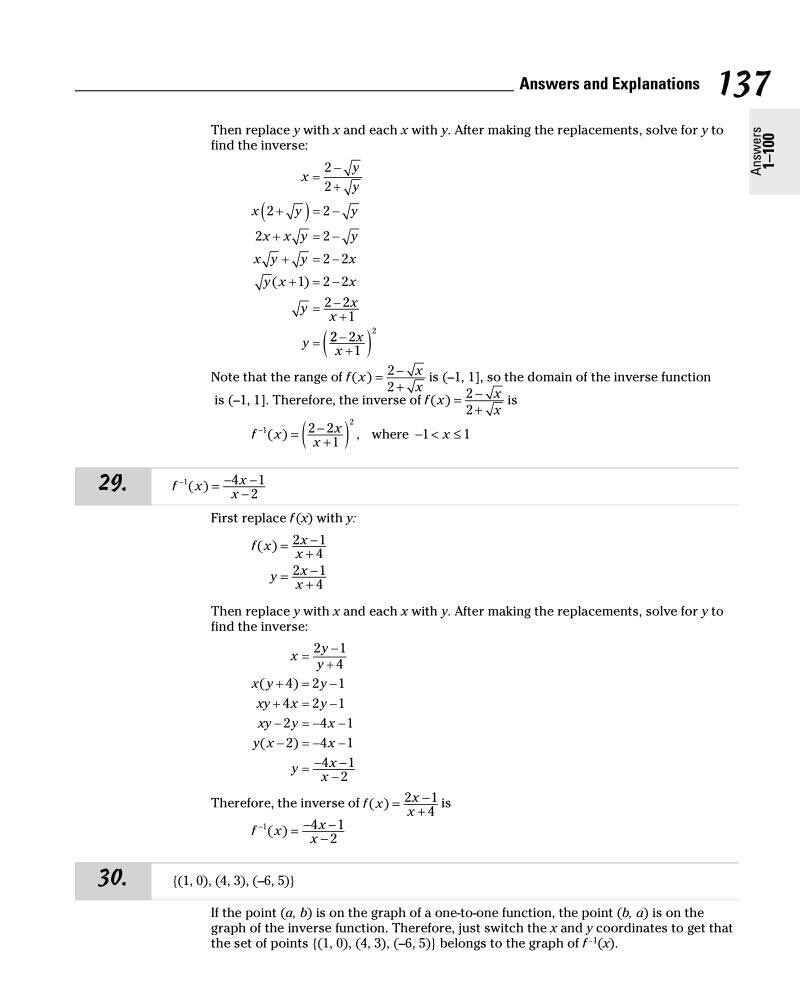
Then replace y with x and each x with y. After making the replacements, solve for y to
find the inverse:
x
y
y
x
y
y
x x y
y
x y
y
x
y x
x
y
x
x
y
=
−
+
+
(
) = −
+
= −
+
= −
+ = −
= −
+
=
2
2
2
2
2
2
2 2
1 2 2
2 2
1
(
)
2 2 2
1
2
−
+
( )
x
x
Note that the range of f x
x
x
( ) = −
+
2
2
is (–1, 1], so the domain of the inverse function
is (–1, 1]. Therefore, the inverse of f x
x
x
( ) = −
+
2
2
is
f x
x
x
x
−
= −
+
( )
− < ≤
1
2
2 2
1
1
1
( )
, where
29.
f x
x
x
−
= − −
−
1
4
1
2
( )
First replace f
(x) with y:
f x
x
x
y
x
x
( ) =
−
+
=
−
+
2 1
4
2 1
4
Then replace y with x and each x with y. After making the replacements, solve for y to
find the inverse:
x
y
y
x y
y
xy
x
y
xy
y
x
y x
x
y
x
=
−
+
+ =
−
+
=
−
−
= − −
− = − −
= −
2 1
4
4 2 1
4
2 1
2
4
1
2
4 1
4
(
)
(
)
− −
−
1
2
x
Therefore, the inverse of f x
x
x
( ) =
−
+
2 1
4
is
f x
x
x
−
= − −
−
1
4
1
2
( )
30.
{(1, 0), (4, 3), (–6, 5)}
If the point (a, b) is on the graph of a one-to-one function, the point (b, a) is on the
graph of the inverse function. Therefore, just switch the x and y coordinates to get that
the set of points {(1, 0), (4, 3), (–6, 5)} belongs to the graph of f
−1
(x).
Answers
1–100
Then replace y with x and each x with y. After making the replacements, solve for y to
find the inverse:
x
y
y
x
y
y
x x y
y
x y
y
x
y x
x
y
x
x
y
=
−
+
+
(
) = −
+
= −
+
= −
+ = −
= −
+
=
2
2
2
2
2
2
2 2
1 2 2
2 2
1
(
)
2 2 2
1
2
−
+
( )
x
x
Note that the range of f x
x
x
( ) = −
+
2
2
is (–1, 1], so the domain of the inverse function
is (–1, 1]. Therefore, the inverse of f x
x
x
( ) = −
+
2
2
is
f x
x
x
x
−
= −
+
( )
− < ≤
1
2
2 2
1
1
1
( )
, where
29.
f x
x
x
−
= − −
−
1
4
1
2
( )
First replace f
(x) with y:
f x
x
x
y
x
x
( ) =
−
+
=
−
+
2 1
4
2 1
4
Then replace y with x and each x with y. After making the replacements, solve for y to
find the inverse:
x
y
y
x y
y
xy
x
y
xy
y
x
y x
x
y
x
=
−
+
+ =
−
+
=
−
−
= − −
− = − −
= −
2 1
4
4 2 1
4
2 1
2
4
1
2
4 1
4
(
)
(
)
− −
−
1
2
x
Therefore, the inverse of f x
x
x
( ) =
−
+
2 1
4
is
f x
x
x
−
= − −
−
1
4
1
2
( )
30.
{(1, 0), (4, 3), (–6, 5)}
If the point (a, b) is on the graph of a one-to-one function, the point (b, a) is on the
graph of the inverse function. Therefore, just switch the x and y coordinates to get that
the set of points {(1, 0), (4, 3), (–6, 5)} belongs to the graph of f
−1
(x).