

Answers and Explanations 135
Answers
1–100
24.
f x
x
−
= −
1
4
5
( )
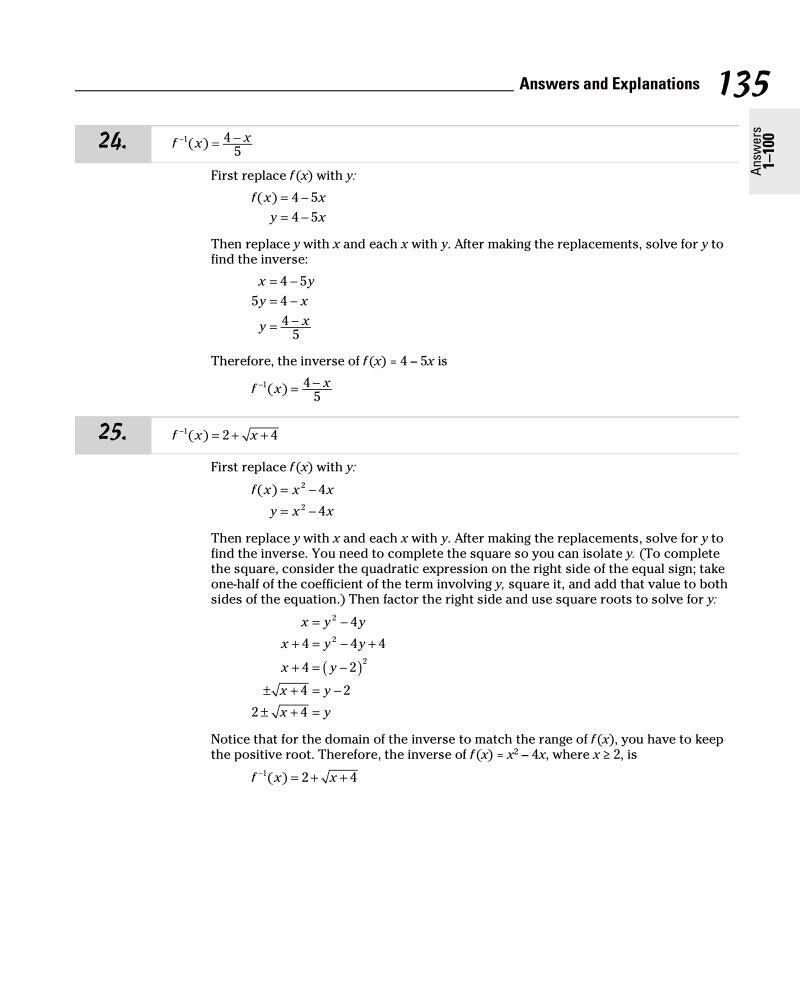
First replace f
(x) with y:
f x
x
y
x
( ) = −
= −
4 5
4 5
Then replace y with x and each x with y. After making the replacements, solve for y to
find the inverse:
x
y
y
x
y
x
= −
= −
= −
4 5
5
4
4
5
Therefore, the inverse of f
(x) = 4 – 5x is
f x
x
−
= −
1
4
5
( )
25.
f x
x
−
= +
+
1
2
4
( )
First replace f
(x) with y:
f x
x
x
y x
x
( ) =
−
=
−
2
2
4
4
Then replace y with x and each x with y. After making the replacements, solve for y to
find the inverse. You need to complete the square so you can isolate y. (To complete
the square, consider the quadratic expression on the right side of the equal sign; take
one-half of the coefficient of the term involving y, square it, and add that value to both
sides of the equation.) Then factor the right side and use square roots to solve for y:
x y
y
x
y
y
x
y
x
y
x
y
=
−
+ =
−
+
+ =
−
(
)
±
+ = −
±
+ =
2
2
2
4
4
4
4
4
2
4
2
2
4
Notice that for the domain of the inverse to match the range of f
(x), you have to keep
the positive root. Therefore, the inverse of f
(x) = x
2
– 4x, where x ≥ 2, is
f x
x
−
= +
+
1
2
4
( )
Answers
1–100
24.
f x
x
−
= −
1
4
5
( )
First replace f
(x) with y:
f x
x
y
x
( ) = −
= −
4 5
4 5
Then replace y with x and each x with y. After making the replacements, solve for y to
find the inverse:
x
y
y
x
y
x
= −
= −
= −
4 5
5
4
4
5
Therefore, the inverse of f
(x) = 4 – 5x is
f x
x
−
= −
1
4
5
( )
25.
f x
x
−
= +
+
1
2
4
( )
First replace f
(x) with y:
f x
x
x
y x
x
( ) =
−
=
−
2
2
4
4
Then replace y with x and each x with y. After making the replacements, solve for y to
find the inverse. You need to complete the square so you can isolate y. (To complete
the square, consider the quadratic expression on the right side of the equal sign; take
one-half of the coefficient of the term involving y, square it, and add that value to both
sides of the equation.) Then factor the right side and use square roots to solve for y:
x y
y
x
y
y
x
y
x
y
x
y
=
−
+ =
−
+
+ =
−
(
)
±
+ = −
±
+ =
2
2
2
4
4
4
4
4
2
4
2
2
4
Notice that for the domain of the inverse to match the range of f
(x), you have to keep
the positive root. Therefore, the inverse of f
(x) = x
2
– 4x, where x ≥ 2, is
f x
x
−
= +
+
1
2
4
( )