

96 Part I: The Questions
731. A cylindrical storage container has a diameter of 12 feet and a height of 8 feet. The
container is filled with water to a distance
of 4 feet from the top of the tank. Water is
being pumped out, but the pump breaks
after 13,500π foot-pounds of work has been
completed. In feet, how far is the remaining
water from the top of the tank? Round your
answer to the hundredths place.
732. Twenty-five joules of work is needed to
stretch a spring from 40 centimeters to
60 centimeters. If 40 joules of work is required
to stretch the spring from 60 centimeters to
80 centimeters, what is the natural length of
the spring in centimeters? Round the
answer to two decimal places. (Note: For a
spring, force equals the spring constant k
multiplied by the spring’s displacement
from its natural length: F(x) = kx. Also note
that 1 newton-meter = 1 joule.)
733. A cylindrical storage tank with a radius of
1 meter and a length of 5 meters is lying on its
side and is full of water. If the top of the tank
is 3 meters below ground, how much work in
joules will it take to pump all the water to
ground level? (Note: The acceleration due to
gravity is 9.8 meters per second squared, and
the density of water is 1,000 kilograms per
cubic meter.)
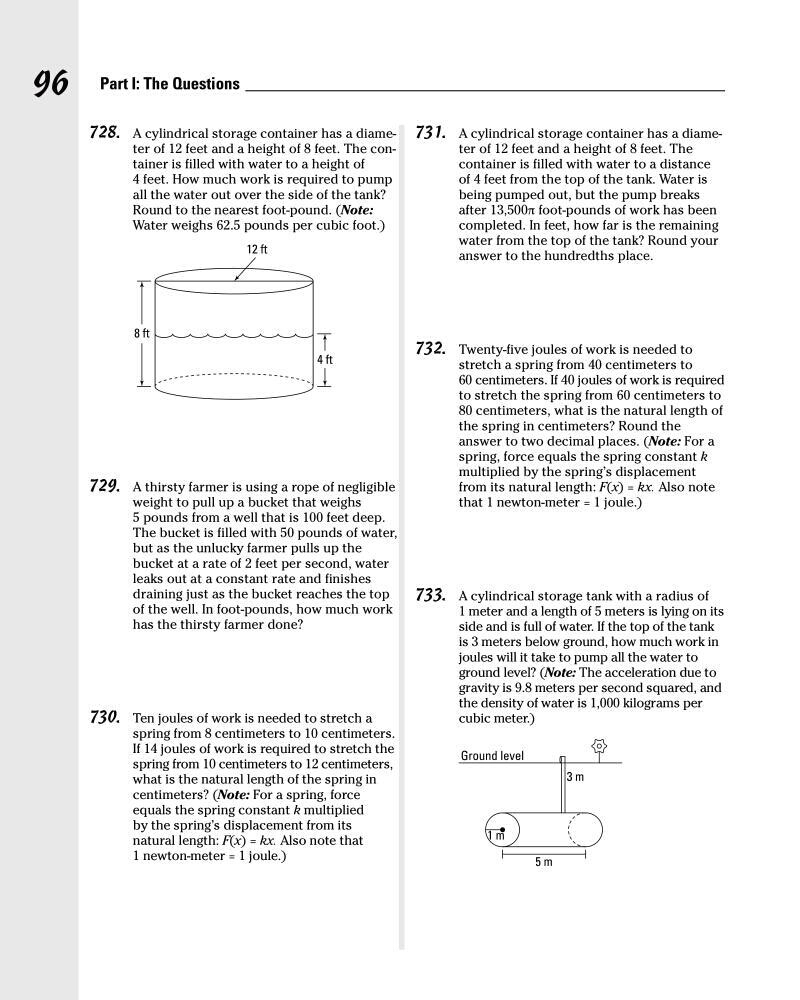
728. A cylindrical storage container has a diameter of 12 feet and a height of 8 feet. The container is filled with water to a height of
4 feet. How much work is required to pump
all the water out over the side of the tank?
Round to the nearest foot-pound. (Note:
Water weighs 62.5 pounds per cubic foot.)
729. A thirsty farmer is using a rope of negligible
weight to pull up a bucket that weighs
5 pounds from a well that is 100 feet deep.
The bucket is filled with 50 pounds of water,
but as the unlucky farmer pulls up the
bucket at a rate of 2 feet per second, water
leaks out at a constant rate and finishes
draining just as the bucket reaches the top
of the well. In foot-pounds, how much work
has the thirsty farmer done?
730. Ten joules of work is needed to stretch a
spring from 8 centimeters to 10 centimeters.
If 14 joules of work is required to stretch the
spring from 10 centimeters to 12 centimeters,
what is the natural length of the spring in
centimeters? (Note: For a spring, force
equals the spring constant k multiplied
by the spring’s displacement from its
natural length: F(x) = kx. Also note that
1 newton-meter = 1 joule.)
731. A cylindrical storage container has a diameter of 12 feet and a height of 8 feet. The
container is filled with water to a distance
of 4 feet from the top of the tank. Water is
being pumped out, but the pump breaks
after 13,500π foot-pounds of work has been
completed. In feet, how far is the remaining
water from the top of the tank? Round your
answer to the hundredths place.
732. Twenty-five joules of work is needed to
stretch a spring from 40 centimeters to
60 centimeters. If 40 joules of work is required
to stretch the spring from 60 centimeters to
80 centimeters, what is the natural length of
the spring in centimeters? Round the
answer to two decimal places. (Note: For a
spring, force equals the spring constant k
multiplied by the spring’s displacement
from its natural length: F(x) = kx. Also note
that 1 newton-meter = 1 joule.)
733. A cylindrical storage tank with a radius of
1 meter and a length of 5 meters is lying on its
side and is full of water. If the top of the tank
is 3 meters below ground, how much work in
joules will it take to pump all the water to
ground level? (Note: The acceleration due to
gravity is 9.8 meters per second squared, and
the density of water is 1,000 kilograms per
cubic meter.)
728. A cylindrical storage container has a diameter of 12 feet and a height of 8 feet. The container is filled with water to a height of
4 feet. How much work is required to pump
all the water out over the side of the tank?
Round to the nearest foot-pound. (Note:
Water weighs 62.5 pounds per cubic foot.)
729. A thirsty farmer is using a rope of negligible
weight to pull up a bucket that weighs
5 pounds from a well that is 100 feet deep.
The bucket is filled with 50 pounds of water,
but as the unlucky farmer pulls up the
bucket at a rate of 2 feet per second, water
leaks out at a constant rate and finishes
draining just as the bucket reaches the top
of the well. In foot-pounds, how much work
has the thirsty farmer done?
730. Ten joules of work is needed to stretch a
spring from 8 centimeters to 10 centimeters.
If 14 joules of work is required to stretch the
spring from 10 centimeters to 12 centimeters,
what is the natural length of the spring in
centimeters? (Note: For a spring, force
equals the spring constant k multiplied
by the spring’s displacement from its
natural length: F(x) = kx. Also note that
1 newton-meter = 1 joule.)