

iii. Opposite angles in a cyclic QUADRILATERAL
sum to 180°.
3. Two-Chord Theorem
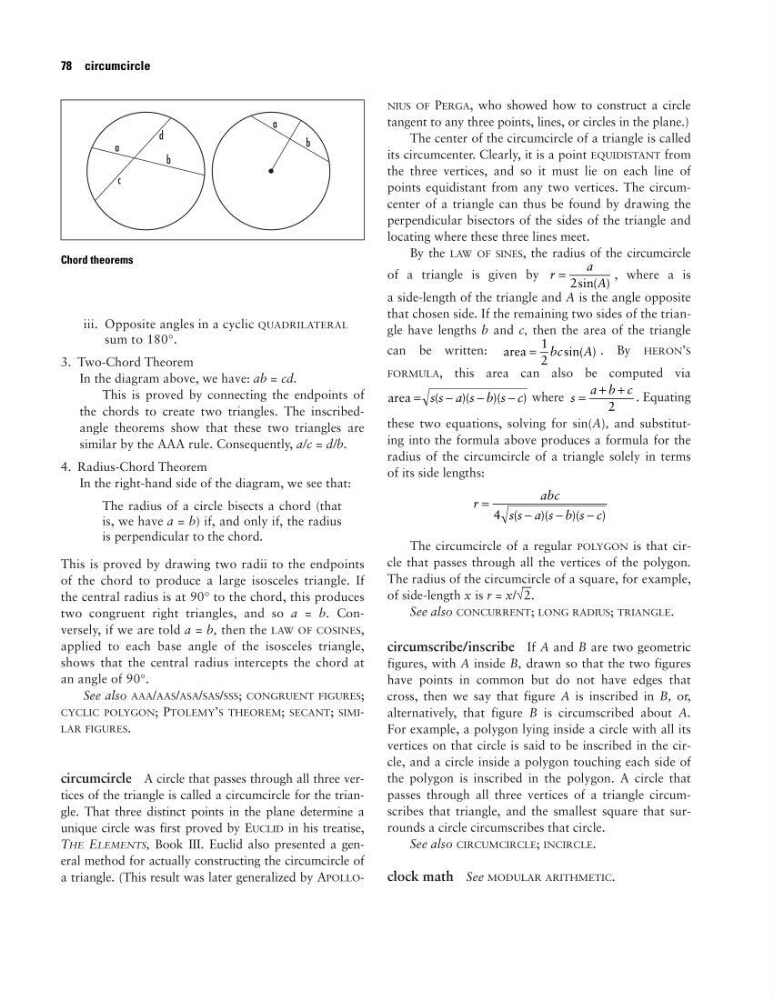
In the diagram above, we have: ab = cd.
This is proved by connecting the endpoints of
the chords to create two triangles. The inscribedangle theorems show that these two triangles are
similar by the AAA rule. Consequently, a/c = d/b.
4. Radius-Chord Theorem
In the right-hand side of the diagram, we see that:
The radius of a circle bisects a chord (that
is, we have a = b) if, and only if, the radius
is perpendicular to the chord.
This is proved by drawing two radii to the endpoints
of the chord to produce a large isosceles triangle. If
the central radius is at 90° to the chord, this produces
two congruent right triangles, and so a = b. Conversely, if we are told a = b, then the LAW OF COSINES,
applied to each base angle of the isosceles triangle,
shows that the central radius intercepts the chord at
an angle of 90°.
See also AAA/AAS/ASA/SAS/SSS; CONGRUENT FIGURES;
CYCLIC POLYGON; PTOLEMY’S THEOREM; SECANT; SIMILAR FIGURES.
circumcircle A circle that passes through all three vertices of the triangle is called a circumcircle for the triangle. That three distinct points in the plane determine a
unique circle was first proved by EUCLID in his treatise,
THE ELEMENTS, Book III. Euclid also presented a general method for actually constructing the circumcircle of
a triangle. (This result was later generalized by APOLLONIUS OF PERGA, who showed how to construct a circle
tangent to any three points, lines, or circles in the plane.)
The center of the circumcircle of a triangle is called
its circumcenter. Clearly, it is a point EQUIDISTANT from
the three vertices, and so it must lie on each line of
points equidistant from any two vertices. The circumcenter of a triangle can thus be found by drawing the
perpendicular bisectors of the sides of the triangle and
locating where these three lines meet.
By the LAW OF SINES, the radius of the circumcircle
of a triangle is given by
, where a is
a side-length of the triangle and A is the angle opposite
that chosen side. If the remaining two sides of the triangle have lengths b and c, then the area of the triangle
can be written:
. By HERON’S
FORMULA, this area can also be computed via
where
. Equating
these two equations, solving for sin(A), and substituting into the formula above produces a formula for the
radius of the circumcircle of a triangle solely in terms
of its side lengths:
The circumcircle of a regular POLYGON is that circle that passes through all the vertices of the polygon.
The radius of the circumcircle of a square, for example,
of side-length x is r = x/√
–
2.
See also CONCURRENT; LONG RADIUS; TRIANGLE.
circumscribe/inscribe If A and B are two geometric
figures, with A inside B, drawn so that the two figures
have points in common but do not have edges that
cross, then we say that figure A is inscribed in B, or,
alternatively, that figure B is circumscribed about A.
For example, a polygon lying inside a circle with all its
vertices on that circle is said to be inscribed in the circle, and a circle inside a polygon touching each side of
the polygon is inscribed in the polygon. A circle that
passes through all three vertices of a triangle circumscribes that triangle, and the smallest square that surrounds a circle circumscribes that circle.
See also CIRCUMCIRCLE; INCIRCLE.
clock math See MODULAR ARITHMETIC.
r
abc
s s a s b s c
=
−
−
−
4 (
)(
)(
)
s
a b c
=
+ +
2
area =
−
−
−
s s a s b s c
(
)(
)(
)
area =
1
2
bc
A
sin( )
r
a
A
= 2sin( )
78 circumcircle
Chord theorems
sum to 180°.
3. Two-Chord Theorem
In the diagram above, we have: ab = cd.
This is proved by connecting the endpoints of
the chords to create two triangles. The inscribedangle theorems show that these two triangles are
similar by the AAA rule. Consequently, a/c = d/b.
4. Radius-Chord Theorem
In the right-hand side of the diagram, we see that:
The radius of a circle bisects a chord (that
is, we have a = b) if, and only if, the radius
is perpendicular to the chord.
This is proved by drawing two radii to the endpoints
of the chord to produce a large isosceles triangle. If
the central radius is at 90° to the chord, this produces
two congruent right triangles, and so a = b. Conversely, if we are told a = b, then the LAW OF COSINES,
applied to each base angle of the isosceles triangle,
shows that the central radius intercepts the chord at
an angle of 90°.
See also AAA/AAS/ASA/SAS/SSS; CONGRUENT FIGURES;
CYCLIC POLYGON; PTOLEMY’S THEOREM; SECANT; SIMILAR FIGURES.
circumcircle A circle that passes through all three vertices of the triangle is called a circumcircle for the triangle. That three distinct points in the plane determine a
unique circle was first proved by EUCLID in his treatise,
THE ELEMENTS, Book III. Euclid also presented a general method for actually constructing the circumcircle of
a triangle. (This result was later generalized by APOLLONIUS OF PERGA, who showed how to construct a circle
tangent to any three points, lines, or circles in the plane.)
The center of the circumcircle of a triangle is called
its circumcenter. Clearly, it is a point EQUIDISTANT from
the three vertices, and so it must lie on each line of
points equidistant from any two vertices. The circumcenter of a triangle can thus be found by drawing the
perpendicular bisectors of the sides of the triangle and
locating where these three lines meet.
By the LAW OF SINES, the radius of the circumcircle
of a triangle is given by
, where a is
a side-length of the triangle and A is the angle opposite
that chosen side. If the remaining two sides of the triangle have lengths b and c, then the area of the triangle
can be written:
. By HERON’S
FORMULA, this area can also be computed via
where
. Equating
these two equations, solving for sin(A), and substituting into the formula above produces a formula for the
radius of the circumcircle of a triangle solely in terms
of its side lengths:
The circumcircle of a regular POLYGON is that circle that passes through all the vertices of the polygon.
The radius of the circumcircle of a square, for example,
of side-length x is r = x/√
–
2.
See also CONCURRENT; LONG RADIUS; TRIANGLE.
circumscribe/inscribe If A and B are two geometric
figures, with A inside B, drawn so that the two figures
have points in common but do not have edges that
cross, then we say that figure A is inscribed in B, or,
alternatively, that figure B is circumscribed about A.
For example, a polygon lying inside a circle with all its
vertices on that circle is said to be inscribed in the circle, and a circle inside a polygon touching each side of
the polygon is inscribed in the polygon. A circle that
passes through all three vertices of a triangle circumscribes that triangle, and the smallest square that surrounds a circle circumscribes that circle.
See also CIRCUMCIRCLE; INCIRCLE.
clock math See MODULAR ARITHMETIC.
r
abc
s s a s b s c
=
−
−
−
4 (
)(
)(
)
s
a b c
=
+ +
2
area =
−
−
−
s s a s b s c
(
)(
)(
)
area =
1
2
bc
A
sin( )
r
a
A
= 2sin( )
78 circumcircle
Chord theorems