

Intuitively, the concept is easy to grasp if we think of
derivatives as rates of change. For example, if y changes
a times as fast as u, and u changes b times as fast as x,
then we expect y to change ab times faster than x.
The chain rule extends to functions of more than
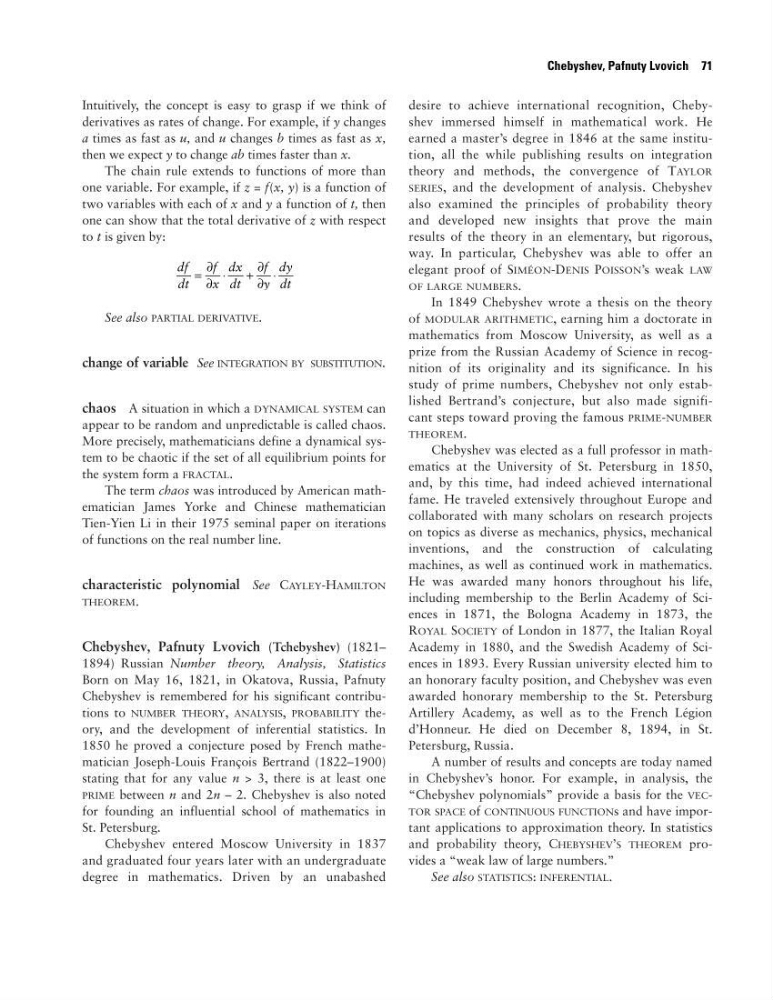
one variable. For example, if z = f(x, y) is a function of
two variables with each of x and y a function of t, then
one can show that the total derivative of z with respect
to t is given by:
See also PARTIAL DERIVATIVE.
change of variable See INTEGRATION BY SUBSTITUTION.
chaos A situation in which a DYNAMICAL SYSTEM can
appear to be random and unpredictable is called chaos.
More precisely, mathematicians define a dynamical system to be chaotic if the set of all equilibrium points for
the system form a FRACTAL.
The term chaos was introduced by American mathematician James Yorke and Chinese mathematician
Tien-Yien Li in their 1975 seminal paper on iterations
of functions on the real number line.
characteristic polynomial See CAYLEY-HAMILTON
THEOREM.
Chebyshev, Pafnuty Lvovich (Tchebyshev) (1821–
1894) Russian Number theory, Analysis, Statistics
Born on May 16, 1821, in Okatova, Russia, Pafnuty
Chebyshev is remembered for his significant contributions to NUMBER THEORY, ANALYSIS, PROBABILITY theory, and the development of inferential statistics. In
1850 he proved a conjecture posed by French mathematician Joseph-Louis François Bertrand (1822–1900)
stating that for any value n > 3, there is at least one
PRIME between n and 2n – 2. Chebyshev is also noted
for founding an influential school of mathematics in
St. Petersburg.
Chebyshev entered Moscow University in 1837
and graduated four years later with an undergraduate
degree in mathematics. Driven by an unabashed
desire to achieve international recognition, Chebyshev immersed himself in mathematical work. He
earned a master’s degree in 1846 at the same institution, all the while publishing results on integration
theory and methods, the convergence of TAYLOR
SERIES, and the development of analysis. Chebyshev
also examined the principles of probability theory
and developed new insights that prove the main
results of the theory in an elementary, but rigorous,
way. In particular, Chebyshev was able to offer an
elegant proof of SIMÉON-DENIS POISSON’s weak LAW
OF LARGE NUMBERS.
In 1849 Chebyshev wrote a thesis on the theory
of MODULAR ARITHMETIC, earning him a doctorate in
mathematics from Moscow University, as well as a
prize from the Russian Academy of Science in recognition of its originality and its significance. In his
study of prime numbers, Chebyshev not only established Bertrand’s conjecture, but also made significant steps toward proving the famous PRIME-NUMBER
THEOREM.
Chebyshev was elected as a full professor in mathematics at the University of St. Petersburg in 1850,
and, by this time, had indeed achieved international
fame. He traveled extensively throughout Europe and
collaborated with many scholars on research projects
on topics as diverse as mechanics, physics, mechanical
inventions, and the construction of calculating
machines, as well as continued work in mathematics.
He was awarded many honors throughout his life,
including membership to the Berlin Academy of Sciences in 1871, the Bologna Academy in 1873, the
ROYAL SOCIETY of London in 1877, the Italian Royal
Academy in 1880, and the Swedish Academy of Sciences in 1893. Every Russian university elected him to
an honorary faculty position, and Chebyshev was even
awarded honorary membership to the St. Petersburg
Artillery Academy, as well as to the French Légion
d’Honneur. He died on December 8, 1894, in St.
Petersburg, Russia.
A number of results and concepts are today named
in Chebyshev’s honor. For example, in analysis, the
“Chebyshev polynomials” provide a basis for the VECTOR SPACE of CONTINUOUS FUNCTIONs and have important applications to approximation theory. In statistics
and probability theory, CHEBYSHEV’S THEOREM provides a “weak law of large numbers.”
See also STATISTICS: INFERENTIAL.
df
dt
f
x
dx
dt
f
y
dy
dt
=
∂
∂
⋅
+
∂
∂
⋅
Chebyshev, Pafnuty Lvovich 71
derivatives as rates of change. For example, if y changes
a times as fast as u, and u changes b times as fast as x,
then we expect y to change ab times faster than x.
The chain rule extends to functions of more than
one variable. For example, if z = f(x, y) is a function of
two variables with each of x and y a function of t, then
one can show that the total derivative of z with respect
to t is given by:
See also PARTIAL DERIVATIVE.
change of variable See INTEGRATION BY SUBSTITUTION.
chaos A situation in which a DYNAMICAL SYSTEM can
appear to be random and unpredictable is called chaos.
More precisely, mathematicians define a dynamical system to be chaotic if the set of all equilibrium points for
the system form a FRACTAL.
The term chaos was introduced by American mathematician James Yorke and Chinese mathematician
Tien-Yien Li in their 1975 seminal paper on iterations
of functions on the real number line.
characteristic polynomial See CAYLEY-HAMILTON
THEOREM.
Chebyshev, Pafnuty Lvovich (Tchebyshev) (1821–
1894) Russian Number theory, Analysis, Statistics
Born on May 16, 1821, in Okatova, Russia, Pafnuty
Chebyshev is remembered for his significant contributions to NUMBER THEORY, ANALYSIS, PROBABILITY theory, and the development of inferential statistics. In
1850 he proved a conjecture posed by French mathematician Joseph-Louis François Bertrand (1822–1900)
stating that for any value n > 3, there is at least one
PRIME between n and 2n – 2. Chebyshev is also noted
for founding an influential school of mathematics in
St. Petersburg.
Chebyshev entered Moscow University in 1837
and graduated four years later with an undergraduate
degree in mathematics. Driven by an unabashed
desire to achieve international recognition, Chebyshev immersed himself in mathematical work. He
earned a master’s degree in 1846 at the same institution, all the while publishing results on integration
theory and methods, the convergence of TAYLOR
SERIES, and the development of analysis. Chebyshev
also examined the principles of probability theory
and developed new insights that prove the main
results of the theory in an elementary, but rigorous,
way. In particular, Chebyshev was able to offer an
elegant proof of SIMÉON-DENIS POISSON’s weak LAW
OF LARGE NUMBERS.
In 1849 Chebyshev wrote a thesis on the theory
of MODULAR ARITHMETIC, earning him a doctorate in
mathematics from Moscow University, as well as a
prize from the Russian Academy of Science in recognition of its originality and its significance. In his
study of prime numbers, Chebyshev not only established Bertrand’s conjecture, but also made significant steps toward proving the famous PRIME-NUMBER
THEOREM.
Chebyshev was elected as a full professor in mathematics at the University of St. Petersburg in 1850,
and, by this time, had indeed achieved international
fame. He traveled extensively throughout Europe and
collaborated with many scholars on research projects
on topics as diverse as mechanics, physics, mechanical
inventions, and the construction of calculating
machines, as well as continued work in mathematics.
He was awarded many honors throughout his life,
including membership to the Berlin Academy of Sciences in 1871, the Bologna Academy in 1873, the
ROYAL SOCIETY of London in 1877, the Italian Royal
Academy in 1880, and the Swedish Academy of Sciences in 1893. Every Russian university elected him to
an honorary faculty position, and Chebyshev was even
awarded honorary membership to the St. Petersburg
Artillery Academy, as well as to the French Légion
d’Honneur. He died on December 8, 1894, in St.
Petersburg, Russia.
A number of results and concepts are today named
in Chebyshev’s honor. For example, in analysis, the
“Chebyshev polynomials” provide a basis for the VECTOR SPACE of CONTINUOUS FUNCTIONs and have important applications to approximation theory. In statistics
and probability theory, CHEBYSHEV’S THEOREM provides a “weak law of large numbers.”
See also STATISTICS: INFERENTIAL.
df
dt
f
x
dx
dt
f
y
dy
dt
=
∂
∂
⋅
+
∂
∂
⋅
Chebyshev, Pafnuty Lvovich 71