

BERNOULLI FAMILY was the first to write down the formula for the catenary. Up to constants, it is given by:
This is the hyperbolic cosine function from the set of
HYPERBOLIC FUNCTIONs. Engineers, in designing suspension bridges such as the Golden Gate Bridge in San
Francisco, make extensive use of this function in their
work. The name catenary comes from the Latin word
catena for “chain.”
Cauchy, Augustin-Louis (1789–1857) French Analysis, Calculus, Number theory Born on August 21,
1789, French scholar Augustin-Louis Cauchy is remembered as one of the most important mathematicians of
his time. With 789 mathematical papers and seven
influential textbooks to his credit, Cauchy made significant contributions to the study of NUMBER THEORY,
ANALYSIS, GROUP THEORY, DIFFERENTIAL EQUATIONs,
and PROBABILITY. In his famous 1821 text Cours d’analyse (A course of analysis), Cauchy was the first to provide an exact, rigorous meaning of the terms derivative
and integral as used in CALCULUS through the development of the notion of a LIMIT. Cauchy also properly
defined the terms continuity and convergence. His insistence on the absolute need for rigor and clarity in all of
mathematics had a lasting effect and set the standards
of rigor required today of all mathematical research.
After graduating from the L’École Polytechnique
in 1807 with a degree in mathematics, Cauchy pursued a career in engineering. Noted as a promising
practitioner in the field, Cauchy was assigned to the
Ourcq Canal project and by age 21 managed to
receive a high-ranking commission in Cherbourg as a
military engineer.
Despite his busy work life, Cauchy continued to
pursue interests in mathematics. In 1811 he proved a
result on the geometry of polyhedra, which he submitted for publication. He received considerable praise for
this accomplishment and decided to change careers and
pursue research in mathematics full time. A year later
he returned to Paris and began looking for a faculty
position at an academic institution. Cauchy was finally
awarded an assistant professorship at the L’École Polytechnique in 1815.
All the while, Cauchy continued to produce and publish mathematical results. The same year as his appointment, Cauchy won the Grand Prize of the L’Académie
Royale des Sciences for his outstanding mathematical discoveries on the theory of waves. This recognition garnered him some notice in the scientific community, but
real fame came to Cauchy when, another year later, he
solved an outstanding problem posed by PIERRE DE FERMAT (1601–1665) on the properties of FIGURATE NUMBERS. Cauchy had now proved himself an expert in a
surprisingly large number of disparate fields.
Cauchy published an incredible number of papers
during this early period of his life, at a rate of as many
as two a week. He was so prolific that the editors of
the French journal Comptes Rendu imposed a quota on
him. In response, Cauchy persuaded a family member,
who worked in the publishing field, to create a new
journal that contained nothing but papers by him!
y
e
e
x
x
x
=
+
=
−
2
cosh( )
66 Cauchy, Augustin-Louis
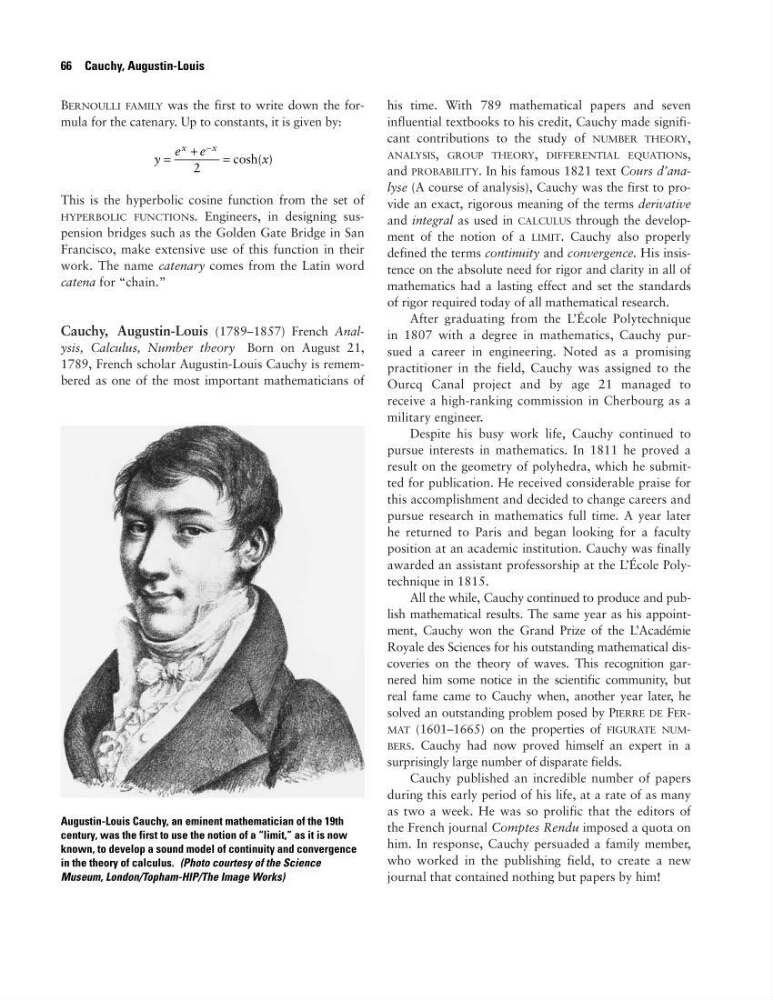
Augustin-Louis Cauchy, an eminent mathematician of the 19th
century, was the first to use the notion of a “limit,” as it is now
known, to develop a sound model of continuity and convergence
in the theory of calculus. (Photo courtesy of the Science
Museum, London/Topham-HIP/The Image Works)
This is the hyperbolic cosine function from the set of
HYPERBOLIC FUNCTIONs. Engineers, in designing suspension bridges such as the Golden Gate Bridge in San
Francisco, make extensive use of this function in their
work. The name catenary comes from the Latin word
catena for “chain.”
Cauchy, Augustin-Louis (1789–1857) French Analysis, Calculus, Number theory Born on August 21,
1789, French scholar Augustin-Louis Cauchy is remembered as one of the most important mathematicians of
his time. With 789 mathematical papers and seven
influential textbooks to his credit, Cauchy made significant contributions to the study of NUMBER THEORY,
ANALYSIS, GROUP THEORY, DIFFERENTIAL EQUATIONs,
and PROBABILITY. In his famous 1821 text Cours d’analyse (A course of analysis), Cauchy was the first to provide an exact, rigorous meaning of the terms derivative
and integral as used in CALCULUS through the development of the notion of a LIMIT. Cauchy also properly
defined the terms continuity and convergence. His insistence on the absolute need for rigor and clarity in all of
mathematics had a lasting effect and set the standards
of rigor required today of all mathematical research.
After graduating from the L’École Polytechnique
in 1807 with a degree in mathematics, Cauchy pursued a career in engineering. Noted as a promising
practitioner in the field, Cauchy was assigned to the
Ourcq Canal project and by age 21 managed to
receive a high-ranking commission in Cherbourg as a
military engineer.
Despite his busy work life, Cauchy continued to
pursue interests in mathematics. In 1811 he proved a
result on the geometry of polyhedra, which he submitted for publication. He received considerable praise for
this accomplishment and decided to change careers and
pursue research in mathematics full time. A year later
he returned to Paris and began looking for a faculty
position at an academic institution. Cauchy was finally
awarded an assistant professorship at the L’École Polytechnique in 1815.
All the while, Cauchy continued to produce and publish mathematical results. The same year as his appointment, Cauchy won the Grand Prize of the L’Académie
Royale des Sciences for his outstanding mathematical discoveries on the theory of waves. This recognition garnered him some notice in the scientific community, but
real fame came to Cauchy when, another year later, he
solved an outstanding problem posed by PIERRE DE FERMAT (1601–1665) on the properties of FIGURATE NUMBERS. Cauchy had now proved himself an expert in a
surprisingly large number of disparate fields.
Cauchy published an incredible number of papers
during this early period of his life, at a rate of as many
as two a week. He was so prolific that the editors of
the French journal Comptes Rendu imposed a quota on
him. In response, Cauchy persuaded a family member,
who worked in the publishing field, to create a new
journal that contained nothing but papers by him!
y
e
e
x
x
x
=
+
=
−
2
cosh( )
66 Cauchy, Augustin-Louis
Augustin-Louis Cauchy, an eminent mathematician of the 19th
century, was the first to use the notion of a “limit,” as it is now
known, to develop a sound model of continuity and convergence
in the theory of calculus. (Photo courtesy of the Science
Museum, London/Topham-HIP/The Image Works)