

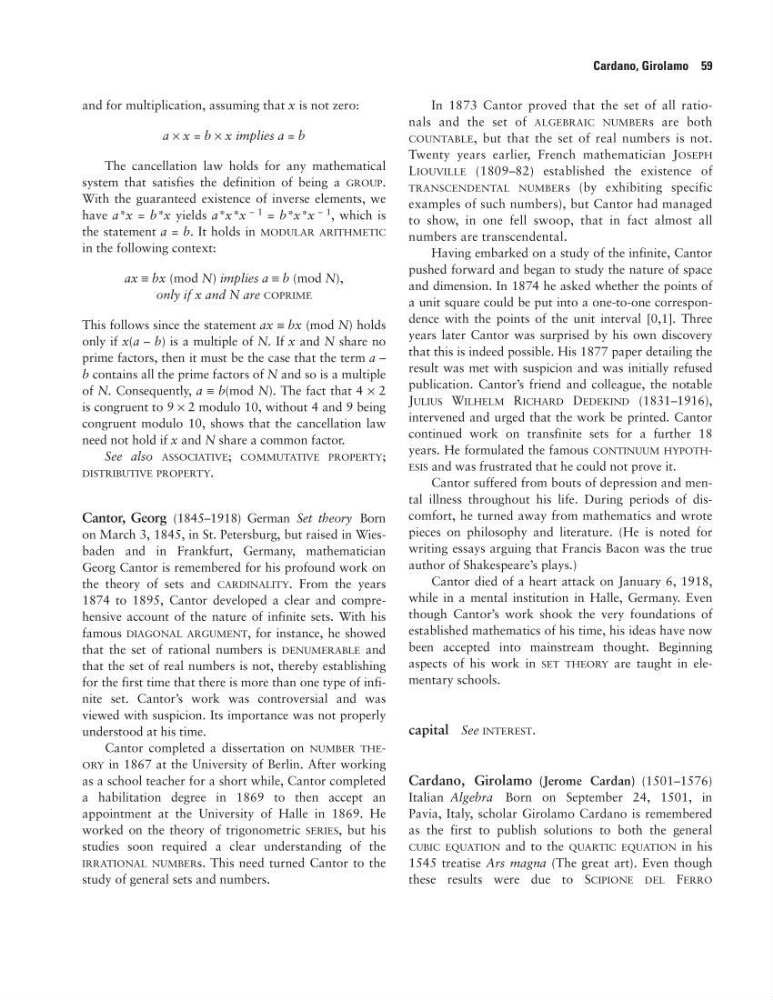
and for multiplication, assuming that x is not zero:
a × x = b × x implies a = b
The cancellation law holds for any mathematical
system that satisfies the definition of being a GROUP.
With the guaranteed existence of inverse elements, we
have a*x = b*x yields a*x*x
– 1 = b*x*x
– 1
, which is
the statement a = b. It holds in MODULAR ARITHMETIC
in the following context:
ax ≡ bx (mod N) implies a ≡ b (mod N),
only if x and N are COPRIME
This follows since the statement ax ≡ bx (mod N) holds
only if x(a – b) is a multiple of N. If x and N share no
prime factors, then it must be the case that the term a –
b contains all the prime factors of N and so is a multiple
of N. Consequently, a ≡ b(mod N). The fact that 4 × 2
is congruent to 9 × 2 modulo 10, without 4 and 9 being
congruent modulo 10, shows that the cancellation law
need not hold if x and N share a common factor.
See also ASSOCIATIVE; COMMUTATIVE PROPERTY;
DISTRIBUTIVE PROPERTY.
Cantor, Georg (1845–1918) German Set theory Born
on March 3, 1845, in St. Petersburg, but raised in Wiesbaden and in Frankfurt, Germany, mathematician
Georg Cantor is remembered for his profound work on
the theory of sets and CARDINALITY. From the years
1874 to 1895, Cantor developed a clear and comprehensive account of the nature of infinite sets. With his
famous DIAGONAL ARGUMENT, for instance, he showed
that the set of rational numbers is DENUMERABLE and
that the set of real numbers is not, thereby establishing
for the first time that there is more than one type of infinite set. Cantor’s work was controversial and was
viewed with suspicion. Its importance was not properly
understood at his time.
Cantor completed a dissertation on NUMBER THEORY in 1867 at the University of Berlin. After working
as a school teacher for a short while, Cantor completed
a habilitation degree in 1869 to then accept an
appointment at the University of Halle in 1869. He
worked on the theory of trigonometric SERIES, but his
studies soon required a clear understanding of the
IRRATIONAL NUMBERs. This need turned Cantor to the
study of general sets and numbers.
In 1873 Cantor proved that the set of all rationals and the set of ALGEBRAIC NUMBERs are both
COUNTABLE, but that the set of real numbers is not.
Twenty years earlier, French mathematician JOSEPH
LIOUVILLE (1809–82) established the existence of
TRANSCENDENTAL NUMBERs (by exhibiting specific
examples of such numbers), but Cantor had managed
to show, in one fell swoop, that in fact almost all
numbers are transcendental.
Having embarked on a study of the infinite, Cantor
pushed forward and began to study the nature of space
and dimension. In 1874 he asked whether the points of
a unit square could be put into a one-to-one correspondence with the points of the unit interval [0,1]. Three
years later Cantor was surprised by his own discovery
that this is indeed possible. His 1877 paper detailing the
result was met with suspicion and was initially refused
publication. Cantor’s friend and colleague, the notable
JULIUS WILHELM RICHARD DEDEKIND (1831–1916),
intervened and urged that the work be printed. Cantor
continued work on transfinite sets for a further 18
years. He formulated the famous CONTINUUM HYPOTHESIS and was frustrated that he could not prove it.
Cantor suffered from bouts of depression and mental illness throughout his life. During periods of discomfort, he turned away from mathematics and wrote
pieces on philosophy and literature. (He is noted for
writing essays arguing that Francis Bacon was the true
author of Shakespeare’s plays.)
Cantor died of a heart attack on January 6, 1918,
while in a mental institution in Halle, Germany. Even
though Cantor’s work shook the very foundations of
established mathematics of his time, his ideas have now
been accepted into mainstream thought. Beginning
aspects of his work in SET THEORY are taught in elementary schools.
capital See INTEREST.
Cardano, Girolamo (Jerome Cardan) (1501–1576)
Italian Algebra Born on September 24, 1501, in
Pavia, Italy, scholar Girolamo Cardano is remembered
as the first to publish solutions to both the general
CUBIC EQUATION and to the QUARTIC EQUATION in his
1545 treatise Ars magna (The great art). Even though
these results were due to SCIPIONE DEL FERRO
Cardano, Girolamo 59
a × x = b × x implies a = b
The cancellation law holds for any mathematical
system that satisfies the definition of being a GROUP.
With the guaranteed existence of inverse elements, we
have a*x = b*x yields a*x*x
– 1 = b*x*x
– 1
, which is
the statement a = b. It holds in MODULAR ARITHMETIC
in the following context:
ax ≡ bx (mod N) implies a ≡ b (mod N),
only if x and N are COPRIME
This follows since the statement ax ≡ bx (mod N) holds
only if x(a – b) is a multiple of N. If x and N share no
prime factors, then it must be the case that the term a –
b contains all the prime factors of N and so is a multiple
of N. Consequently, a ≡ b(mod N). The fact that 4 × 2
is congruent to 9 × 2 modulo 10, without 4 and 9 being
congruent modulo 10, shows that the cancellation law
need not hold if x and N share a common factor.
See also ASSOCIATIVE; COMMUTATIVE PROPERTY;
DISTRIBUTIVE PROPERTY.
Cantor, Georg (1845–1918) German Set theory Born
on March 3, 1845, in St. Petersburg, but raised in Wiesbaden and in Frankfurt, Germany, mathematician
Georg Cantor is remembered for his profound work on
the theory of sets and CARDINALITY. From the years
1874 to 1895, Cantor developed a clear and comprehensive account of the nature of infinite sets. With his
famous DIAGONAL ARGUMENT, for instance, he showed
that the set of rational numbers is DENUMERABLE and
that the set of real numbers is not, thereby establishing
for the first time that there is more than one type of infinite set. Cantor’s work was controversial and was
viewed with suspicion. Its importance was not properly
understood at his time.
Cantor completed a dissertation on NUMBER THEORY in 1867 at the University of Berlin. After working
as a school teacher for a short while, Cantor completed
a habilitation degree in 1869 to then accept an
appointment at the University of Halle in 1869. He
worked on the theory of trigonometric SERIES, but his
studies soon required a clear understanding of the
IRRATIONAL NUMBERs. This need turned Cantor to the
study of general sets and numbers.
In 1873 Cantor proved that the set of all rationals and the set of ALGEBRAIC NUMBERs are both
COUNTABLE, but that the set of real numbers is not.
Twenty years earlier, French mathematician JOSEPH
LIOUVILLE (1809–82) established the existence of
TRANSCENDENTAL NUMBERs (by exhibiting specific
examples of such numbers), but Cantor had managed
to show, in one fell swoop, that in fact almost all
numbers are transcendental.
Having embarked on a study of the infinite, Cantor
pushed forward and began to study the nature of space
and dimension. In 1874 he asked whether the points of
a unit square could be put into a one-to-one correspondence with the points of the unit interval [0,1]. Three
years later Cantor was surprised by his own discovery
that this is indeed possible. His 1877 paper detailing the
result was met with suspicion and was initially refused
publication. Cantor’s friend and colleague, the notable
JULIUS WILHELM RICHARD DEDEKIND (1831–1916),
intervened and urged that the work be printed. Cantor
continued work on transfinite sets for a further 18
years. He formulated the famous CONTINUUM HYPOTHESIS and was frustrated that he could not prove it.
Cantor suffered from bouts of depression and mental illness throughout his life. During periods of discomfort, he turned away from mathematics and wrote
pieces on philosophy and literature. (He is noted for
writing essays arguing that Francis Bacon was the true
author of Shakespeare’s plays.)
Cantor died of a heart attack on January 6, 1918,
while in a mental institution in Halle, Germany. Even
though Cantor’s work shook the very foundations of
established mathematics of his time, his ideas have now
been accepted into mainstream thought. Beginning
aspects of his work in SET THEORY are taught in elementary schools.
capital See INTEREST.
Cardano, Girolamo (Jerome Cardan) (1501–1576)
Italian Algebra Born on September 24, 1501, in
Pavia, Italy, scholar Girolamo Cardano is remembered
as the first to publish solutions to both the general
CUBIC EQUATION and to the QUARTIC EQUATION in his
1545 treatise Ars magna (The great art). Even though
these results were due to SCIPIONE DEL FERRO
Cardano, Girolamo 59