

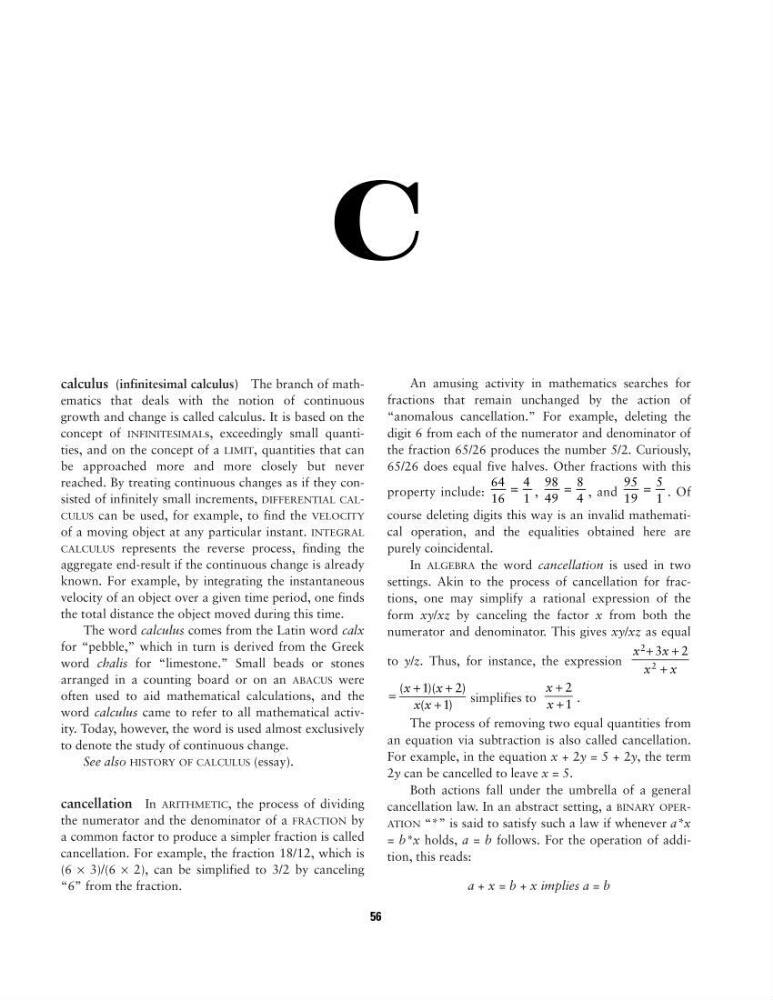
calculus (infinitesimal calculus) The branch of mathematics that deals with the notion of continuous
growth and change is called calculus. It is based on the
concept of INFINITESIMALs, exceedingly small quantities, and on the concept of a LIMIT, quantities that can
be approached more and more closely but never
reached. By treating continuous changes as if they consisted of infinitely small increments, DIFFERENTIAL CALCULUS can be used, for example, to find the VELOCITY
of a moving object at any particular instant. INTEGRAL
CALCULUS represents the reverse process, finding the
aggregate end-result if the continuous change is already
known. For example, by integrating the instantaneous
velocity of an object over a given time period, one finds
the total distance the object moved during this time.
The word calculus comes from the Latin word calx
for “pebble,” which in turn is derived from the Greek
word chalis for “limestone.” Small beads or stones
arranged in a counting board or on an ABACUS were
often used to aid mathematical calculations, and the
word calculus came to refer to all mathematical activity. Today, however, the word is used almost exclusively
to denote the study of continuous change.
See also HISTORY OF CALCULUS (essay).
cancellation In ARITHMETIC, the process of dividing
the numerator and the denominator of a FRACTION by
a common factor to produce a simpler fraction is called
cancellation. For example, the fraction 18/12, which is
(6 × 3)/(6 × 2), can be simplified to 3/2 by canceling
“6” from the fraction.
An amusing activity in mathematics searches for
fractions that remain unchanged by the action of
“anomalous cancellation.” For example, deleting the
digit 6 from each of the numerator and denominator of
the fraction 65/26 produces the number 5/2. Curiously,
65/26 does equal five halves. Other fractions with this
property include:
,
, and
. Of
course deleting digits this way is an invalid mathematical operation, and the equalities obtained here are
purely coincidental.
In ALGEBRA the word cancellation is used in two
settings. Akin to the process of cancellation for fractions, one may simplify a rational expression of the
form xy/xz by canceling the factor x from both the
numerator and denominator. This gives xy/xz as equal
to y/z. Thus, for instance, the expression
simplifies to
.
The process of removing two equal quantities from
an equation via subtraction is also called cancellation.
For example, in the equation x + 2y = 5 + 2y, the term
2y can be cancelled to leave x = 5.
Both actions fall under the umbrella of a general
cancellation law. In an abstract setting, a BINARY OPERATION “*” is said to satisfy such a law if whenever a*x
= b*x holds, a = b follows. For the operation of addition, this reads:
a + x = b + x implies a = b
x
x
+
+
2
1
x
x
x x
1
2
1
=
+
+
+
(
)(
)
(
)
x
x
x
x
2
2
3
2
+ +
+
95 5
— = –
19 1
98 8
— = –
49 4
64 4
— = –
16 1
56
C
growth and change is called calculus. It is based on the
concept of INFINITESIMALs, exceedingly small quantities, and on the concept of a LIMIT, quantities that can
be approached more and more closely but never
reached. By treating continuous changes as if they consisted of infinitely small increments, DIFFERENTIAL CALCULUS can be used, for example, to find the VELOCITY
of a moving object at any particular instant. INTEGRAL
CALCULUS represents the reverse process, finding the
aggregate end-result if the continuous change is already
known. For example, by integrating the instantaneous
velocity of an object over a given time period, one finds
the total distance the object moved during this time.
The word calculus comes from the Latin word calx
for “pebble,” which in turn is derived from the Greek
word chalis for “limestone.” Small beads or stones
arranged in a counting board or on an ABACUS were
often used to aid mathematical calculations, and the
word calculus came to refer to all mathematical activity. Today, however, the word is used almost exclusively
to denote the study of continuous change.
See also HISTORY OF CALCULUS (essay).
cancellation In ARITHMETIC, the process of dividing
the numerator and the denominator of a FRACTION by
a common factor to produce a simpler fraction is called
cancellation. For example, the fraction 18/12, which is
(6 × 3)/(6 × 2), can be simplified to 3/2 by canceling
“6” from the fraction.
An amusing activity in mathematics searches for
fractions that remain unchanged by the action of
“anomalous cancellation.” For example, deleting the
digit 6 from each of the numerator and denominator of
the fraction 65/26 produces the number 5/2. Curiously,
65/26 does equal five halves. Other fractions with this
property include:
,
, and
. Of
course deleting digits this way is an invalid mathematical operation, and the equalities obtained here are
purely coincidental.
In ALGEBRA the word cancellation is used in two
settings. Akin to the process of cancellation for fractions, one may simplify a rational expression of the
form xy/xz by canceling the factor x from both the
numerator and denominator. This gives xy/xz as equal
to y/z. Thus, for instance, the expression
simplifies to
.
The process of removing two equal quantities from
an equation via subtraction is also called cancellation.
For example, in the equation x + 2y = 5 + 2y, the term
2y can be cancelled to leave x = 5.
Both actions fall under the umbrella of a general
cancellation law. In an abstract setting, a BINARY OPERATION “*” is said to satisfy such a law if whenever a*x
= b*x holds, a = b follows. For the operation of addition, this reads:
a + x = b + x implies a = b
x
x
+
+
2
1
x
x
x x
1
2
1
=
+
+
+
(
)(
)
(
)
x
x
x
x
2
2
3
2
+ +
+
95 5
— = –
19 1
98 8
— = –
49 4
64 4
— = –
16 1
56
C