

CIRCLE solely in terms of the lengths of its four sides.
His formula reads:
where a, b, c, and d are the four side-lengths and
is the figure’s semiperimeter.
If p and q are the lengths of the figure’s two diagonals then PTOLEMY’S THEOREM asserts that pq = ac + bd.
Brahmagupta’s formula follows from BRETSCHNEIDER’S
FORMULA for the area of a quadrilateral:
by substituting in this value for pq.
If one of the sides of the quadrilateral has length
zero, that is, the figure is a TRIANGLE, then Brahmagupta’s formula reduces to HERON’S FORMULA.
See also CYCLIC POLYGON.
braid A number of strings plaited together is called a
braid. The theory of braids examines the number of
(essentially distinct) ways a fixed number of strings,
held initially in parallel, can be braided. One can combine two braids on a fixed number of strings by repeating the pattern of the second braid at the end of the
first braid. If, after completing this maneuver, the act of
physically shaking the system of strings settles the
strands to the unbraided state, then we say that the two
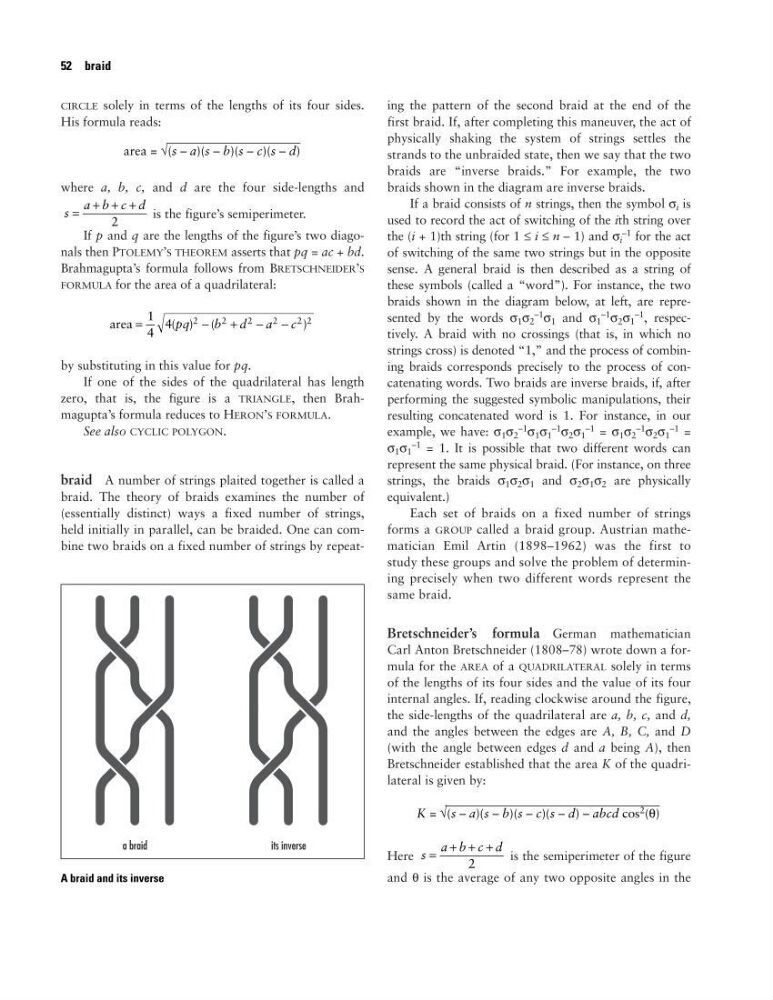
braids are “inverse braids.” For example, the two
braids shown in the diagram are inverse braids.
If a braid consists of n strings, then the symbol σ i is
used to record the act of switching of the ith string over
the (i + 1)th string (for 1 ≤ i ≤ n – 1) and σ i
–1 for the act
of switching of the same two strings but in the opposite
sense. A general braid is then described as a string of
these symbols (called a “word”). For instance, the two
braids shown in the diagram below, at left, are represented by the words σ 1 σ 2
–1
σ 1 and σ 1
–1
σ 2 σ 1
–1
, respectively. A braid with no crossings (that is, in which no
strings cross) is denoted “1,” and the process of combining braids corresponds precisely to the process of concatenating words. Two braids are inverse braids, if, after
performing the suggested symbolic manipulations, their
resulting concatenated word is 1. For instance, in our
example, we have: σ 1 σ 2
–1
σ 1 σ 1
–1
σ 2 σ 1
–1 = σ 1 σ 2
–1
σ 2 σ 1
–1 =
σ 1 σ 1
–1 = 1. It is possible that two different words can
represent the same physical braid. (For instance, on three
strings, the braids σ 1 σ 2 σ 1 and σ 2 σ 1 σ 2 are physically
equivalent.)
Each set of braids on a fixed number of strings
forms a GROUP called a braid group. Austrian mathematician Emil Artin (1898–1962) was the first to
study these groups and solve the problem of determining precisely when two different words represent the
same braid.
Bretschneider’s formula German mathematician
Carl Anton Bretschneider (1808–78) wrote down a formula for the AREA of a QUADRILATERAL solely in terms
of the lengths of its four sides and the value of its four
internal angles. If, reading clockwise around the figure,
the side-lengths of the quadrilateral are a, b, c, and d,
and the angles between the edges are A, B, C, and D
(with the angle between edges d and a being A), then
Bretschneider established that the area K of the quadrilateral is given by:
Here
is the semiperimeter of the figure
and θ is the average of any two opposite angles in the
s
a b c d
=
+ + +
2
K = √(s – a)(s – b)(s – c)(s – d) – abcd cos
2
(θ)
area =
−
+
− −
1
4
4
2
2
2
2
2 2
( ) (
)
pq
b d
a c
s
a b c d
=
+ + +
2
area = √(s – a)(s – b)(s – c)(s – d)
52 braid
A braid and its inverse
His formula reads:
where a, b, c, and d are the four side-lengths and
is the figure’s semiperimeter.
If p and q are the lengths of the figure’s two diagonals then PTOLEMY’S THEOREM asserts that pq = ac + bd.
Brahmagupta’s formula follows from BRETSCHNEIDER’S
FORMULA for the area of a quadrilateral:
by substituting in this value for pq.
If one of the sides of the quadrilateral has length
zero, that is, the figure is a TRIANGLE, then Brahmagupta’s formula reduces to HERON’S FORMULA.
See also CYCLIC POLYGON.
braid A number of strings plaited together is called a
braid. The theory of braids examines the number of
(essentially distinct) ways a fixed number of strings,
held initially in parallel, can be braided. One can combine two braids on a fixed number of strings by repeating the pattern of the second braid at the end of the
first braid. If, after completing this maneuver, the act of
physically shaking the system of strings settles the
strands to the unbraided state, then we say that the two
braids are “inverse braids.” For example, the two
braids shown in the diagram are inverse braids.
If a braid consists of n strings, then the symbol σ i is
used to record the act of switching of the ith string over
the (i + 1)th string (for 1 ≤ i ≤ n – 1) and σ i
–1 for the act
of switching of the same two strings but in the opposite
sense. A general braid is then described as a string of
these symbols (called a “word”). For instance, the two
braids shown in the diagram below, at left, are represented by the words σ 1 σ 2
–1
σ 1 and σ 1
–1
σ 2 σ 1
–1
, respectively. A braid with no crossings (that is, in which no
strings cross) is denoted “1,” and the process of combining braids corresponds precisely to the process of concatenating words. Two braids are inverse braids, if, after
performing the suggested symbolic manipulations, their
resulting concatenated word is 1. For instance, in our
example, we have: σ 1 σ 2
–1
σ 1 σ 1
–1
σ 2 σ 1
–1 = σ 1 σ 2
–1
σ 2 σ 1
–1 =
σ 1 σ 1
–1 = 1. It is possible that two different words can
represent the same physical braid. (For instance, on three
strings, the braids σ 1 σ 2 σ 1 and σ 2 σ 1 σ 2 are physically
equivalent.)
Each set of braids on a fixed number of strings
forms a GROUP called a braid group. Austrian mathematician Emil Artin (1898–1962) was the first to
study these groups and solve the problem of determining precisely when two different words represent the
same braid.
Bretschneider’s formula German mathematician
Carl Anton Bretschneider (1808–78) wrote down a formula for the AREA of a QUADRILATERAL solely in terms
of the lengths of its four sides and the value of its four
internal angles. If, reading clockwise around the figure,
the side-lengths of the quadrilateral are a, b, c, and d,
and the angles between the edges are A, B, C, and D
(with the angle between edges d and a being A), then
Bretschneider established that the area K of the quadrilateral is given by:
Here
is the semiperimeter of the figure
and θ is the average of any two opposite angles in the
s
a b c d
=
+ + +
2
K = √(s – a)(s – b)(s – c)(s – d) – abcd cos
2
(θ)
area =
−
+
− −
1
4
4
2
2
2
2
2 2
( ) (
)
pq
b d
a c
s
a b c d
=
+ + +
2
area = √(s – a)(s – b)(s – c)(s – d)
52 braid
A braid and its inverse