

z-score (z-value) If a set of DATA has mean µ and
standard deviation σ, then the z-score of a particular
data value x is given by:
This transformation converts the data values of one
set into another set of values with mean 0 and standard deviation 1. It allows one to effectively compare
two or more independent sets of data. As an example:
a group of freshman college music majors are given
exams in performance, theory, and composition. One
student, John, wishes to judge how well he fared in
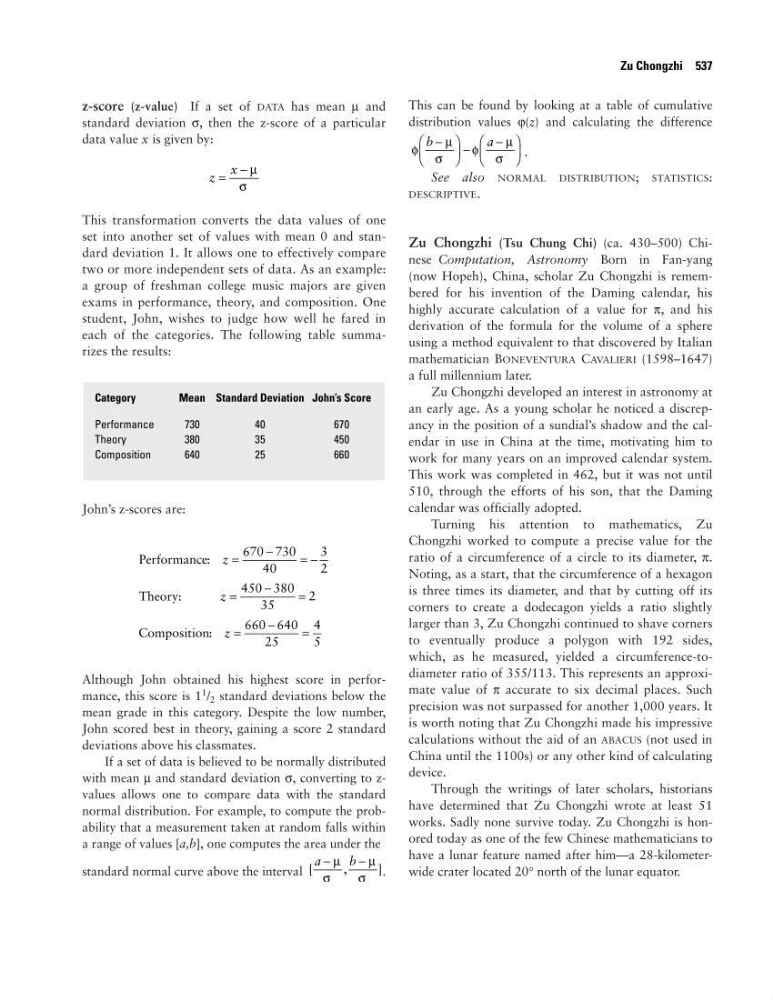
each of the categories. The following table summarizes the results:
John’s z-scores are:
Although John obtained his highest score in performance, this score is 1
1
/ 2 standard deviations below the
mean grade in this category. Despite the low number,
John scored best in theory, gaining a score 2 standard
deviations above his classmates.
If a set of data is believed to be normally distributed
with mean µ and standard deviation σ, converting to zvalues allows one to compare data with the standard
normal distribution. For example, to compute the probability that a measurement taken at random falls within
a range of values [a,b], one computes the area under the
standard normal curve above the interval
.
This can be found by looking at a table of cumulative
distribution values ϕ(z) and calculating the difference
.
See also NORMAL DISTRIBUTION; STATISTICS:
DESCRIPTIVE.
Zu Chongzhi (Tsu Chung Chi) (ca. 430–500) Chinese Computation, Astronomy Born in Fan-yang
(now Hopeh), China, scholar Zu Chongzhi is remembered for his invention of the Daming calendar, his
highly accurate calculation of a value for π, and his
derivation of the formula for the volume of a sphere
using a method equivalent to that discovered by Italian
mathematician BONEVENTURA CAVALIERI (1598–1647)
a full millennium later.
Zu Chongzhi developed an interest in astronomy at
an early age. As a young scholar he noticed a discrepancy in the position of a sundial’s shadow and the calendar in use in China at the time, motivating him to
work for many years on an improved calendar system.
This work was completed in 462, but it was not until
510, through the efforts of his son, that the Daming
calendar was officially adopted.
Turning his attention to mathematics, Zu
Chongzhi worked to compute a precise value for the
ratio of a circumference of a circle to its diameter, π.
Noting, as a start, that the circumference of a hexagon
is three times its diameter, and that by cutting off its
corners to create a dodecagon yields a ratio slightly
larger than 3, Zu Chongzhi continued to shave corners
to eventually produce a polygon with 192 sides,
which, as he measured, yielded a circumference-todiameter ratio of 355/113. This represents an approximate value of π accurate to six decimal places. Such
precision was not surpassed for another 1,000 years. It
is worth noting that Zu Chongzhi made his impressive
calculations without the aid of an ABACUS (not used in
China until the 1100s) or any other kind of calculating
device.
Through the writings of later scholars, historians
have determined that Zu Chongzhi wrote at least 51
works. Sadly none survive today. Zu Chongzhi is honored today as one of the few Chinese mathematicians to
have a lunar feature named after him—a 28-kilometerwide crater located 20° north of the lunar equator.
φ
µ
σ
φ
µ
σ
b
a
−
−
−
[
,
]
a
b
−
−
µ
σ
µ
σ
Performance
Theory
Composition
:
:
:
z
z
z
=
−
= −
=
−
=
=
−
=
670 730
40
3
2
450 380
35
2
660 640
25
4
5
Category
Mean Standard Deviation John’s Score
Performance
730
40
670
Theory
380
35
450
Composition
640
25
660
z
x
=
− µ
σ
Zu Chongzhi 537
standard deviation σ, then the z-score of a particular
data value x is given by:
This transformation converts the data values of one
set into another set of values with mean 0 and standard deviation 1. It allows one to effectively compare
two or more independent sets of data. As an example:
a group of freshman college music majors are given
exams in performance, theory, and composition. One
student, John, wishes to judge how well he fared in
each of the categories. The following table summarizes the results:
John’s z-scores are:
Although John obtained his highest score in performance, this score is 1
1
/ 2 standard deviations below the
mean grade in this category. Despite the low number,
John scored best in theory, gaining a score 2 standard
deviations above his classmates.
If a set of data is believed to be normally distributed
with mean µ and standard deviation σ, converting to zvalues allows one to compare data with the standard
normal distribution. For example, to compute the probability that a measurement taken at random falls within
a range of values [a,b], one computes the area under the
standard normal curve above the interval
.
This can be found by looking at a table of cumulative
distribution values ϕ(z) and calculating the difference
.
See also NORMAL DISTRIBUTION; STATISTICS:
DESCRIPTIVE.
Zu Chongzhi (Tsu Chung Chi) (ca. 430–500) Chinese Computation, Astronomy Born in Fan-yang
(now Hopeh), China, scholar Zu Chongzhi is remembered for his invention of the Daming calendar, his
highly accurate calculation of a value for π, and his
derivation of the formula for the volume of a sphere
using a method equivalent to that discovered by Italian
mathematician BONEVENTURA CAVALIERI (1598–1647)
a full millennium later.
Zu Chongzhi developed an interest in astronomy at
an early age. As a young scholar he noticed a discrepancy in the position of a sundial’s shadow and the calendar in use in China at the time, motivating him to
work for many years on an improved calendar system.
This work was completed in 462, but it was not until
510, through the efforts of his son, that the Daming
calendar was officially adopted.
Turning his attention to mathematics, Zu
Chongzhi worked to compute a precise value for the
ratio of a circumference of a circle to its diameter, π.
Noting, as a start, that the circumference of a hexagon
is three times its diameter, and that by cutting off its
corners to create a dodecagon yields a ratio slightly
larger than 3, Zu Chongzhi continued to shave corners
to eventually produce a polygon with 192 sides,
which, as he measured, yielded a circumference-todiameter ratio of 355/113. This represents an approximate value of π accurate to six decimal places. Such
precision was not surpassed for another 1,000 years. It
is worth noting that Zu Chongzhi made his impressive
calculations without the aid of an ABACUS (not used in
China until the 1100s) or any other kind of calculating
device.
Through the writings of later scholars, historians
have determined that Zu Chongzhi wrote at least 51
works. Sadly none survive today. Zu Chongzhi is honored today as one of the few Chinese mathematicians to
have a lunar feature named after him—a 28-kilometerwide crater located 20° north of the lunar equator.
φ
µ
σ
φ
µ
σ
b
a
−
−
−
[
,
]
a
b
−
−
µ
σ
µ
σ
Performance
Theory
Composition
:
:
:
z
z
z
=
−
= −
=
−
=
=
−
=
670 730
40
3
2
450 380
35
2
660 640
25
4
5
Category
Mean Standard Deviation John’s Score
Performance
730
40
670
Theory
380
35
450
Composition
640
25
660
z
x
=
− µ
σ
Zu Chongzhi 537