

of the vector is given by PYTHAGORAS’S THEOREM: |a| =
, which is just the DISTANCE FORMULA in this
new setting.
Vectors drawn in the plane are called two-dimensional. Three-dimensional vectors, given by triples of
numbers, represent quantities with magnitude and
direction in three-dimensional space. SIR WILLIAM
ROWAN HAMILTON (1805–65) coined the term vector
for these quantities in his book Lectures on Quaternions. The name is based on the Latin word vectus, the
perfect participle of vehere, which means “to carry.”
Operations on Vectors
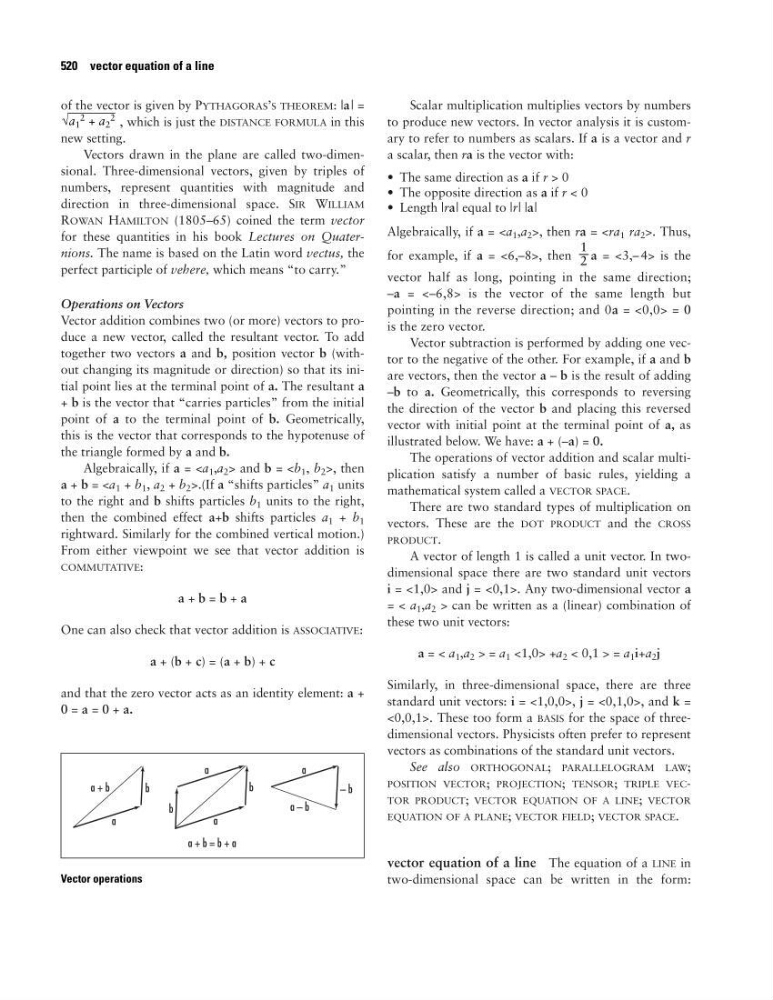
Vector addition combines two (or more) vectors to produce a new vector, called the resultant vector. To add
together two vectors a and b, position vector b (without changing its magnitude or direction) so that its initial point lies at the terminal point of a. The resultant a
+ b is the vector that “carries particles” from the initial
point of a to the terminal point of b. Geometrically,
this is the vector that corresponds to the hypotenuse of
the triangle formed by a and b.
Algebraically, if a = and b = , then
a + b = .(If a “shifts particles” a 1 units
to the right and b shifts particles b 1 units to the right,
then the combined effect a+b shifts particles a 1 + b 1
rightward. Similarly for the combined vertical motion.)
From either viewpoint we see that vector addition is
COMMUTATIVE:
a + b = b + a
One can also check that vector addition is ASSOCIATIVE:
a + (b + c) = (a + b) + c
and that the zero vector acts as an identity element: a +
0 = a = 0 + a.
Scalar multiplication multiplies vectors by numbers
to produce new vectors. In vector analysis it is customary to refer to numbers as scalars. If a is a vector and r
a scalar, then ra is the vector with:
• The same direction as a if r > 0
• The opposite direction as a if r < 0
• Length |ra| equal to |r| |a|
Algebraically, if a = , then ra =. Thus,
for example, if a = <6,–8>, then
a = <3,– 4> is the
vector half as long, pointing in the same direction;
–a = <–6,8> is the vector of the same length but
pointing in the reverse direction; and 0a = <0,0> = 0
is the zero vector.
Vector subtraction is performed by adding one vector to the negative of the other. For example, if a and b
are vectors, then the vector a – b is the result of adding
–b to a. Geometrically, this corresponds to reversing
the direction of the vector b and placing this reversed
vector with initial point at the terminal point of a, as
illustrated below. We have: a + (–a) = 0.
The operations of vector addition and scalar multiplication satisfy a number of basic rules, yielding a
mathematical system called a VECTOR SPACE.
There are two standard types of multiplication on
vectors. These are the DOT PRODUCT and the CROSS
PRODUCT.
A vector of length 1 is called a unit vector. In twodimensional space there are two standard unit vectors
i = <1,0> and j = <0,1>. Any two-dimensional vector a
= < a 1 ,a 2 > can be written as a (linear) combination of
these two unit vectors:
a = < a 1 ,a 2 > = a 1 <1,0> +a 2 < 0,1 > = a 1 i+a 2 j
Similarly, in three-dimensional space, there are three
standard unit vectors: i = <1,0,0>, j = <0,1,0>, and k =
<0,0,1>. These too form a BASIS for the space of threedimensional vectors. Physicists often prefer to represent
vectors as combinations of the standard unit vectors.
See also ORTHOGONAL; PARALLELOGRAM LAW;
POSITION VECTOR; PROJECTION; TENSOR; TRIPLE VECTOR PRODUCT; VECTOR EQUATION OF A LINE; VECTOR
EQUATION OF A PLANE; VECTOR FIELD; VECTOR SPACE.
vector equation of a line The equation of a LINE in
two-dimensional space can be written in the form:
1
–
2
√a 1
2 + a 2
2
520 vector equation of a line
Vector operations
, which is just the DISTANCE FORMULA in this
new setting.
Vectors drawn in the plane are called two-dimensional. Three-dimensional vectors, given by triples of
numbers, represent quantities with magnitude and
direction in three-dimensional space. SIR WILLIAM
ROWAN HAMILTON (1805–65) coined the term vector
for these quantities in his book Lectures on Quaternions. The name is based on the Latin word vectus, the
perfect participle of vehere, which means “to carry.”
Operations on Vectors
Vector addition combines two (or more) vectors to produce a new vector, called the resultant vector. To add
together two vectors a and b, position vector b (without changing its magnitude or direction) so that its initial point lies at the terminal point of a. The resultant a
+ b is the vector that “carries particles” from the initial
point of a to the terminal point of b. Geometrically,
this is the vector that corresponds to the hypotenuse of
the triangle formed by a and b.
Algebraically, if a = and b = , then
a + b = .(If a “shifts particles” a 1 units
to the right and b shifts particles b 1 units to the right,
then the combined effect a+b shifts particles a 1 + b 1
rightward. Similarly for the combined vertical motion.)
From either viewpoint we see that vector addition is
COMMUTATIVE:
a + b = b + a
One can also check that vector addition is ASSOCIATIVE:
a + (b + c) = (a + b) + c
and that the zero vector acts as an identity element: a +
0 = a = 0 + a.
Scalar multiplication multiplies vectors by numbers
to produce new vectors. In vector analysis it is customary to refer to numbers as scalars. If a is a vector and r
a scalar, then ra is the vector with:
• The same direction as a if r > 0
• The opposite direction as a if r < 0
• Length |ra| equal to |r| |a|
Algebraically, if a = , then ra =
for example, if a = <6,–8>, then
a = <3,– 4> is the
vector half as long, pointing in the same direction;
–a = <–6,8> is the vector of the same length but
pointing in the reverse direction; and 0a = <0,0> = 0
is the zero vector.
Vector subtraction is performed by adding one vector to the negative of the other. For example, if a and b
are vectors, then the vector a – b is the result of adding
–b to a. Geometrically, this corresponds to reversing
the direction of the vector b and placing this reversed
vector with initial point at the terminal point of a, as
illustrated below. We have: a + (–a) = 0.
The operations of vector addition and scalar multiplication satisfy a number of basic rules, yielding a
mathematical system called a VECTOR SPACE.
There are two standard types of multiplication on
vectors. These are the DOT PRODUCT and the CROSS
PRODUCT.
A vector of length 1 is called a unit vector. In twodimensional space there are two standard unit vectors
i = <1,0> and j = <0,1>. Any two-dimensional vector a
= < a 1 ,a 2 > can be written as a (linear) combination of
these two unit vectors:
a = < a 1 ,a 2 > = a 1 <1,0> +a 2 < 0,1 > = a 1 i+a 2 j
Similarly, in three-dimensional space, there are three
standard unit vectors: i = <1,0,0>, j = <0,1,0>, and k =
<0,0,1>. These too form a BASIS for the space of threedimensional vectors. Physicists often prefer to represent
vectors as combinations of the standard unit vectors.
See also ORTHOGONAL; PARALLELOGRAM LAW;
POSITION VECTOR; PROJECTION; TENSOR; TRIPLE VECTOR PRODUCT; VECTOR EQUATION OF A LINE; VECTOR
EQUATION OF A PLANE; VECTOR FIELD; VECTOR SPACE.
vector equation of a line The equation of a LINE in
two-dimensional space can be written in the form:
1
–
2
√a 1
2 + a 2
2
520 vector equation of a line
Vector operations