

differential equation
has
trivial solution y = 0. Any solution to a problem that
may be of interest is called nontrivial. For example, the
equation x
3 – 2x = 0 has nontrivial solution x = √
–
2.
The word trivial comes from the Latin word trivium, the medieval name for the three least-complicated
of the seven subjects of study offered in medieval universities: grammar, rhetoric, and logic. (The remaining
four subjects—arithmetic, astronomy, geometry and
music—were known as the quadrivium.)
Mathematicians often use the word trivial to
describe a result that requires little or no effort to
prove. For example, that any multiple of 4 is divisible
by 2 would be deemed a trivial result.
truth table In the field of FORMAL LOGIC, propositional calculus is the name given to the analysis of truthvalues of complicated statements built up from simpler
statements linked together via the connectives and; or; if
… then …; and if, and only if (called, respectively, the
CONJUNCTION, the DISJUNCTION, the CONDITIONAL, and
the BICONDITIONAL). One can also consider the NEGATION of a statement.
For example, the statement “The moon is round
and is made of green cheese” is a compound statement
made of two simpler statements (“The moon is round”
and “The moon is made of green cheese”) linked
together via the connective and. The truth-value of the
statement as a whole depends on the truth-value of the
two individual statements of which it is composed.
In symbols, statements are usually represented as
lowercase letters (p,q,r, for example), and the connectives combining them are denoted:
p and q: p
q
p or q: p ∨ q
If p then q: p → q
p if, and only if, q: p ↔ q
not p: ¬p
A compound statement is a statement built up
from simpler statements via connectives. For example,
p
(q → r) and p ∨ (¬p)
are compound statements. (Parentheses are used to
indicate the order in which the connectives are to be
applied.) For example, if p is the statement “The moon
is round,” q the statement “The moon is made of green
cheese,” and r the statement “The moon is edible,”
then p
(q → r) can be interpreted as, “The moon is
round AND, IF the moon is made of green cheese,
THEN it is edible.” The statement p ∨ (¬p) can be
interpreted as “The moon either is or is not round.”
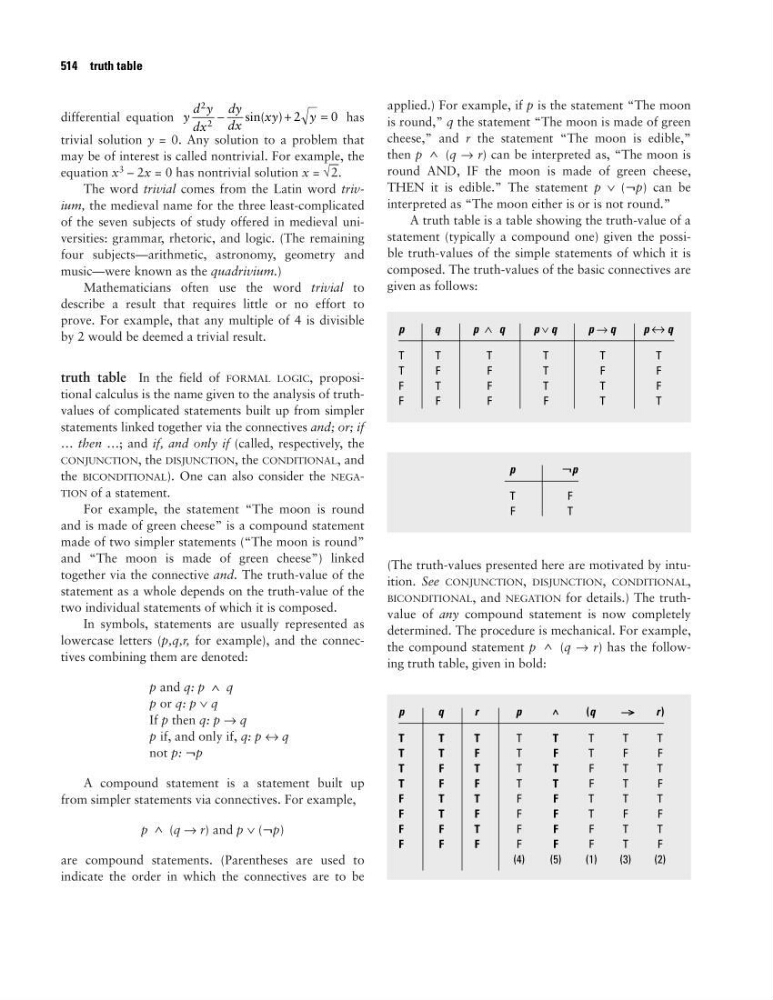
A truth table is a table showing the truth-value of a
statement (typically a compound one) given the possible truth-values of the simple statements of which it is
composed. The truth-values of the basic connectives are
given as follows:
(The truth-values presented here are motivated by intuition. See CONJUNCTION, DISJUNCTION, CONDITIONAL,
BICONDITIONAL, and NEGATION for details.) The truthvalue of any compound statement is now completely
determined. The procedure is mechanical. For example,
the compound statement p
(q → r) has the following truth table, given in bold:
∨
∨
∨
∨
y
d y
dx
dy
dx
xy
y
2
2
2
0
−
+
=
sin( )
514 truth table
p
q
p
q
p∨ q
p→ q
p↔ q
T
T
T
T
T
T
T
F
F
T
F
F
F
T
F
T
T
F
F
F
F
F
T
T
∨
p
¬p
T
F
F
T
p
q
r
p
(q
— >
r)
T
T
T
T
T
T
T
T
T
T
F
T
F
T
F
F
T
F
T
T
T
F
T
T
T
F
F
T
T
F
T
F
F
T
T
F
F
T
T
T
F
T
F
F
F
T
F
F
F
F
T
F
F
F
T
T
F
F
F
F
F
F
T
F
(4)
(5)
(1)
(3)
(2)
^
has
trivial solution y = 0. Any solution to a problem that
may be of interest is called nontrivial. For example, the
equation x
3 – 2x = 0 has nontrivial solution x = √
–
2.
The word trivial comes from the Latin word trivium, the medieval name for the three least-complicated
of the seven subjects of study offered in medieval universities: grammar, rhetoric, and logic. (The remaining
four subjects—arithmetic, astronomy, geometry and
music—were known as the quadrivium.)
Mathematicians often use the word trivial to
describe a result that requires little or no effort to
prove. For example, that any multiple of 4 is divisible
by 2 would be deemed a trivial result.
truth table In the field of FORMAL LOGIC, propositional calculus is the name given to the analysis of truthvalues of complicated statements built up from simpler
statements linked together via the connectives and; or; if
… then …; and if, and only if (called, respectively, the
CONJUNCTION, the DISJUNCTION, the CONDITIONAL, and
the BICONDITIONAL). One can also consider the NEGATION of a statement.
For example, the statement “The moon is round
and is made of green cheese” is a compound statement
made of two simpler statements (“The moon is round”
and “The moon is made of green cheese”) linked
together via the connective and. The truth-value of the
statement as a whole depends on the truth-value of the
two individual statements of which it is composed.
In symbols, statements are usually represented as
lowercase letters (p,q,r, for example), and the connectives combining them are denoted:
p and q: p
q
p or q: p ∨ q
If p then q: p → q
p if, and only if, q: p ↔ q
not p: ¬p
A compound statement is a statement built up
from simpler statements via connectives. For example,
p
(q → r) and p ∨ (¬p)
are compound statements. (Parentheses are used to
indicate the order in which the connectives are to be
applied.) For example, if p is the statement “The moon
is round,” q the statement “The moon is made of green
cheese,” and r the statement “The moon is edible,”
then p
(q → r) can be interpreted as, “The moon is
round AND, IF the moon is made of green cheese,
THEN it is edible.” The statement p ∨ (¬p) can be
interpreted as “The moon either is or is not round.”
A truth table is a table showing the truth-value of a
statement (typically a compound one) given the possible truth-values of the simple statements of which it is
composed. The truth-values of the basic connectives are
given as follows:
(The truth-values presented here are motivated by intuition. See CONJUNCTION, DISJUNCTION, CONDITIONAL,
BICONDITIONAL, and NEGATION for details.) The truthvalue of any compound statement is now completely
determined. The procedure is mechanical. For example,
the compound statement p
(q → r) has the following truth table, given in bold:
∨
∨
∨
∨
y
d y
dx
dy
dx
xy
y
2
2
2
0
−
+
=
sin( )
514 truth table
p
q
p
q
p∨ q
p→ q
p↔ q
T
T
T
T
T
T
T
F
F
T
F
F
F
T
F
T
T
F
F
F
F
F
T
T
∨
p
¬p
T
F
F
T
p
q
r
p
(q
— >
r)
T
T
T
T
T
T
T
T
T
T
F
T
F
T
F
F
T
F
T
T
T
F
T
T
T
F
F
T
T
F
T
F
F
T
T
F
F
T
T
T
F
T
F
F
F
T
F
F
F
F
T
F
F
F
T
T
F
F
F
F
F
F
T
F
(4)
(5)
(1)
(3)
(2)
^