

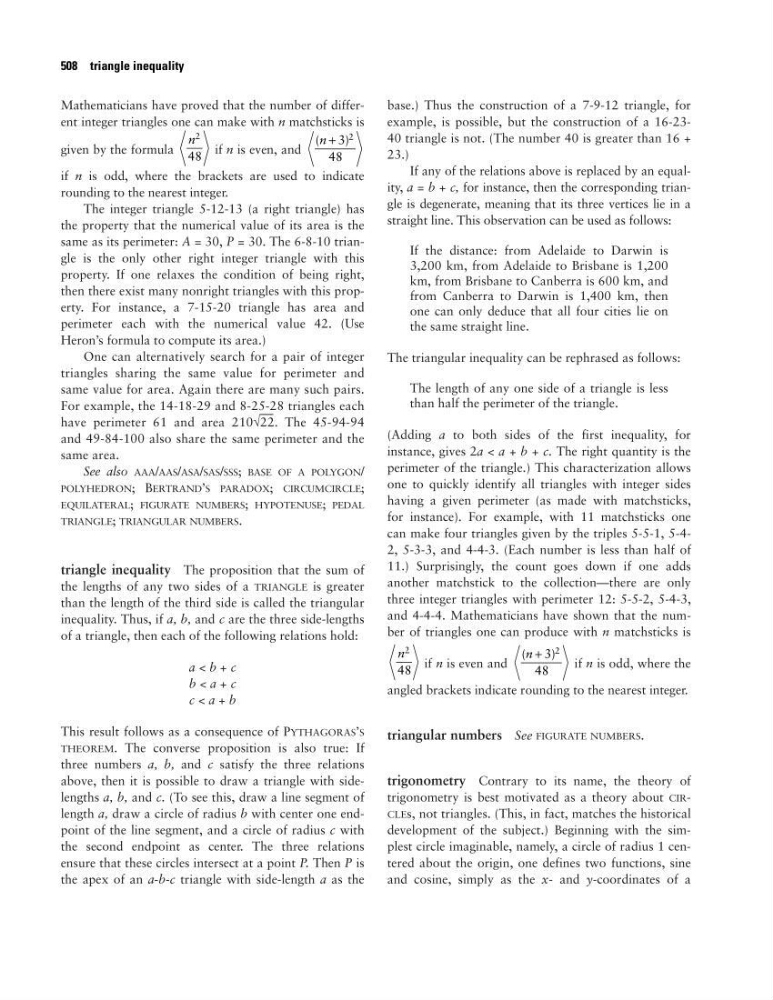
Mathematicians have proved that the number of different integer triangles one can make with n matchsticks is
given by the formula
if n is even, and
if n is odd, where the brackets are used to indicate
rounding to the nearest integer.
The integer triangle 5-12-13 (a right triangle) has
the property that the numerical value of its area is the
same as its perimeter: A = 30, P = 30. The 6-8-10 triangle is the only other right integer triangle with this
property. If one relaxes the condition of being right,
then there exist many nonright triangles with this property. For instance, a 7-15-20 triangle has area and
perimeter each with the numerical value 42. (Use
Heron’s formula to compute its area.)
One can alternatively search for a pair of integer
triangles sharing the same value for perimeter and
same value for area. Again there are many such pairs.
For example, the 14-18-29 and 8-25-28 triangles each
have perimeter 61 and area 210√
–
22. The 45-94-94
and 49-84-100 also share the same perimeter and the
same area.
See also AAA/AAS/ASA/SAS/SSS; BASE OF A POLYGON/
POLYHEDRON; BERTRAND’S PARADOX; CIRCUMCIRCLE;
EQUILATERAL; FIGURATE NUMBERS; HYPOTENUSE; PEDAL
TRIANGLE; TRIANGULAR NUMBERS.
triangle inequality The proposition that the sum of
the lengths of any two sides of a TRIANGLE is greater
than the length of the third side is called the triangular
inequality. Thus, if a, b, and c are the three side-lengths
of a triangle, then each of the following relations hold:
a < b + c
b < a + c
c < a + b
This result follows as a consequence of PYTHAGORAS’S
THEOREM. The converse proposition is also true: If
three numbers a, b, and c satisfy the three relations
above, then it is possible to draw a triangle with sidelengths a, b, and c. (To see this, draw a line segment of
length a, draw a circle of radius b with center one endpoint of the line segment, and a circle of radius c with
the second endpoint as center. The three relations
ensure that these circles intersect at a point P. Then P is
the apex of an a-b-c triangle with side-length a as the
base.) Thus the construction of a 7-9-12 triangle, for
example, is possible, but the construction of a 16-2340 triangle is not. (The number 40 is greater than 16 +
23.)
If any of the relations above is replaced by an equality, a = b + c, for instance, then the corresponding triangle is degenerate, meaning that its three vertices lie in a
straight line. This observation can be used as follows:
If the distance: from Adelaide to Darwin is
3,200 km, from Adelaide to Brisbane is 1,200
km, from Brisbane to Canberra is 600 km, and
from Canberra to Darwin is 1,400 km, then
one can only deduce that all four cities lie on
the same straight line.
The triangular inequality can be rephrased as follows:
The length of any one side of a triangle is less
than half the perimeter of the triangle.
(Adding a to both sides of the first inequality, for
instance, gives 2a < a + b + c. The right quantity is the
perimeter of the triangle.) This characterization allows
one to quickly identify all triangles with integer sides
having a given perimeter (as made with matchsticks,
for instance). For example, with 11 matchsticks one
can make four triangles given by the triples 5-5-1, 5-42, 5-3-3, and 4-4-3. (Each number is less than half of
11.) Surprisingly, the count goes down if one adds
another matchstick to the collection—there are only
three integer triangles with perimeter 12: 5-5-2, 5-4-3,
and 4-4-4. Mathematicians have shown that the number of triangles one can produce with n matchsticks is
if n is even and
if n is odd, where the
angled brackets indicate rounding to the nearest integer.
triangular numbers See FIGURATE NUMBERS.
trigonometry Contrary to its name, the theory of
trigonometry is best motivated as a theory about CIRCLEs, not triangles. (This, in fact, matches the historical
development of the subject.) Beginning with the simplest circle imaginable, namely, a circle of radius 1 centered about the origin, one defines two functions, sine
and cosine, simply as the x- and y-coordinates of a
(
)
n + 3
48
2
n
2
48
(
)
n + 3
48
2
n
2
48
508 triangle inequality
given by the formula
if n is even, and
if n is odd, where the brackets are used to indicate
rounding to the nearest integer.
The integer triangle 5-12-13 (a right triangle) has
the property that the numerical value of its area is the
same as its perimeter: A = 30, P = 30. The 6-8-10 triangle is the only other right integer triangle with this
property. If one relaxes the condition of being right,
then there exist many nonright triangles with this property. For instance, a 7-15-20 triangle has area and
perimeter each with the numerical value 42. (Use
Heron’s formula to compute its area.)
One can alternatively search for a pair of integer
triangles sharing the same value for perimeter and
same value for area. Again there are many such pairs.
For example, the 14-18-29 and 8-25-28 triangles each
have perimeter 61 and area 210√
–
22. The 45-94-94
and 49-84-100 also share the same perimeter and the
same area.
See also AAA/AAS/ASA/SAS/SSS; BASE OF A POLYGON/
POLYHEDRON; BERTRAND’S PARADOX; CIRCUMCIRCLE;
EQUILATERAL; FIGURATE NUMBERS; HYPOTENUSE; PEDAL
TRIANGLE; TRIANGULAR NUMBERS.
triangle inequality The proposition that the sum of
the lengths of any two sides of a TRIANGLE is greater
than the length of the third side is called the triangular
inequality. Thus, if a, b, and c are the three side-lengths
of a triangle, then each of the following relations hold:
a < b + c
b < a + c
c < a + b
This result follows as a consequence of PYTHAGORAS’S
THEOREM. The converse proposition is also true: If
three numbers a, b, and c satisfy the three relations
above, then it is possible to draw a triangle with sidelengths a, b, and c. (To see this, draw a line segment of
length a, draw a circle of radius b with center one endpoint of the line segment, and a circle of radius c with
the second endpoint as center. The three relations
ensure that these circles intersect at a point P. Then P is
the apex of an a-b-c triangle with side-length a as the
base.) Thus the construction of a 7-9-12 triangle, for
example, is possible, but the construction of a 16-2340 triangle is not. (The number 40 is greater than 16 +
23.)
If any of the relations above is replaced by an equality, a = b + c, for instance, then the corresponding triangle is degenerate, meaning that its three vertices lie in a
straight line. This observation can be used as follows:
If the distance: from Adelaide to Darwin is
3,200 km, from Adelaide to Brisbane is 1,200
km, from Brisbane to Canberra is 600 km, and
from Canberra to Darwin is 1,400 km, then
one can only deduce that all four cities lie on
the same straight line.
The triangular inequality can be rephrased as follows:
The length of any one side of a triangle is less
than half the perimeter of the triangle.
(Adding a to both sides of the first inequality, for
instance, gives 2a < a + b + c. The right quantity is the
perimeter of the triangle.) This characterization allows
one to quickly identify all triangles with integer sides
having a given perimeter (as made with matchsticks,
for instance). For example, with 11 matchsticks one
can make four triangles given by the triples 5-5-1, 5-42, 5-3-3, and 4-4-3. (Each number is less than half of
11.) Surprisingly, the count goes down if one adds
another matchstick to the collection—there are only
three integer triangles with perimeter 12: 5-5-2, 5-4-3,
and 4-4-4. Mathematicians have shown that the number of triangles one can produce with n matchsticks is
if n is even and
if n is odd, where the
angled brackets indicate rounding to the nearest integer.
triangular numbers See FIGURATE NUMBERS.
trigonometry Contrary to its name, the theory of
trigonometry is best motivated as a theory about CIRCLEs, not triangles. (This, in fact, matches the historical
development of the subject.) Beginning with the simplest circle imaginable, namely, a circle of radius 1 centered about the origin, one defines two functions, sine
and cosine, simply as the x- and y-coordinates of a
(
)
n + 3
48
2
n
2
48
(
)
n + 3
48
2
n
2
48
508 triangle inequality