

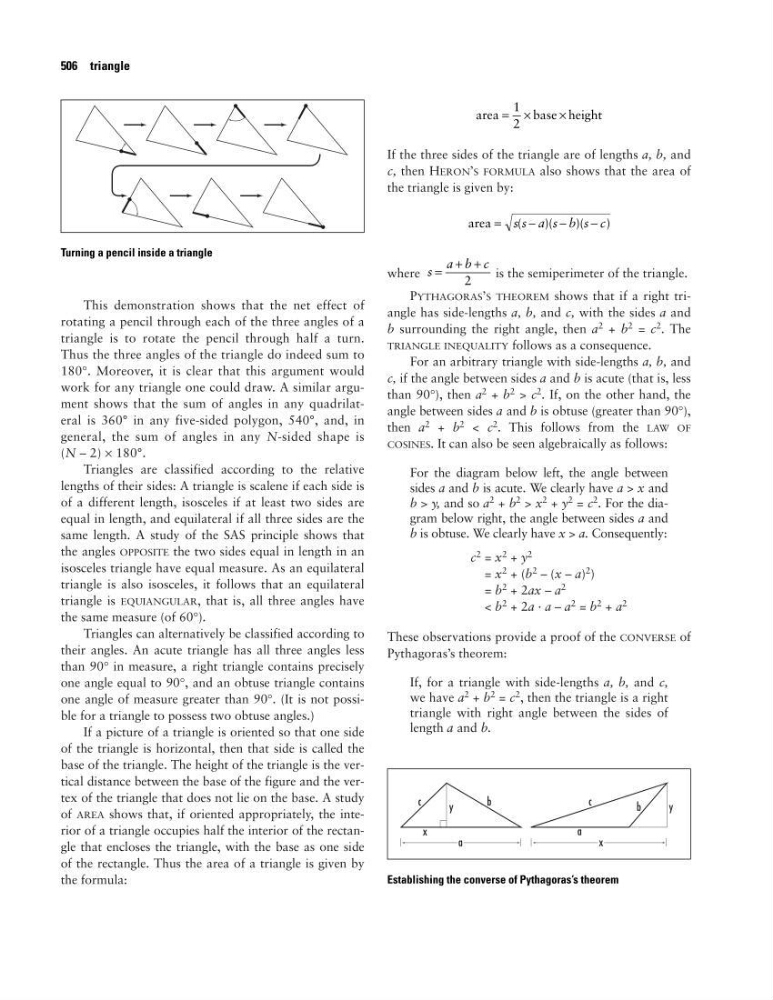
This demonstration shows that the net effect of
rotating a pencil through each of the three angles of a
triangle is to rotate the pencil through half a turn.
Thus the three angles of the triangle do indeed sum to
180°. Moreover, it is clear that this argument would
work for any triangle one could draw. A similar argument shows that the sum of angles in any quadrilateral is 360° in any five-sided polygon, 540°, and, in
general, the sum of angles in any N-sided shape is
(N – 2) × 180°.
Triangles are classified according to the relative
lengths of their sides: A triangle is scalene if each side is
of a different length, isosceles if at least two sides are
equal in length, and equilateral if all three sides are the
same length. A study of the SAS principle shows that
the angles OPPOSITE the two sides equal in length in an
isosceles triangle have equal measure. As an equilateral
triangle is also isosceles, it follows that an equilateral
triangle is EQUIANGULAR, that is, all three angles have
the same measure (of 60°).
Triangles can alternatively be classified according to
their angles. An acute triangle has all three angles less
than 90° in measure, a right triangle contains precisely
one angle equal to 90°, and an obtuse triangle contains
one angle of measure greater than 90°. (It is not possible for a triangle to possess two obtuse angles.)
If a picture of a triangle is oriented so that one side
of the triangle is horizontal, then that side is called the
base of the triangle. The height of the triangle is the vertical distance between the base of the figure and the vertex of the triangle that does not lie on the base. A study
of AREA shows that, if oriented appropriately, the interior of a triangle occupies half the interior of the rectangle that encloses the triangle, with the base as one side
of the rectangle. Thus the area of a triangle is given by
the formula:
If the three sides of the triangle are of lengths a, b, and
c, then HERON’S FORMULA also shows that the area of
the triangle is given by:
where
is the semiperimeter of the triangle.
PYTHAGORAS’S THEOREM shows that if a right triangle has side-lengths a, b, and c, with the sides a and
b surrounding the right angle, then a
2 + b
2 = c
2
. The
TRIANGLE INEQUALITY follows as a consequence.
For an arbitrary triangle with side-lengths a, b, and
c, if the angle between sides a and b is acute (that is, less
than 90°), then a
2 + b
2 > c
2
. If, on the other hand, the
angle between sides a and b is obtuse (greater than 90°),
then a
2 + b
2 < c
2
. This follows from the LAW OF
COSINES. It can also be seen algebraically as follows:
For the diagram below left, the angle between
sides a and b is acute. We clearly have a > x and
b > y, and so a
2 + b
2 > x
2 + y
2 = c
2
. For the diagram below right, the angle between sides a and
b is obtuse. We clearly have x > a. Consequently:
c
2 = x
2 + y
2
= x
2 + (b
2 – (x – a)
2
)
= b
2 + 2ax – a
2
< b
2 + 2a · a – a
2 = b
2 + a
2
These observations provide a proof of the CONVERSE of
Pythagoras’s theorem:
If, for a triangle with side-lengths a, b, and c,
we have a
2 + b
2 = c
2
, then the triangle is a right
triangle with right angle between the sides of
length a and b.
s
a b c
=
+ +
2
area =
−
−
−
s s a s b s c
(
)(
)(
)
area
base height
= ×
×
1
2
506 triangle
Turning a pencil inside a triangle
Establishing the converse of Pythagoras’s theorem
rotating a pencil through each of the three angles of a
triangle is to rotate the pencil through half a turn.
Thus the three angles of the triangle do indeed sum to
180°. Moreover, it is clear that this argument would
work for any triangle one could draw. A similar argument shows that the sum of angles in any quadrilateral is 360° in any five-sided polygon, 540°, and, in
general, the sum of angles in any N-sided shape is
(N – 2) × 180°.
Triangles are classified according to the relative
lengths of their sides: A triangle is scalene if each side is
of a different length, isosceles if at least two sides are
equal in length, and equilateral if all three sides are the
same length. A study of the SAS principle shows that
the angles OPPOSITE the two sides equal in length in an
isosceles triangle have equal measure. As an equilateral
triangle is also isosceles, it follows that an equilateral
triangle is EQUIANGULAR, that is, all three angles have
the same measure (of 60°).
Triangles can alternatively be classified according to
their angles. An acute triangle has all three angles less
than 90° in measure, a right triangle contains precisely
one angle equal to 90°, and an obtuse triangle contains
one angle of measure greater than 90°. (It is not possible for a triangle to possess two obtuse angles.)
If a picture of a triangle is oriented so that one side
of the triangle is horizontal, then that side is called the
base of the triangle. The height of the triangle is the vertical distance between the base of the figure and the vertex of the triangle that does not lie on the base. A study
of AREA shows that, if oriented appropriately, the interior of a triangle occupies half the interior of the rectangle that encloses the triangle, with the base as one side
of the rectangle. Thus the area of a triangle is given by
the formula:
If the three sides of the triangle are of lengths a, b, and
c, then HERON’S FORMULA also shows that the area of
the triangle is given by:
where
is the semiperimeter of the triangle.
PYTHAGORAS’S THEOREM shows that if a right triangle has side-lengths a, b, and c, with the sides a and
b surrounding the right angle, then a
2 + b
2 = c
2
. The
TRIANGLE INEQUALITY follows as a consequence.
For an arbitrary triangle with side-lengths a, b, and
c, if the angle between sides a and b is acute (that is, less
than 90°), then a
2 + b
2 > c
2
. If, on the other hand, the
angle between sides a and b is obtuse (greater than 90°),
then a
2 + b
2 < c
2
. This follows from the LAW OF
COSINES. It can also be seen algebraically as follows:
For the diagram below left, the angle between
sides a and b is acute. We clearly have a > x and
b > y, and so a
2 + b
2 > x
2 + y
2 = c
2
. For the diagram below right, the angle between sides a and
b is obtuse. We clearly have x > a. Consequently:
c
2 = x
2 + y
2
= x
2 + (b
2 – (x – a)
2
)
= b
2 + 2ax – a
2
< b
2 + 2a · a – a
2 = b
2 + a
2
These observations provide a proof of the CONVERSE of
Pythagoras’s theorem:
If, for a triangle with side-lengths a, b, and c,
we have a
2 + b
2 = c
2
, then the triangle is a right
triangle with right angle between the sides of
length a and b.
s
a b c
=
+ +
2
area =
−
−
−
s s a s b s c
(
)(
)(
)
area
base height
= ×
×
1
2
506 triangle
Turning a pencil inside a triangle
Establishing the converse of Pythagoras’s theorem