

has the effect of, respectively, reflecting points across
the x-axis, rotating points about the origin through an
angle θ, and projecting points onto the x-axis.
In algebra, a change in the form of a mathematical
expression, without changing its validity, is called a
transformation. For example, the action of EXPANDING
BRACKETS transforms the expression y = (x + 1)
2 into
the equivalent expression y = x
2 + 2x + 1.
See also AFFINE TRANSFORMATION; LINEAR TRANSFORMATION; PROJECTION.
transformation of coordinates (transformation of
axes) In coordinate geometry, it is often convenient to
change the position of a set of coordinate axes, either by
a ROTATION or a TRANSLATION, to simplify the expression of a given curve under study. For example, consider
the curve given by the equation x
2 – 6x + y
2 + 4y = 3. By
COMPLETING THE SQUARE, this equation can be rewritten:
(x – 3)
2 + (y + 2)
2 = 16
Setting X = x – 3 and Y = y + 2 this reads:
X
2 + Y
2 = 16
identifying the curve as a CIRCLE of radius four. In this
process we have, in effect, introduced two new coordinate axes, X and Y, each a translation of one of the
original x- and y-axes. The origin of the new coordinate system lies at the location where X = 0 and Y = 0,
that is, at the point (3,–2).
Changing from the use of CARTESIAN COORDINATES to POLAR COORDINATES, or, in three-dimensional
geometry, to SPHERICAL COORDINATES or CYLINDRICAL COORDINATES, is also deemed a transformation of
coordinates.
See also PRINCIPAL AXES; TRANSFORMATION.
translation See GEOMETRIC TRANSFORMATION.
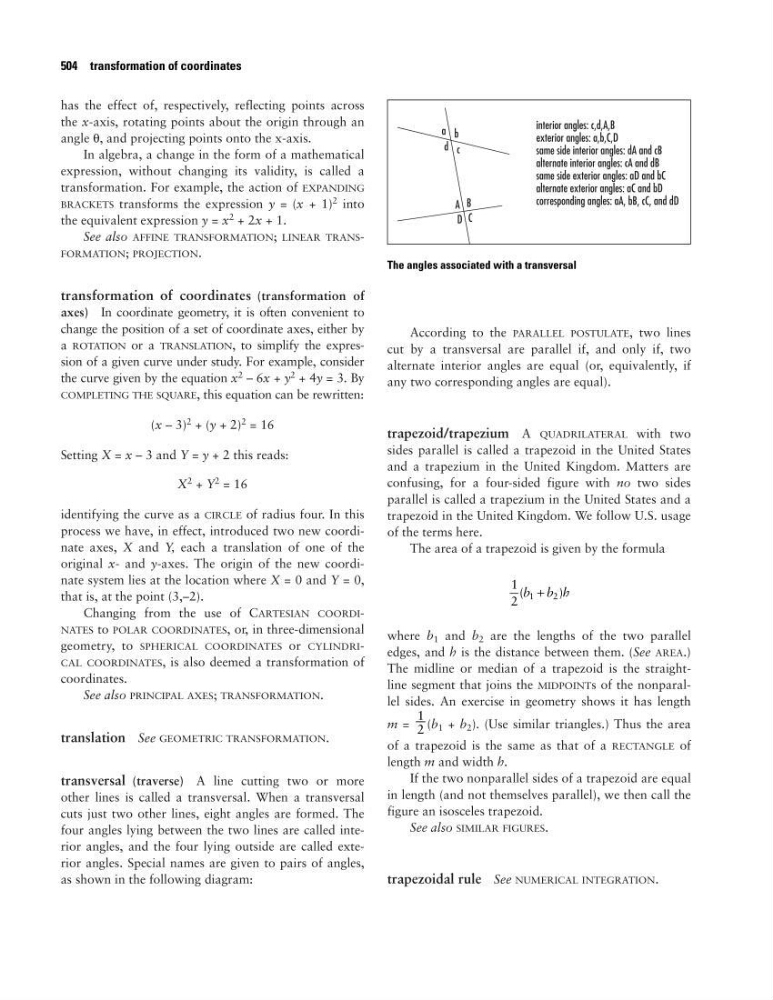
transversal (traverse) A line cutting two or more
other lines is called a transversal. When a transversal
cuts just two other lines, eight angles are formed. The
four angles lying between the two lines are called interior angles, and the four lying outside are called exterior angles. Special names are given to pairs of angles,
as shown in the following diagram:
According to the PARALLEL POSTULATE, two lines
cut by a transversal are parallel if, and only if, two
alternate interior angles are equal (or, equivalently, if
any two corresponding angles are equal).
trapezoid/trapezium A QUADRILATERAL with two
sides parallel is called a trapezoid in the United States
and a trapezium in the United Kingdom. Matters are
confusing, for a four-sided figure with no two sides
parallel is called a trapezium in the United States and a
trapezoid in the United Kingdom. We follow U.S. usage
of the terms here.
The area of a trapezoid is given by the formula
where b 1 and b 2 are the lengths of the two parallel
edges, and h is the distance between them. (See AREA.)
The midline or median of a trapezoid is the straightline segment that joins the MIDPOINTs of the nonparallel sides. An exercise in geometry shows it has length
m = (b 1 + b 2 ). (Use similar triangles.) Thus the area
of a trapezoid is the same as that of a RECTANGLE of
length m and width h.
If the two nonparallel sides of a trapezoid are equal
in length (and not themselves parallel), we then call the
figure an isosceles trapezoid.
See also SIMILAR FIGURES.
trapezoidal rule See NUMERICAL INTEGRATION.
1
–
2
1
2
1
2
(
)
b b h
+
504 transformation of coordinates
The angles associated with a transversal
the x-axis, rotating points about the origin through an
angle θ, and projecting points onto the x-axis.
In algebra, a change in the form of a mathematical
expression, without changing its validity, is called a
transformation. For example, the action of EXPANDING
BRACKETS transforms the expression y = (x + 1)
2 into
the equivalent expression y = x
2 + 2x + 1.
See also AFFINE TRANSFORMATION; LINEAR TRANSFORMATION; PROJECTION.
transformation of coordinates (transformation of
axes) In coordinate geometry, it is often convenient to
change the position of a set of coordinate axes, either by
a ROTATION or a TRANSLATION, to simplify the expression of a given curve under study. For example, consider
the curve given by the equation x
2 – 6x + y
2 + 4y = 3. By
COMPLETING THE SQUARE, this equation can be rewritten:
(x – 3)
2 + (y + 2)
2 = 16
Setting X = x – 3 and Y = y + 2 this reads:
X
2 + Y
2 = 16
identifying the curve as a CIRCLE of radius four. In this
process we have, in effect, introduced two new coordinate axes, X and Y, each a translation of one of the
original x- and y-axes. The origin of the new coordinate system lies at the location where X = 0 and Y = 0,
that is, at the point (3,–2).
Changing from the use of CARTESIAN COORDINATES to POLAR COORDINATES, or, in three-dimensional
geometry, to SPHERICAL COORDINATES or CYLINDRICAL COORDINATES, is also deemed a transformation of
coordinates.
See also PRINCIPAL AXES; TRANSFORMATION.
translation See GEOMETRIC TRANSFORMATION.
transversal (traverse) A line cutting two or more
other lines is called a transversal. When a transversal
cuts just two other lines, eight angles are formed. The
four angles lying between the two lines are called interior angles, and the four lying outside are called exterior angles. Special names are given to pairs of angles,
as shown in the following diagram:
According to the PARALLEL POSTULATE, two lines
cut by a transversal are parallel if, and only if, two
alternate interior angles are equal (or, equivalently, if
any two corresponding angles are equal).
trapezoid/trapezium A QUADRILATERAL with two
sides parallel is called a trapezoid in the United States
and a trapezium in the United Kingdom. Matters are
confusing, for a four-sided figure with no two sides
parallel is called a trapezium in the United States and a
trapezoid in the United Kingdom. We follow U.S. usage
of the terms here.
The area of a trapezoid is given by the formula
where b 1 and b 2 are the lengths of the two parallel
edges, and h is the distance between them. (See AREA.)
The midline or median of a trapezoid is the straightline segment that joins the MIDPOINTs of the nonparallel sides. An exercise in geometry shows it has length
m = (b 1 + b 2 ). (Use similar triangles.) Thus the area
of a trapezoid is the same as that of a RECTANGLE of
length m and width h.
If the two nonparallel sides of a trapezoid are equal
in length (and not themselves parallel), we then call the
figure an isosceles trapezoid.
See also SIMILAR FIGURES.
trapezoidal rule See NUMERICAL INTEGRATION.
1
–
2
1
2
1
2
(
)
b b h
+
504 transformation of coordinates
The angles associated with a transversal