

Tartaglia, Niccolò (1499–1557) Italian Algebra Born
in Brescia, Italy, in 1499 (his exact birth date is not
known), scholar Niccolò Tartaglia is remembered as one
of the first mathematicians to discover the long-sought
solution to the general CUBIC EQUATION. His method was
published, without permission, by GIROLAMO CARDANO
(1501–76), to whom he had revealed the details in confidence. Tartaglia also published the influential three-volume text General trattato di numeri et misure (Treatise
on numbers and measures), and was the first Italian
scholar to translate and publish EUCLID’S famous treatise
THE ELEMENTS.
Tartaglia, born Niccolò Fontana, was only a boy
when the French invaded his hometown in 1512. During the massacre Tartaglia received severe sword
wounds to his jaw and palate and was left for dead in a
cathedral. He survived, but thereafter could only speak
with difficulty, hence his nickname, Tartaglia, meaning
“stammerer.”
During the Renaissance, scholars were mostly supported by rich patrons and had to prove their talent by
defeating other scholars in public competitions. For
this reason, mathematicians would keep their methods
secret. In 1535 Tartaglia discovered a means for solving
cubic equations of the form x
3 + ax
2 = b and began
publicizing his achievement. Earlier, SCIPIONE DEL
FERRO (1465–1526) had revealed to his student Antonio Maria Fiore (ca. 1506–60) a method of solving
Tartaglia, Niccolò 493
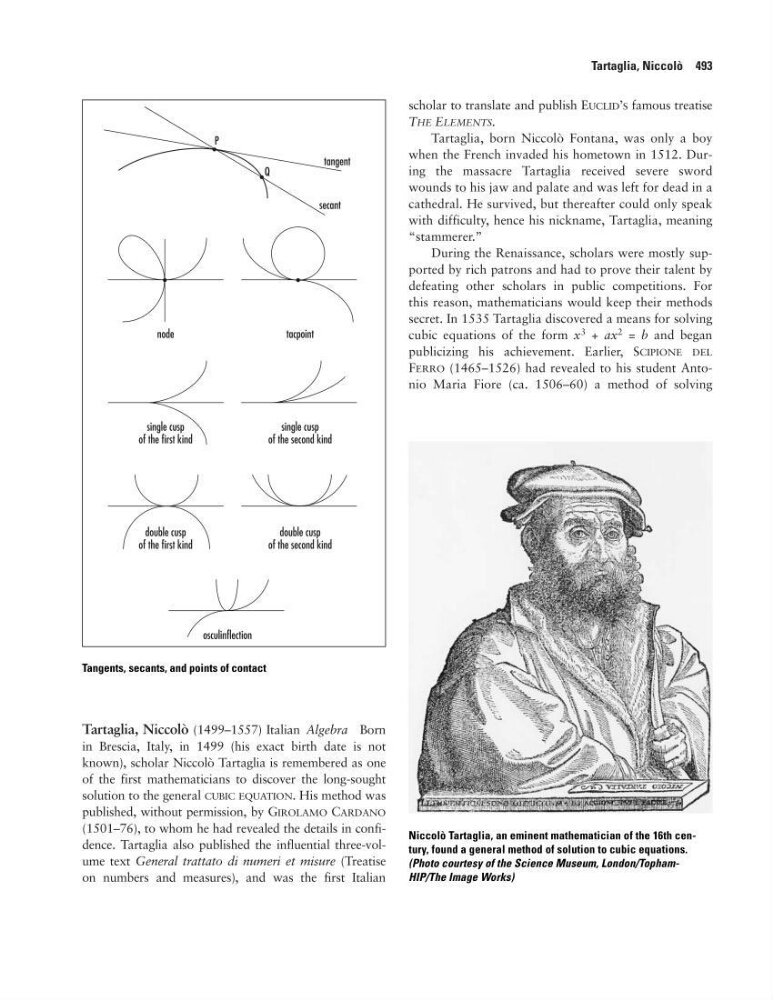
Tangents, secants, and points of contact
Niccolò Tartaglia, an eminent mathematician of the 16th century, found a general method of solution to cubic equations.
(Photo courtesy of the Science Museum, London/TophamHIP/The Image Works)
in Brescia, Italy, in 1499 (his exact birth date is not
known), scholar Niccolò Tartaglia is remembered as one
of the first mathematicians to discover the long-sought
solution to the general CUBIC EQUATION. His method was
published, without permission, by GIROLAMO CARDANO
(1501–76), to whom he had revealed the details in confidence. Tartaglia also published the influential three-volume text General trattato di numeri et misure (Treatise
on numbers and measures), and was the first Italian
scholar to translate and publish EUCLID’S famous treatise
THE ELEMENTS.
Tartaglia, born Niccolò Fontana, was only a boy
when the French invaded his hometown in 1512. During the massacre Tartaglia received severe sword
wounds to his jaw and palate and was left for dead in a
cathedral. He survived, but thereafter could only speak
with difficulty, hence his nickname, Tartaglia, meaning
“stammerer.”
During the Renaissance, scholars were mostly supported by rich patrons and had to prove their talent by
defeating other scholars in public competitions. For
this reason, mathematicians would keep their methods
secret. In 1535 Tartaglia discovered a means for solving
cubic equations of the form x
3 + ax
2 = b and began
publicizing his achievement. Earlier, SCIPIONE DEL
FERRO (1465–1526) had revealed to his student Antonio Maria Fiore (ca. 1506–60) a method of solving
Tartaglia, Niccolò 493
Tangents, secants, and points of contact
Niccolò Tartaglia, an eminent mathematician of the 16th century, found a general method of solution to cubic equations.
(Photo courtesy of the Science Museum, London/TophamHIP/The Image Works)