

exists a general formula akin to the quadratic formula
for quadratic equations that solves all fifth (or higher)
degree equations.
The work of ÉVARISTE GALOIS (1811–32) provided
the first important steps toward understanding the general properties of solutions to polynomial equations,
and Norwegian mathematician NIELS HENRIK ABEL
(1802–29) provided the first proof that there can be no
general formula for the solution of fifth-degree equations
via radicals. This is surprising given that the FUNDAMENTAL THEOREM OF ALGEBRA assures that every fifthdegree equation has precisely five solutions. Abel’s result
shows then that, in general, not every solution can be
expressed in terms of a finite application of simple arithmetic operations on the coefficients of the equation.
As mentioned earlier, some special quintics do have
solutions by radicals. For example, ABRAHAM DE
MOIVRE (1667–1754) showed that the solutions of a
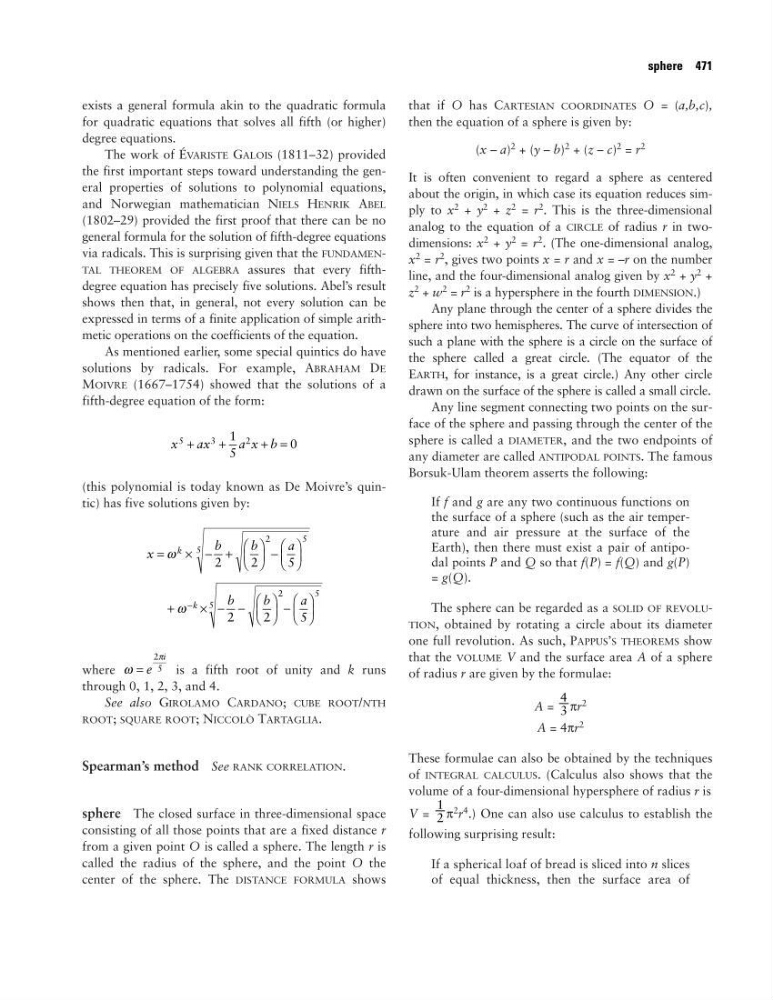
fifth-degree equation of the form:
(this polynomial is today known as De Moivre’s quintic) has five solutions given by:
where
is a fifth root of unity and k runs
through 0, 1, 2, 3, and 4.
See also GIROLAMO CARDANO; CUBE ROOT/NTH
ROOT; SQUARE ROOT; NICCOLÒ TARTAGLIA.
Spearman’s method See RANK CORRELATION.
sphere The closed surface in three-dimensional space
consisting of all those points that are a fixed distance r
from a given point O is called a sphere. The length r is
called the radius of the sphere, and the point O the
center of the sphere. The DISTANCE FORMULA shows
that if O has CARTESIAN COORDINATES O = (a,b,c),
then the equation of a sphere is given by:
(x – a)
2 + (y – b)
2 + (z – c)
2 = r
2
It is often convenient to regard a sphere as centered
about the origin, in which case its equation reduces simply to x
2 + y
2 + z
2 = r
2
. This is the three-dimensional
analog to the equation of a CIRCLE of radius r in twodimensions: x
2 + y
2 = r
2
. (The one-dimensional analog,
x
2 = r
2
, gives two points x = r and x = –r on the number
line, and the four-dimensional analog given by x
2 + y
2 +
z
2 + w
2 = r
2 is a hypersphere in the fourth DIMENSION.)
Any plane through the center of a sphere divides the
sphere into two hemispheres. The curve of intersection of
such a plane with the sphere is a circle on the surface of
the sphere called a great circle. (The equator of the
EARTH, for instance, is a great circle.) Any other circle
drawn on the surface of the sphere is called a small circle.
Any line segment connecting two points on the surface of the sphere and passing through the center of the
sphere is called a DIAMETER, and the two endpoints of
any diameter are called ANTIPODAL POINTS. The famous
Borsuk-Ulam theorem asserts the following:
If f and g are any two continuous functions on
the surface of a sphere (such as the air temperature and air pressure at the surface of the
Earth), then there must exist a pair of antipodal points P and Q so that f(P) = f(Q) and g(P)
= g(Q).
The sphere can be regarded as a SOLID OF REVOLUTION, obtained by rotating a circle about its diameter
one full revolution. As such, PAPPUS’S THEOREMS show
that the VOLUME V and the surface area A of a sphere
of radius r are given by the formulae:
A = πr
2
A = 4πr
2
These formulae can also be obtained by the techniques
of INTEGRAL CALCULUS. (Calculus also shows that the
volume of a four-dimensional hypersphere of radius r is
V = π
2
r
4
.) One can also use calculus to establish the
following surprising result:
If a spherical loaf of bread is sliced into n slices
of equal thickness, then the surface area of
1
–
2
4
–
3
ω
π
= e
i
2
5
x
b
b
a
b
b
a
k
k
=
× − +
−
+
× − −
−
−
ω
ω
2
2
5
2
2
5
2
5
5
2
5
5
x ax
a x b
5
3
2
1
5
0
+
+
+ =
sphere 471
for quadratic equations that solves all fifth (or higher)
degree equations.
The work of ÉVARISTE GALOIS (1811–32) provided
the first important steps toward understanding the general properties of solutions to polynomial equations,
and Norwegian mathematician NIELS HENRIK ABEL
(1802–29) provided the first proof that there can be no
general formula for the solution of fifth-degree equations
via radicals. This is surprising given that the FUNDAMENTAL THEOREM OF ALGEBRA assures that every fifthdegree equation has precisely five solutions. Abel’s result
shows then that, in general, not every solution can be
expressed in terms of a finite application of simple arithmetic operations on the coefficients of the equation.
As mentioned earlier, some special quintics do have
solutions by radicals. For example, ABRAHAM DE
MOIVRE (1667–1754) showed that the solutions of a
fifth-degree equation of the form:
(this polynomial is today known as De Moivre’s quintic) has five solutions given by:
where
is a fifth root of unity and k runs
through 0, 1, 2, 3, and 4.
See also GIROLAMO CARDANO; CUBE ROOT/NTH
ROOT; SQUARE ROOT; NICCOLÒ TARTAGLIA.
Spearman’s method See RANK CORRELATION.
sphere The closed surface in three-dimensional space
consisting of all those points that are a fixed distance r
from a given point O is called a sphere. The length r is
called the radius of the sphere, and the point O the
center of the sphere. The DISTANCE FORMULA shows
that if O has CARTESIAN COORDINATES O = (a,b,c),
then the equation of a sphere is given by:
(x – a)
2 + (y – b)
2 + (z – c)
2 = r
2
It is often convenient to regard a sphere as centered
about the origin, in which case its equation reduces simply to x
2 + y
2 + z
2 = r
2
. This is the three-dimensional
analog to the equation of a CIRCLE of radius r in twodimensions: x
2 + y
2 = r
2
. (The one-dimensional analog,
x
2 = r
2
, gives two points x = r and x = –r on the number
line, and the four-dimensional analog given by x
2 + y
2 +
z
2 + w
2 = r
2 is a hypersphere in the fourth DIMENSION.)
Any plane through the center of a sphere divides the
sphere into two hemispheres. The curve of intersection of
such a plane with the sphere is a circle on the surface of
the sphere called a great circle. (The equator of the
EARTH, for instance, is a great circle.) Any other circle
drawn on the surface of the sphere is called a small circle.
Any line segment connecting two points on the surface of the sphere and passing through the center of the
sphere is called a DIAMETER, and the two endpoints of
any diameter are called ANTIPODAL POINTS. The famous
Borsuk-Ulam theorem asserts the following:
If f and g are any two continuous functions on
the surface of a sphere (such as the air temperature and air pressure at the surface of the
Earth), then there must exist a pair of antipodal points P and Q so that f(P) = f(Q) and g(P)
= g(Q).
The sphere can be regarded as a SOLID OF REVOLUTION, obtained by rotating a circle about its diameter
one full revolution. As such, PAPPUS’S THEOREMS show
that the VOLUME V and the surface area A of a sphere
of radius r are given by the formulae:
A = πr
2
A = 4πr
2
These formulae can also be obtained by the techniques
of INTEGRAL CALCULUS. (Calculus also shows that the
volume of a four-dimensional hypersphere of radius r is
V = π
2
r
4
.) One can also use calculus to establish the
following surprising result:
If a spherical loaf of bread is sliced into n slices
of equal thickness, then the surface area of
1
–
2
4
–
3
ω
π
= e
i
2
5
x
b
b
a
b
b
a
k
k
=
× − +
−
+
× − −
−
−
ω
ω
2
2
5
2
2
5
2
5
5
2
5
5
x ax
a x b
5
3
2
1
5
0
+
+
+ =
sphere 471