

Defense of the Mathematicians Against the Objections
of the Author of The Analyst,” defending the logical
foundations of SIR ISAAC NEWTON’s newly invented
CALCULUS. Despite the apparent lack of published mathematical work, Bayes was nonetheless elected a fellow
of the prestigious academic ROYAL SOCIETY in 1742.
Bayes retired from the ministry in 1752 but
remained in Tunbridge Wells until his death on April
17, 1761. His friend, Richard Price, discovered the
now-famous paper on probability theory among his
belongings and submitted it for publication. A second
paper, “A Letter on Asymptotic Series from Bayes to
John Canton,” one on asymptotic series, was also published after Bayes’s death. The theoretical approach of
inferential statistics Bayes proposed remains an active
area of research today.
See also BAYES’S THEOREM; STATISTICS: INFERENTIAL.
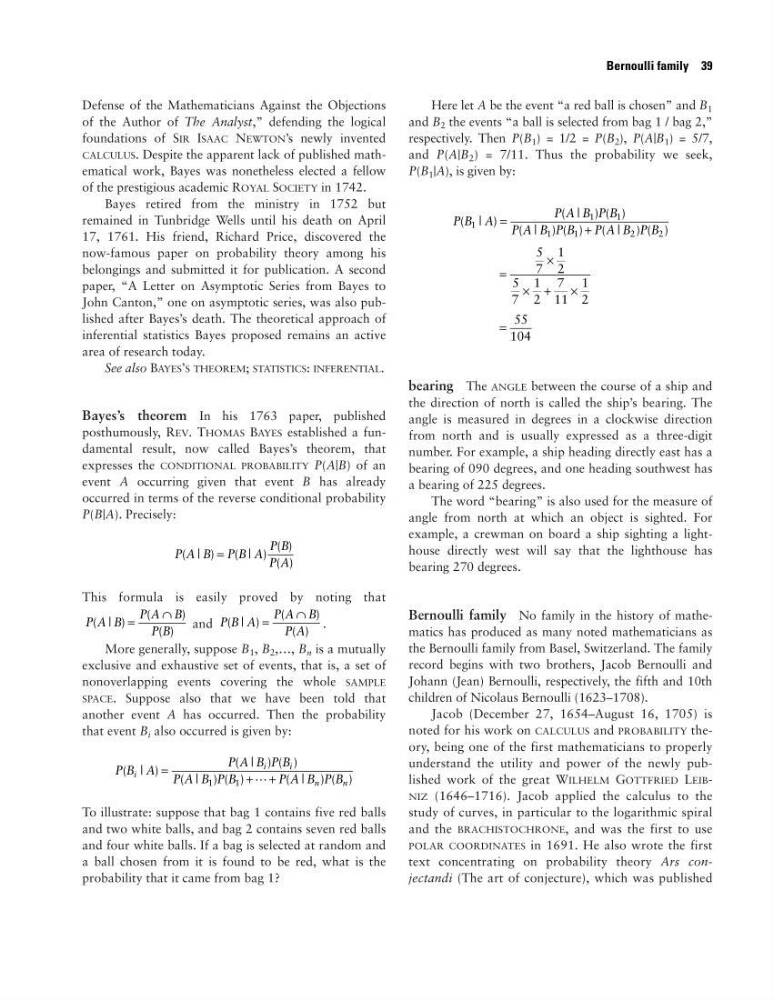
Bayes’s theorem In his 1763 paper, published
posthumously, REV. THOMAS BAYES established a fundamental result, now called Bayes’s theorem, that
expresses the CONDITIONAL PROBABILITY P(A|B) of an
event A occurring given that event B has already
occurred in terms of the reverse conditional probability
P(B|A). Precisely:
This formula is easily proved by noting that
and
.
More generally, suppose B 1 , B 2 ,…, B n is a mutually
exclusive and exhaustive set of events, that is, a set of
nonoverlapping events covering the whole SAMPLE
SPACE. Suppose also that we have been told that
another event A has occurred. Then the probability
that event B i also occurred is given by:
To illustrate: suppose that bag 1 contains five red balls
and two white balls, and bag 2 contains seven red balls
and four white balls. If a bag is selected at random and
a ball chosen from it is found to be red, what is the
probability that it came from bag 1?
Here let A be the event “a red ball is chosen” and B 1
and B 2 the events “a ball is selected from bag 1 / bag 2,”
respectively. Then P(B 1 ) = 1/2 = P(B 2 ), P(A|B 1 ) = 5/7,
and P(A|B 2 ) = 7/11. Thus the probability we seek,
P(B 1| A), is given by:
bearing The ANGLE between the course of a ship and
the direction of north is called the ship’s bearing. The
angle is measured in degrees in a clockwise direction
from north and is usually expressed as a three-digit
number. For example, a ship heading directly east has a
bearing of 090 degrees, and one heading southwest has
a bearing of 225 degrees.
The word “bearing” is also used for the measure of
angle from north at which an object is sighted. For
example, a crewman on board a ship sighting a lighthouse directly west will say that the lighthouse has
bearing 270 degrees.
Bernoulli family No family in the history of mathematics has produced as many noted mathematicians as
the Bernoulli family from Basel, Switzerland. The family
record begins with two brothers, Jacob Bernoulli and
Johann (Jean) Bernoulli, respectively, the fifth and 10th
children of Nicolaus Bernoulli (1623–1708).
Jacob (December 27, 1654–August 16, 1705) is
noted for his work on CALCULUS and PROBABILITY theory, being one of the first mathematicians to properly
understand the utility and power of the newly published work of the great WILHELM GOTTFRIED LEIBNIZ (1646–1716). Jacob applied the calculus to the
study of curves, in particular to the logarithmic spiral
and the BRACHISTOCHRONE, and was the first to use
POLAR COORDINATES in 1691. He also wrote the first
text concentrating on probability theory Ars conjectandi (The art of conjecture), which was published
P B A
P A B P B
P A B P B
P A B P B
( | )
( | ) ( )
( | ) ( ) ( | ) ( )
1
1
1
1
1
2
2
5
7
1
2
5
7
1
2
7
11
1
2
55
104
=
+
=
×
× +
×
=
P B A
P A B P B
P A B P B
P A B P B
i
i
i
n
n
( | )
( | ) ( )
( | ) ( )
( | ) ( )
=
+ +
1
1
L
P B A
P A B
P A
( | )
(
)
( )
=
∩
P A B
P A B
P B
( | )
(
)
( )
=
∩
P A B P B A
P B
P A
( | )
( | )
( )
( )
=
Bernoulli family 39
of the Author of The Analyst,” defending the logical
foundations of SIR ISAAC NEWTON’s newly invented
CALCULUS. Despite the apparent lack of published mathematical work, Bayes was nonetheless elected a fellow
of the prestigious academic ROYAL SOCIETY in 1742.
Bayes retired from the ministry in 1752 but
remained in Tunbridge Wells until his death on April
17, 1761. His friend, Richard Price, discovered the
now-famous paper on probability theory among his
belongings and submitted it for publication. A second
paper, “A Letter on Asymptotic Series from Bayes to
John Canton,” one on asymptotic series, was also published after Bayes’s death. The theoretical approach of
inferential statistics Bayes proposed remains an active
area of research today.
See also BAYES’S THEOREM; STATISTICS: INFERENTIAL.
Bayes’s theorem In his 1763 paper, published
posthumously, REV. THOMAS BAYES established a fundamental result, now called Bayes’s theorem, that
expresses the CONDITIONAL PROBABILITY P(A|B) of an
event A occurring given that event B has already
occurred in terms of the reverse conditional probability
P(B|A). Precisely:
This formula is easily proved by noting that
and
.
More generally, suppose B 1 , B 2 ,…, B n is a mutually
exclusive and exhaustive set of events, that is, a set of
nonoverlapping events covering the whole SAMPLE
SPACE. Suppose also that we have been told that
another event A has occurred. Then the probability
that event B i also occurred is given by:
To illustrate: suppose that bag 1 contains five red balls
and two white balls, and bag 2 contains seven red balls
and four white balls. If a bag is selected at random and
a ball chosen from it is found to be red, what is the
probability that it came from bag 1?
Here let A be the event “a red ball is chosen” and B 1
and B 2 the events “a ball is selected from bag 1 / bag 2,”
respectively. Then P(B 1 ) = 1/2 = P(B 2 ), P(A|B 1 ) = 5/7,
and P(A|B 2 ) = 7/11. Thus the probability we seek,
P(B 1| A), is given by:
bearing The ANGLE between the course of a ship and
the direction of north is called the ship’s bearing. The
angle is measured in degrees in a clockwise direction
from north and is usually expressed as a three-digit
number. For example, a ship heading directly east has a
bearing of 090 degrees, and one heading southwest has
a bearing of 225 degrees.
The word “bearing” is also used for the measure of
angle from north at which an object is sighted. For
example, a crewman on board a ship sighting a lighthouse directly west will say that the lighthouse has
bearing 270 degrees.
Bernoulli family No family in the history of mathematics has produced as many noted mathematicians as
the Bernoulli family from Basel, Switzerland. The family
record begins with two brothers, Jacob Bernoulli and
Johann (Jean) Bernoulli, respectively, the fifth and 10th
children of Nicolaus Bernoulli (1623–1708).
Jacob (December 27, 1654–August 16, 1705) is
noted for his work on CALCULUS and PROBABILITY theory, being one of the first mathematicians to properly
understand the utility and power of the newly published work of the great WILHELM GOTTFRIED LEIBNIZ (1646–1716). Jacob applied the calculus to the
study of curves, in particular to the logarithmic spiral
and the BRACHISTOCHRONE, and was the first to use
POLAR COORDINATES in 1691. He also wrote the first
text concentrating on probability theory Ars conjectandi (The art of conjecture), which was published
P B A
P A B P B
P A B P B
P A B P B
( | )
( | ) ( )
( | ) ( ) ( | ) ( )
1
1
1
1
1
2
2
5
7
1
2
5
7
1
2
7
11
1
2
55
104
=
+
=
×
× +
×
=
P B A
P A B P B
P A B P B
P A B P B
i
i
i
n
n
( | )
( | ) ( )
( | ) ( )
( | ) ( )
=
+ +
1
1
L
P B A
P A B
P A
( | )
(
)
( )
=
∩
P A B
P A B
P B
( | )
(
)
( )
=
∩
P A B P B A
P B
P A
( | )
( | )
( )
( )
=
Bernoulli family 39