

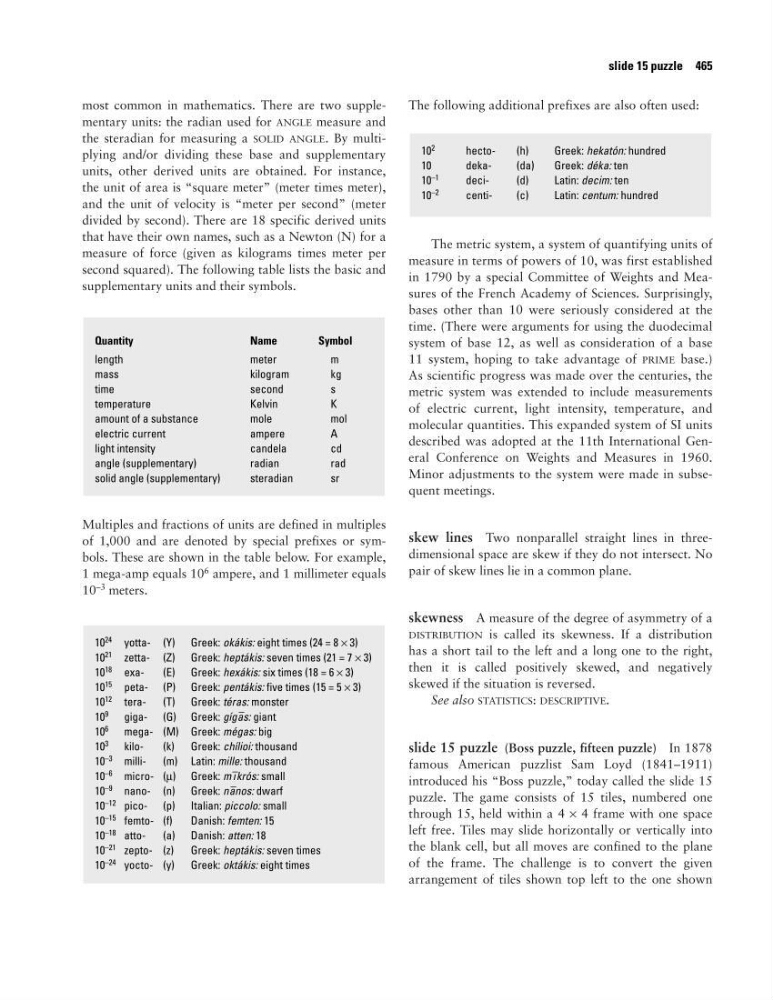
most common in mathematics. There are two supplementary units: the radian used for ANGLE measure and
the steradian for measuring a SOLID ANGLE. By multiplying and/or dividing these base and supplementary
units, other derived units are obtained. For instance,
the unit of area is “square meter” (meter times meter),
and the unit of velocity is “meter per second” (meter
divided by second). There are 18 specific derived units
that have their own names, such as a Newton (N) for a
measure of force (given as kilograms times meter per
second squared). The following table lists the basic and
supplementary units and their symbols.
Multiples and fractions of units are defined in multiples
of 1,000 and are denoted by special prefixes or symbols. These are shown in the table below. For example,
1 mega-amp equals 10
6 ampere, and 1 millimeter equals
10
–3 meters.
The following additional prefixes are also often used:
The metric system, a system of quantifying units of
measure in terms of powers of 10, was first established
in 1790 by a special Committee of Weights and Measures of the French Academy of Sciences. Surprisingly,
bases other than 10 were seriously considered at the
time. (There were arguments for using the duodecimal
system of base 12, as well as consideration of a base
11 system, hoping to take advantage of PRIME base.)
As scientific progress was made over the centuries, the
metric system was extended to include measurements
of electric current, light intensity, temperature, and
molecular quantities. This expanded system of SI units
described was adopted at the 11th International General Conference on Weights and Measures in 1960.
Minor adjustments to the system were made in subsequent meetings.
skew lines Two nonparallel straight lines in threedimensional space are skew if they do not intersect. No
pair of skew lines lie in a common plane.
skewness A measure of the degree of asymmetry of a
DISTRIBUTION is called its skewness. If a distribution
has a short tail to the left and a long one to the right,
then it is called positively skewed, and negatively
skewed if the situation is reversed.
See also STATISTICS: DESCRIPTIVE.
slide 15 puzzle (Boss puzzle, fifteen puzzle) In 1878
famous American puzzlist Sam Loyd (1841–1911)
introduced his “Boss puzzle,” today called the slide 15
puzzle. The game consists of 15 tiles, numbered one
through 15, held within a 4 × 4 frame with one space
left free. Tiles may slide horizontally or vertically into
the blank cell, but all moves are confined to the plane
of the frame. The challenge is to convert the given
arrangement of tiles shown top left to the one shown
10
2
hecto(h)
Greek: hekatón: hundred
10
deka(da)
Greek: déka: ten
10
–1
deci(d)
Latin: decim: ten
10
–2
centi(c)
Latin: centum: hundred
10
24
yotta- (Y) Greek: okákis: eight times (24 = 8 × 3)
10
21
zetta- (Z) Greek: heptákis: seven times (21 = 7 × 3)
10
18
exa(E) Greek: hexákis: six times (18 = 6 × 3)
10
15
peta- (P) Greek: pentákis: five times (15 = 5 × 3)
10
12
tera- (T) Greek: téras: monster
10
9
giga- (G) Greek: gíg –
as: giant
10
6
mega- (M) Greek: mégas: big
10
3
kilo(k) Greek: chílioi: thousand
10
–3 milli- (m) Latin: mille: thousand
10
–6 micro- (µ) Greek: m – ıkrós: small
10
–9 nano- (n) Greek: n –
anos: dwarf
10
–12 pico- (p) Italian: piccolo: small
10
–15 femto- (f)
Danish: femten: 15
10
–18 atto(a) Danish: atten: 18
10
–21 zepto- (z)
Greek: heptákis: seven times
10
–24 yocto- (y) Greek: oktákis: eight times
Quantity
Name
Symbol
length
meter
m
mass
kilogram
kg
time
second
s
temperature
Kelvin
K
amount of a substance
mole
mol
electric current
ampere
A
light intensity
candela
cd
angle (supplementary)
radian
rad
solid angle (supplementary)
steradian
sr
slide 15 puzzle 465
the steradian for measuring a SOLID ANGLE. By multiplying and/or dividing these base and supplementary
units, other derived units are obtained. For instance,
the unit of area is “square meter” (meter times meter),
and the unit of velocity is “meter per second” (meter
divided by second). There are 18 specific derived units
that have their own names, such as a Newton (N) for a
measure of force (given as kilograms times meter per
second squared). The following table lists the basic and
supplementary units and their symbols.
Multiples and fractions of units are defined in multiples
of 1,000 and are denoted by special prefixes or symbols. These are shown in the table below. For example,
1 mega-amp equals 10
6 ampere, and 1 millimeter equals
10
–3 meters.
The following additional prefixes are also often used:
The metric system, a system of quantifying units of
measure in terms of powers of 10, was first established
in 1790 by a special Committee of Weights and Measures of the French Academy of Sciences. Surprisingly,
bases other than 10 were seriously considered at the
time. (There were arguments for using the duodecimal
system of base 12, as well as consideration of a base
11 system, hoping to take advantage of PRIME base.)
As scientific progress was made over the centuries, the
metric system was extended to include measurements
of electric current, light intensity, temperature, and
molecular quantities. This expanded system of SI units
described was adopted at the 11th International General Conference on Weights and Measures in 1960.
Minor adjustments to the system were made in subsequent meetings.
skew lines Two nonparallel straight lines in threedimensional space are skew if they do not intersect. No
pair of skew lines lie in a common plane.
skewness A measure of the degree of asymmetry of a
DISTRIBUTION is called its skewness. If a distribution
has a short tail to the left and a long one to the right,
then it is called positively skewed, and negatively
skewed if the situation is reversed.
See also STATISTICS: DESCRIPTIVE.
slide 15 puzzle (Boss puzzle, fifteen puzzle) In 1878
famous American puzzlist Sam Loyd (1841–1911)
introduced his “Boss puzzle,” today called the slide 15
puzzle. The game consists of 15 tiles, numbered one
through 15, held within a 4 × 4 frame with one space
left free. Tiles may slide horizontally or vertically into
the blank cell, but all moves are confined to the plane
of the frame. The challenge is to convert the given
arrangement of tiles shown top left to the one shown
10
2
hecto(h)
Greek: hekatón: hundred
10
deka(da)
Greek: déka: ten
10
–1
deci(d)
Latin: decim: ten
10
–2
centi(c)
Latin: centum: hundred
10
24
yotta- (Y) Greek: okákis: eight times (24 = 8 × 3)
10
21
zetta- (Z) Greek: heptákis: seven times (21 = 7 × 3)
10
18
exa(E) Greek: hexákis: six times (18 = 6 × 3)
10
15
peta- (P) Greek: pentákis: five times (15 = 5 × 3)
10
12
tera- (T) Greek: téras: monster
10
9
giga- (G) Greek: gíg –
as: giant
10
6
mega- (M) Greek: mégas: big
10
3
kilo(k) Greek: chílioi: thousand
10
–3 milli- (m) Latin: mille: thousand
10
–6 micro- (µ) Greek: m – ıkrós: small
10
–9 nano- (n) Greek: n –
anos: dwarf
10
–12 pico- (p) Italian: piccolo: small
10
–15 femto- (f)
Danish: femten: 15
10
–18 atto(a) Danish: atten: 18
10
–21 zepto- (z)
Greek: heptákis: seven times
10
–24 yocto- (y) Greek: oktákis: eight times
Quantity
Name
Symbol
length
meter
m
mass
kilogram
kg
time
second
s
temperature
Kelvin
K
amount of a substance
mole
mol
electric current
ampere
A
light intensity
candela
cd
angle (supplementary)
radian
rad
solid angle (supplementary)
steradian
sr
slide 15 puzzle 465