

results. (Arithmetic was performed on a counting
board such as an ABACUS.)
The system of Roman numerals remained popular
in Western Europe until the 17th century. Although the
system was eventually replaced by the HINDU-ARABIC
NUMERAL system we use today, it still remains a tradition to use Roman numerals for clock faces, for the
inscription of dates on buildings, and for copyright
data on films and books, for instance.
See also BASE OF A NUMBER SYSTEM; DECIMAL REPRESENTATION; EGYPTIAN MATHEMATICS; NUMBER.
root (zero) Any value of a variable in an equation that
satisfies the equation is called a root of the equation. For
example, the equation 2x + 1 = 7 has root x = 3, and
the equation a
3 = 8 has root a = 2. As any equation
with a variable x can be written in the form f(x) = 0 for
some FUNCTION f, the roots of an equation are sometimes called the “zeros” of the associated function f.
If f(x) is a polynomial, then the equation f(x) = 0 is
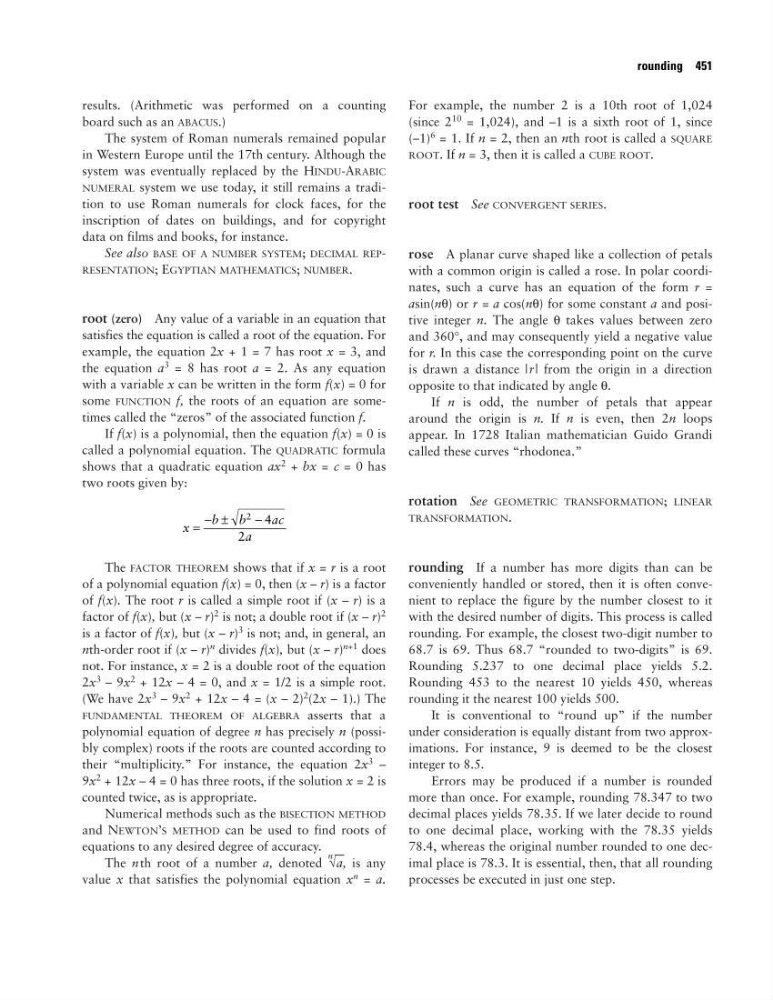
called a polynomial equation. The QUADRATIC formula
shows that a quadratic equation ax
2 + bx = c = 0 has
two roots given by:
The FACTOR THEOREM shows that if x = r is a root
of a polynomial equation f(x) = 0, then (x – r) is a factor
of f(x). The root r is called a simple root if (x – r) is a
factor of f(x), but (x – r)
2 is not; a double root if (x – r)
2
is a factor of f(x), but (x – r)
3 is not; and, in general, an
nth-order root if (x – r)
n divides f(x), but (x – r)
n+1 does
not. For instance, x = 2 is a double root of the equation
2x
3 – 9x
2 + 12x – 4 = 0, and x = 1/2 is a simple root.
(We have 2x
3 – 9x
2 + 12x – 4 = (x – 2)
2
(2x – 1).) The
FUNDAMENTAL THEOREM OF ALGEBRA asserts that a
polynomial equation of degree n has precisely n (possibly complex) roots if the roots are counted according to
their “multiplicity.” For instance, the equation 2x
3 –
9x
2 + 12x – 4 = 0 has three roots, if the solution x = 2 is
counted twice, as is appropriate.
Numerical methods such as the BISECTION METHOD
and NEWTON’S METHOD can be used to find roots of
equations to any desired degree of accuracy.
The nth root of a number a, denoted
n
√
–
a, is any
value x that satisfies the polynomial equation x
n = a.
For example, the number 2 is a 10th root of 1,024
(since 2
10 = 1,024), and –1 is a sixth root of 1, since
(–1)
6 = 1. If n = 2, then an nth root is called a SQUARE
ROOT. If n = 3, then it is called a CUBE ROOT.
root test See CONVERGENT SERIES.
rose A planar curve shaped like a collection of petals
with a common origin is called a rose. In polar coordinates, such a curve has an equation of the form r =
asin(nθ) or r = a cos(nθ) for some constant a and positive integer n. The angle θ takes values between zero
and 360°, and may consequently yield a negative value
for r. In this case the corresponding point on the curve
is drawn a distance | r | from the origin in a direction
opposite to that indicated by angle θ.
If n is odd, the number of petals that appear
around the origin is n. If n is even, then 2n loops
appear. In 1728 Italian mathematician Guido Grandi
called these curves “rhodonea.”
rotation See GEOMETRIC TRANSFORMATION; LINEAR
TRANSFORMATION.
rounding If a number has more digits than can be
conveniently handled or stored, then it is often convenient to replace the figure by the number closest to it
with the desired number of digits. This process is called
rounding. For example, the closest two-digit number to
68.7 is 69. Thus 68.7 “rounded to two-digits” is 69.
Rounding 5.237 to one decimal place yields 5.2.
Rounding 453 to the nearest 10 yields 450, whereas
rounding it the nearest 100 yields 500.
It is conventional to “round up” if the number
under consideration is equally distant from two approximations. For instance, 9 is deemed to be the closest
integer to 8.5.
Errors may be produced if a number is rounded
more than once. For example, rounding 78.347 to two
decimal places yields 78.35. If we later decide to round
to one decimal place, working with the 78.35 yields
78.4, whereas the original number rounded to one decimal place is 78.3. It is essential, then, that all rounding
processes be executed in just one step.
x
b
b
ac
a
=
− ±
−
2
4
2
rounding 451
board such as an ABACUS.)
The system of Roman numerals remained popular
in Western Europe until the 17th century. Although the
system was eventually replaced by the HINDU-ARABIC
NUMERAL system we use today, it still remains a tradition to use Roman numerals for clock faces, for the
inscription of dates on buildings, and for copyright
data on films and books, for instance.
See also BASE OF A NUMBER SYSTEM; DECIMAL REPRESENTATION; EGYPTIAN MATHEMATICS; NUMBER.
root (zero) Any value of a variable in an equation that
satisfies the equation is called a root of the equation. For
example, the equation 2x + 1 = 7 has root x = 3, and
the equation a
3 = 8 has root a = 2. As any equation
with a variable x can be written in the form f(x) = 0 for
some FUNCTION f, the roots of an equation are sometimes called the “zeros” of the associated function f.
If f(x) is a polynomial, then the equation f(x) = 0 is
called a polynomial equation. The QUADRATIC formula
shows that a quadratic equation ax
2 + bx = c = 0 has
two roots given by:
The FACTOR THEOREM shows that if x = r is a root
of a polynomial equation f(x) = 0, then (x – r) is a factor
of f(x). The root r is called a simple root if (x – r) is a
factor of f(x), but (x – r)
2 is not; a double root if (x – r)
2
is a factor of f(x), but (x – r)
3 is not; and, in general, an
nth-order root if (x – r)
n divides f(x), but (x – r)
n+1 does
not. For instance, x = 2 is a double root of the equation
2x
3 – 9x
2 + 12x – 4 = 0, and x = 1/2 is a simple root.
(We have 2x
3 – 9x
2 + 12x – 4 = (x – 2)
2
(2x – 1).) The
FUNDAMENTAL THEOREM OF ALGEBRA asserts that a
polynomial equation of degree n has precisely n (possibly complex) roots if the roots are counted according to
their “multiplicity.” For instance, the equation 2x
3 –
9x
2 + 12x – 4 = 0 has three roots, if the solution x = 2 is
counted twice, as is appropriate.
Numerical methods such as the BISECTION METHOD
and NEWTON’S METHOD can be used to find roots of
equations to any desired degree of accuracy.
The nth root of a number a, denoted
n
√
–
a, is any
value x that satisfies the polynomial equation x
n = a.
For example, the number 2 is a 10th root of 1,024
(since 2
10 = 1,024), and –1 is a sixth root of 1, since
(–1)
6 = 1. If n = 2, then an nth root is called a SQUARE
ROOT. If n = 3, then it is called a CUBE ROOT.
root test See CONVERGENT SERIES.
rose A planar curve shaped like a collection of petals
with a common origin is called a rose. In polar coordinates, such a curve has an equation of the form r =
asin(nθ) or r = a cos(nθ) for some constant a and positive integer n. The angle θ takes values between zero
and 360°, and may consequently yield a negative value
for r. In this case the corresponding point on the curve
is drawn a distance | r | from the origin in a direction
opposite to that indicated by angle θ.
If n is odd, the number of petals that appear
around the origin is n. If n is even, then 2n loops
appear. In 1728 Italian mathematician Guido Grandi
called these curves “rhodonea.”
rotation See GEOMETRIC TRANSFORMATION; LINEAR
TRANSFORMATION.
rounding If a number has more digits than can be
conveniently handled or stored, then it is often convenient to replace the figure by the number closest to it
with the desired number of digits. This process is called
rounding. For example, the closest two-digit number to
68.7 is 69. Thus 68.7 “rounded to two-digits” is 69.
Rounding 5.237 to one decimal place yields 5.2.
Rounding 453 to the nearest 10 yields 450, whereas
rounding it the nearest 100 yields 500.
It is conventional to “round up” if the number
under consideration is equally distant from two approximations. For instance, 9 is deemed to be the closest
integer to 8.5.
Errors may be produced if a number is rounded
more than once. For example, rounding 78.347 to two
decimal places yields 78.35. If we later decide to round
to one decimal place, working with the 78.35 yields
78.4, whereas the original number rounded to one decimal place is 78.3. It is essential, then, that all rounding
processes be executed in just one step.
x
b
b
ac
a
=
− ±
−
2
4
2
rounding 451