

second problem, however, in that in a truly random
sequence, numbers do indeed appear more than once,
which is avoided here.) Many computers today use this
method with the choice m = 2
31 .
Computer-generated pseudo-random numbers are
used in STATISTICS to help facilitate unbiased sampling
of a POPULATION.
See also SAMPLE.
random variable See DISTRIBUTION.
random walk In the theory of statistical mechanics,
a random walk is the path traced out by a particle performing a sequence of unit steps in which the direction
of each step is chosen randomly. For example, gas
molecules randomly jolting back and forth in space are
effectively performing three-dimensional random
walks. (Their resultant motion is called Brownian
motion, which can be used to explain diffusion.)
A child standing on a sidewalk can perform a onedimensional random walk by taking steps backward
and forward according to the results of tossing a coin
(say, “heads” means step forward one pace, “tails” step
backward one pace). Another child standing in an infinite grid of squares performs a two-dimensional random walk by stepping one place north, south, east, or
west according to the rolls of a four-sided die (or of an
ordinary die if rolls of 5 and 6 are ignored).
Gamblers betting $1 at a time at a casino are effectively performing random walks—the contents of their
wallets increase and decrease in a random fashion, one
unit at a time.
We can ask, what are the chances that a gambler
will eventually lose all of his or her money? (Or equivalently, what is the probability that a particle performing
a one-dimensional random walk will eventually move
one place behind “start”?)
This probability can be computed as follows. Suppose the gambler has N dollars in hand and, at each
round of play, has a 50 percent chance of going up $1
and a 50 percent chance of losing $1. Let p be the
probability that the gambler will eventually only have
N – 1 dollars in hand.
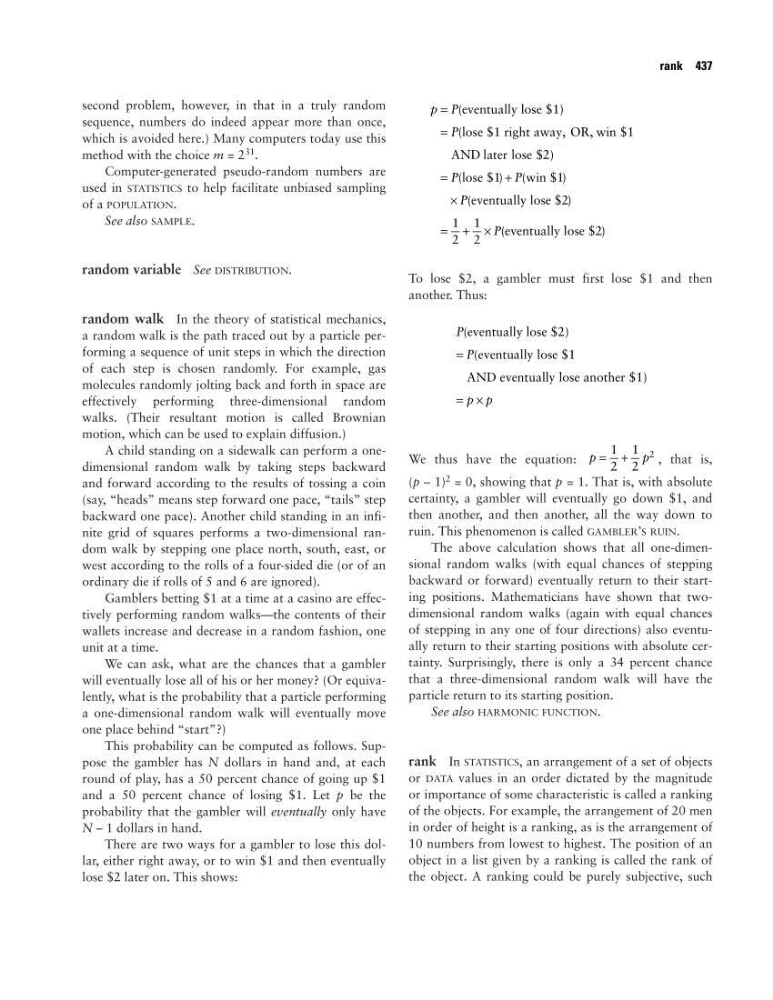
There are two ways for a gambler to lose this dollar, either right away, or to win $1 and then eventually
lose $2 later on. This shows:
To lose $2, a gambler must first lose $1 and then
another. Thus:
We thus have the equation:
, that is,
(p – 1) 2 = 0, showing that p = 1. That is, with absolute
certainty, a gambler will eventually go down $1, and
then another, and then another, all the way down to
ruin. This phenomenon is called GAMBLER’S RUIN.
The above calculation shows that all one-dimensional random walks (with equal chances of stepping
backward or forward) eventually return to their starting positions. Mathematicians have shown that twodimensional random walks (again with equal chances
of stepping in any one of four directions) also eventually return to their starting positions with absolute certainty. Surprisingly, there is only a 34 percent chance
that a three-dimensional random walk will have the
particle return to its starting position.
See also HARMONIC FUNCTION.
rank In STATISTICS, an arrangement of a set of objects
or DATA values in an order dictated by the magnitude
or importance of some characteristic is called a ranking
of the objects. For example, the arrangement of 20 men
in order of height is a ranking, as is the arrangement of
10 numbers from lowest to highest. The position of an
object in a list given by a ranking is called the rank of
the object. A ranking could be purely subjective, such
p
p
= +
1
2
1
2
2
P
P
p p
(eventually lose $2)
(eventually lose $1
AND eventually lose another $1)
=
= ×
p P
P
P
P
P
P
=
=
=
+
×
= + ×
(
(
(
) (
)
(
)
(
)
eventually lose $1)
lose $1 right away, OR, win $1
AND later lose $2)
lose $1
win $1
eventually lose $2
eventually lose $2
1
2
1
2
rank 437
sequence, numbers do indeed appear more than once,
which is avoided here.) Many computers today use this
method with the choice m = 2
31 .
Computer-generated pseudo-random numbers are
used in STATISTICS to help facilitate unbiased sampling
of a POPULATION.
See also SAMPLE.
random variable See DISTRIBUTION.
random walk In the theory of statistical mechanics,
a random walk is the path traced out by a particle performing a sequence of unit steps in which the direction
of each step is chosen randomly. For example, gas
molecules randomly jolting back and forth in space are
effectively performing three-dimensional random
walks. (Their resultant motion is called Brownian
motion, which can be used to explain diffusion.)
A child standing on a sidewalk can perform a onedimensional random walk by taking steps backward
and forward according to the results of tossing a coin
(say, “heads” means step forward one pace, “tails” step
backward one pace). Another child standing in an infinite grid of squares performs a two-dimensional random walk by stepping one place north, south, east, or
west according to the rolls of a four-sided die (or of an
ordinary die if rolls of 5 and 6 are ignored).
Gamblers betting $1 at a time at a casino are effectively performing random walks—the contents of their
wallets increase and decrease in a random fashion, one
unit at a time.
We can ask, what are the chances that a gambler
will eventually lose all of his or her money? (Or equivalently, what is the probability that a particle performing
a one-dimensional random walk will eventually move
one place behind “start”?)
This probability can be computed as follows. Suppose the gambler has N dollars in hand and, at each
round of play, has a 50 percent chance of going up $1
and a 50 percent chance of losing $1. Let p be the
probability that the gambler will eventually only have
N – 1 dollars in hand.
There are two ways for a gambler to lose this dollar, either right away, or to win $1 and then eventually
lose $2 later on. This shows:
To lose $2, a gambler must first lose $1 and then
another. Thus:
We thus have the equation:
, that is,
(p – 1) 2 = 0, showing that p = 1. That is, with absolute
certainty, a gambler will eventually go down $1, and
then another, and then another, all the way down to
ruin. This phenomenon is called GAMBLER’S RUIN.
The above calculation shows that all one-dimensional random walks (with equal chances of stepping
backward or forward) eventually return to their starting positions. Mathematicians have shown that twodimensional random walks (again with equal chances
of stepping in any one of four directions) also eventually return to their starting positions with absolute certainty. Surprisingly, there is only a 34 percent chance
that a three-dimensional random walk will have the
particle return to its starting position.
See also HARMONIC FUNCTION.
rank In STATISTICS, an arrangement of a set of objects
or DATA values in an order dictated by the magnitude
or importance of some characteristic is called a ranking
of the objects. For example, the arrangement of 20 men
in order of height is a ranking, as is the arrangement of
10 numbers from lowest to highest. The position of an
object in a list given by a ranking is called the rank of
the object. A ranking could be purely subjective, such
p
p
= +
1
2
1
2
2
P
P
p p
(eventually lose $2)
(eventually lose $1
AND eventually lose another $1)
=
= ×
p P
P
P
P
P
P
=
=
=
+
×
= + ×
(
(
(
) (
)
(
)
(
)
eventually lose $1)
lose $1 right away, OR, win $1
AND later lose $2)
lose $1
win $1
eventually lose $2
eventually lose $2
1
2
1
2
rank 437