

The quantity b
2 –4ac is called the DISCRIMINANT of
the quadratic equation ax
2 + bx + c = 0. The quadratic
formula shows that if the discriminant is a positive real
number, then the equation has two distinct real solutions.
If it is zero, then the equation has just one (double) root,
and if the discriminant is a negative real number, then
there are no real solutions to the equation. (There are,
however, two distinct complex solutions.) Given two
numbers r 1 and r 2 , then x
2 – (r 1 + r 2 )x + r 1 r 2 = 0 is a
quadratic equation with those two numbers as solutions.
In general, the quadratic formula shows that the two
roots of a quadratic equation ax
2 + bx + c = 0 have sum
– and product .
A quadratic function is a function of the form f(x) =
ax
2 + bx + c with a ≠ 0. If the constants a, b, and c are
real numbers, then the graph of a quadratic function is
a PARABOLA, CONCAVE UP if a is positive and concave
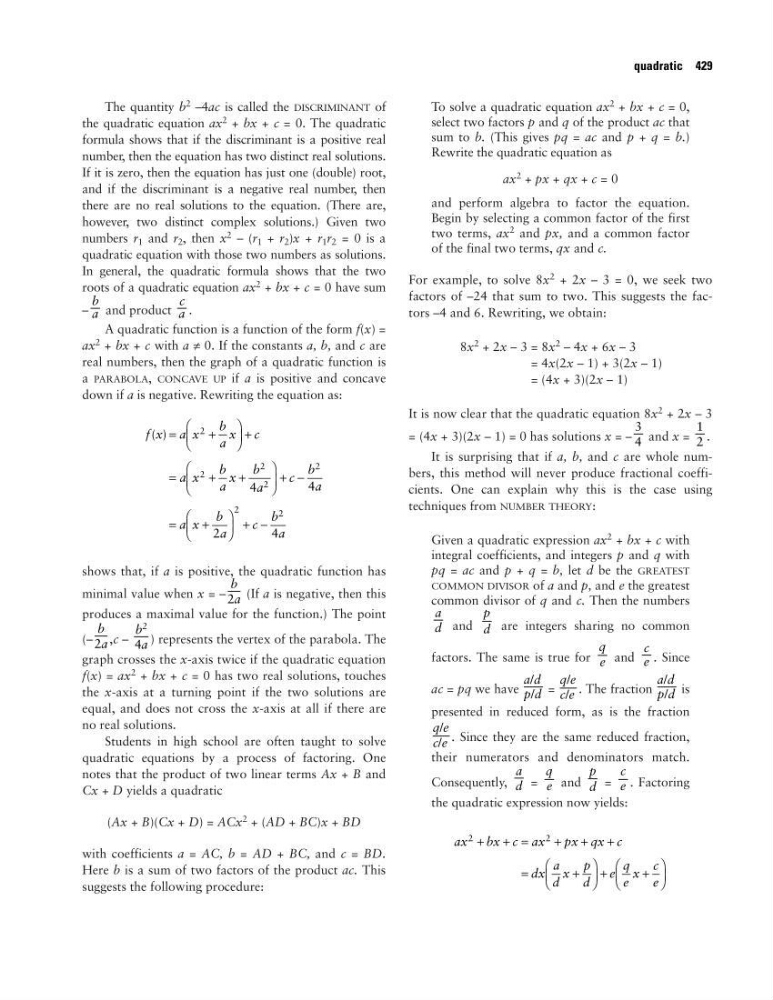
down if a is negative. Rewriting the equation as:
shows that, if a is positive, the quadratic function has
minimal value when x = –
(If a is negative, then this
produces a maximal value for the function.) The point
(– ,c –
) represents the vertex of the parabola. The
graph crosses the x-axis twice if the quadratic equation
f(x) = ax
2 + bx + c = 0 has two real solutions, touches
the x-axis at a turning point if the two solutions are
equal, and does not cross the x-axis at all if there are
no real solutions.
Students in high school are often taught to solve
quadratic equations by a process of factoring. One
notes that the product of two linear terms Ax + B and
Cx + D yields a quadratic
(Ax + B)(Cx + D) = ACx
2 + (AD + BC)x + BD
with coefficients a = AC, b = AD + BC, and c = BD.
Here b is a sum of two factors of the product ac. This
suggests the following procedure:
To solve a quadratic equation ax 2 + bx + c = 0,
select two factors p and q of the product ac that
sum to b. (This gives pq = ac and p + q = b.)
Rewrite the quadratic equation as
ax
2 + px + qx + c = 0
and perform algebra to factor the equation.
Begin by selecting a common factor of the first
two terms, ax
2 and px, and a common factor
of the final two terms, qx and c.
For example, to solve 8x
2 + 2x – 3 = 0, we seek two
factors of –24 that sum to two. This suggests the factors –4 and 6. Rewriting, we obtain:
8x
2 + 2x – 3 = 8x
2 – 4x + 6x – 3
= 4x(2x – 1) + 3(2x – 1)
= (4x + 3)(2x – 1)
It is now clear that the quadratic equation 8x
2 + 2x – 3
= (4x + 3)(2x – 1) = 0 has solutions x = – and x = .
It is surprising that if a, b, and c are whole numbers, this method will never produce fractional coefficients. One can explain why this is the case using
techniques from NUMBER THEORY:
Given a quadratic expression ax
2 + bx + c with
integral coefficients, and integers p and q with
pq = ac and p + q = b, let d be the GREATEST
COMMON DIVISOR of a and p, and e the greatest
common divisor of q and c. Then the numbers
and
are integers sharing no common
factors. The same is true for
and . Since
ac = pq we have
=
. The fraction
is
presented in reduced form, as is the fraction
. Since they are the same reduced fraction,
their numerators and denominators match.
Consequently,
=
and
= . Factoring
the quadratic expression now yields:
ax bx c ax
px qx c
dx
a
d
x
p
d
e
q
e
x
c
e
2
2
+
+ =
+
+
+
=
+
+
+
c
–
e
p
–
d
q
–
e
a
–
d
q/e
—–
c/e
a/d —–
p/d
q/e
—–
c/e
a/d —–
p/d
c
–
e
q
–
e
p
–
d
a
–
d
1
–
2
3
–
4
b
2
–
4a
b
–
2a
b
–
2a
f x a x
b
a
x c
a x
b
a
x
b
a
c
b
a
a x
b
a
c
b
a
( ) =
+
+
=
+
+
+ −
=
+
+ −
2
2
2
2
2
2
2
4
4
2
4
c
– a
b
– a
quadratic 429
2 –4ac is called the DISCRIMINANT of
the quadratic equation ax
2 + bx + c = 0. The quadratic
formula shows that if the discriminant is a positive real
number, then the equation has two distinct real solutions.
If it is zero, then the equation has just one (double) root,
and if the discriminant is a negative real number, then
there are no real solutions to the equation. (There are,
however, two distinct complex solutions.) Given two
numbers r 1 and r 2 , then x
2 – (r 1 + r 2 )x + r 1 r 2 = 0 is a
quadratic equation with those two numbers as solutions.
In general, the quadratic formula shows that the two
roots of a quadratic equation ax
2 + bx + c = 0 have sum
– and product .
A quadratic function is a function of the form f(x) =
ax
2 + bx + c with a ≠ 0. If the constants a, b, and c are
real numbers, then the graph of a quadratic function is
a PARABOLA, CONCAVE UP if a is positive and concave
down if a is negative. Rewriting the equation as:
shows that, if a is positive, the quadratic function has
minimal value when x = –
(If a is negative, then this
produces a maximal value for the function.) The point
(– ,c –
) represents the vertex of the parabola. The
graph crosses the x-axis twice if the quadratic equation
f(x) = ax
2 + bx + c = 0 has two real solutions, touches
the x-axis at a turning point if the two solutions are
equal, and does not cross the x-axis at all if there are
no real solutions.
Students in high school are often taught to solve
quadratic equations by a process of factoring. One
notes that the product of two linear terms Ax + B and
Cx + D yields a quadratic
(Ax + B)(Cx + D) = ACx
2 + (AD + BC)x + BD
with coefficients a = AC, b = AD + BC, and c = BD.
Here b is a sum of two factors of the product ac. This
suggests the following procedure:
To solve a quadratic equation ax 2 + bx + c = 0,
select two factors p and q of the product ac that
sum to b. (This gives pq = ac and p + q = b.)
Rewrite the quadratic equation as
ax
2 + px + qx + c = 0
and perform algebra to factor the equation.
Begin by selecting a common factor of the first
two terms, ax
2 and px, and a common factor
of the final two terms, qx and c.
For example, to solve 8x
2 + 2x – 3 = 0, we seek two
factors of –24 that sum to two. This suggests the factors –4 and 6. Rewriting, we obtain:
8x
2 + 2x – 3 = 8x
2 – 4x + 6x – 3
= 4x(2x – 1) + 3(2x – 1)
= (4x + 3)(2x – 1)
It is now clear that the quadratic equation 8x
2 + 2x – 3
= (4x + 3)(2x – 1) = 0 has solutions x = – and x = .
It is surprising that if a, b, and c are whole numbers, this method will never produce fractional coefficients. One can explain why this is the case using
techniques from NUMBER THEORY:
Given a quadratic expression ax
2 + bx + c with
integral coefficients, and integers p and q with
pq = ac and p + q = b, let d be the GREATEST
COMMON DIVISOR of a and p, and e the greatest
common divisor of q and c. Then the numbers
and
are integers sharing no common
factors. The same is true for
and . Since
ac = pq we have
=
. The fraction
is
presented in reduced form, as is the fraction
. Since they are the same reduced fraction,
their numerators and denominators match.
Consequently,
=
and
= . Factoring
the quadratic expression now yields:
ax bx c ax
px qx c
dx
a
d
x
p
d
e
q
e
x
c
e
2
2
+
+ =
+
+
+
=
+
+
+
c
–
e
p
–
d
q
–
e
a
–
d
q/e
—–
c/e
a/d —–
p/d
q/e
—–
c/e
a/d —–
p/d
c
–
e
q
–
e
p
–
d
a
–
d
1
–
2
3
–
4
b
2
–
4a
b
–
2a
b
–
2a
f x a x
b
a
x c
a x
b
a
x
b
a
c
b
a
a x
b
a
c
b
a
( ) =
+
+
=
+
+
+ −
=
+
+ −
2
2
2
2
2
2
2
4
4
2
4
c
– a
b
– a
quadratic 429