

has a square root, it must be the case that a +
ib equals (p + iq)
2 for some complex number
p + iq. We have a + ib = (p + iq)
2 = p
2 – q
2 +
2pqi, from which it follows that a = p
2 – q
2
and b = 2pq. Also, c
2 = a
2 + b
2 = (p
2 – q
2 )
2 +
(2pq)
2 = (p
2 + q
2 )
2 yielding c = p
2 + q
2 . One
now checks that the numbers p and q must be
integers with the stated properties.
(To complete the final step, write the integers (p
2 + q
2
)
+ (p
2 – q
2
) = 2p
2 and (p
2 + q
2
) – (p
2 – q
2
) = 2q
2 each as
a product of prime numbers. Use this to show that if p
and q are not each themselves integers, then the triple
obtained is not primitive.)
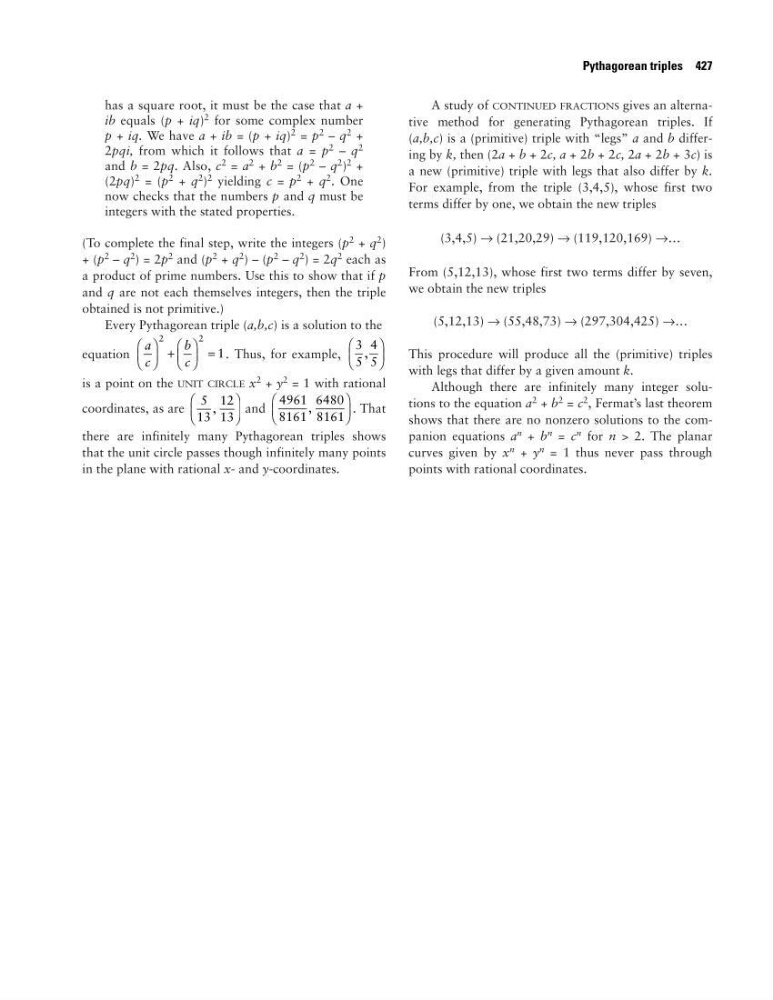
Every Pythagorean triple (a,b,c) is a solution to the
equation
. Thus, for example,
is a point on the UNIT CIRCLE x
2 + y
2 = 1 with rational
coordinates, as are
and
. That
there are infinitely many Pythagorean triples shows
that the unit circle passes though infinitely many points
in the plane with rational x- and y-coordinates.
A study of CONTINUED FRACTIONS gives an alternative method for generating Pythagorean triples. If
(a,b,c) is a (primitive) triple with “legs” a and b differing by k, then (2a + b + 2c, a + 2b + 2c, 2a + 2b + 3c) is
a new (primitive) triple with legs that also differ by k.
For example, from the triple (3,4,5), whose first two
terms differ by one, we obtain the new triples
(3,4,5) → (21,20,29) → (119,120,169) →…
From (5,12,13), whose first two terms differ by seven,
we obtain the new triples
(5,12,13) → (55,48,73) → (297,304,425) →…
This procedure will produce all the (primitive) triples
with legs that differ by a given amount k.
Although there are infinitely many integer solutions to the equation a
2 + b
2 = c
2
, Fermat’s last theorem
shows that there are no nonzero solutions to the companion equations a
n + b
n = c
n for n > 2. The planar
curves given by x
n + y
n = 1 thus never pass through
points with rational coordinates.
4961
8161
6480
8161
,
5
13
12
13
,
3
5
4
5
,
a
c
b
c
+
=
2
2
1
Pythagorean triples 427
ib equals (p + iq)
2 for some complex number
p + iq. We have a + ib = (p + iq)
2 = p
2 – q
2 +
2pqi, from which it follows that a = p
2 – q
2
and b = 2pq. Also, c
2 = a
2 + b
2 = (p
2 – q
2 )
2 +
(2pq)
2 = (p
2 + q
2 )
2 yielding c = p
2 + q
2 . One
now checks that the numbers p and q must be
integers with the stated properties.
(To complete the final step, write the integers (p
2 + q
2
)
+ (p
2 – q
2
) = 2p
2 and (p
2 + q
2
) – (p
2 – q
2
) = 2q
2 each as
a product of prime numbers. Use this to show that if p
and q are not each themselves integers, then the triple
obtained is not primitive.)
Every Pythagorean triple (a,b,c) is a solution to the
equation
. Thus, for example,
is a point on the UNIT CIRCLE x
2 + y
2 = 1 with rational
coordinates, as are
and
. That
there are infinitely many Pythagorean triples shows
that the unit circle passes though infinitely many points
in the plane with rational x- and y-coordinates.
A study of CONTINUED FRACTIONS gives an alternative method for generating Pythagorean triples. If
(a,b,c) is a (primitive) triple with “legs” a and b differing by k, then (2a + b + 2c, a + 2b + 2c, 2a + 2b + 3c) is
a new (primitive) triple with legs that also differ by k.
For example, from the triple (3,4,5), whose first two
terms differ by one, we obtain the new triples
(3,4,5) → (21,20,29) → (119,120,169) →…
From (5,12,13), whose first two terms differ by seven,
we obtain the new triples
(5,12,13) → (55,48,73) → (297,304,425) →…
This procedure will produce all the (primitive) triples
with legs that differ by a given amount k.
Although there are infinitely many integer solutions to the equation a
2 + b
2 = c
2
, Fermat’s last theorem
shows that there are no nonzero solutions to the companion equations a
n + b
n = c
n for n > 2. The planar
curves given by x
n + y
n = 1 thus never pass through
points with rational coordinates.
4961
8161
6480
8161
,
5
13
12
13
,
3
5
4
5
,
a
c
b
c
+
=
2
2
1
Pythagorean triples 427