

If a quantity y is proportional to the inverse of a
variable x, that is, y ∝ , then we say that y and x are
inversely proportional or that y varies inversely as x.
For example, the gas laws in physics assert that gas
pressure is inversely proportional to volume.
In algebra, terms in a statement about the ratios of
quantities are sometimes called proportionals. For
example, in the expression:
a : b = c : d
the quantity c is the third proportional.
proposition In mathematics, any statement for
which a proof is required or has been provided is called
a proposition. In FORMAL LOGIC, any statement that
has a truth-value of either true or false (but not both) is
called a proposition.
See also THEOREM.
Ptolemy, Claudius (ca. 85–165 C.E.) Greek Geometry, Trigonometry, Astronomy Born in Egypt, around
85 C.E., scholar Claudius Ptolemy is remembered for
his epic piece Syntaxis mathematica (Mathematical collection), also known as the Almagest (The greatest),
often deemed as the most significant work in
TRIGONOMETRY of ancient times. The work contains
accurate tables of “chords” (equivalent to a modern
table of sine values), as well as a clear description as to
how that table was constructed. (He used a result
today known as PTOLEMY’S THEOREM, the geometric
equivalent of the trigonometric ADDITION formulae we
use today.) It is known that Ptolemy also attempted to
prove EUCLID’s famous PARALLEL POSTULATE.
The exact location of Ptolemy’s birth is unknown.
Although born in Egypt, he is referred to as a classical
Greek scholar because he followed the scholarly traditions of the Greeks and wrote in that language. His last
name, Ptolemy, is Greek, but his first name, Claudius,
is Roman. This suggests that he was also considered a
Roman citizen.
Accurate translations of all of Ptolemy’s works survive today. His most noted work, Syntaxis mathematica, comes in 13 volumes, and much of the
mathematics developed in it is motivated by concerns
of astronomy. In particular, Ptolemy worked to give
detailed descriptions of the motions of the Sun, Moon,
and the known planets at the time. He believed that the
Earth lay at the center of the solar system.
In Books 1 and 2 of Syntaxis mathematica, Ptolemy
develops a mathematical theory of compound circular
motions (motion in EPICYCLEs) as a means to explain
the observed motion of the planets. This motivated his
need for his accurate table of chords. It is also worth
mentioning that in this work Ptolemy used a 360-sided
polygon inscribed in a circle to find the following
approximation for π correct to three decimal places:
Book 3 of Syntaxis mathematica is concerned with
the motion of the Sun. By carefully analyzing the
π ≈
≈
377
120
3 14166
.
1
– x
Ptolemy, Claudius 421
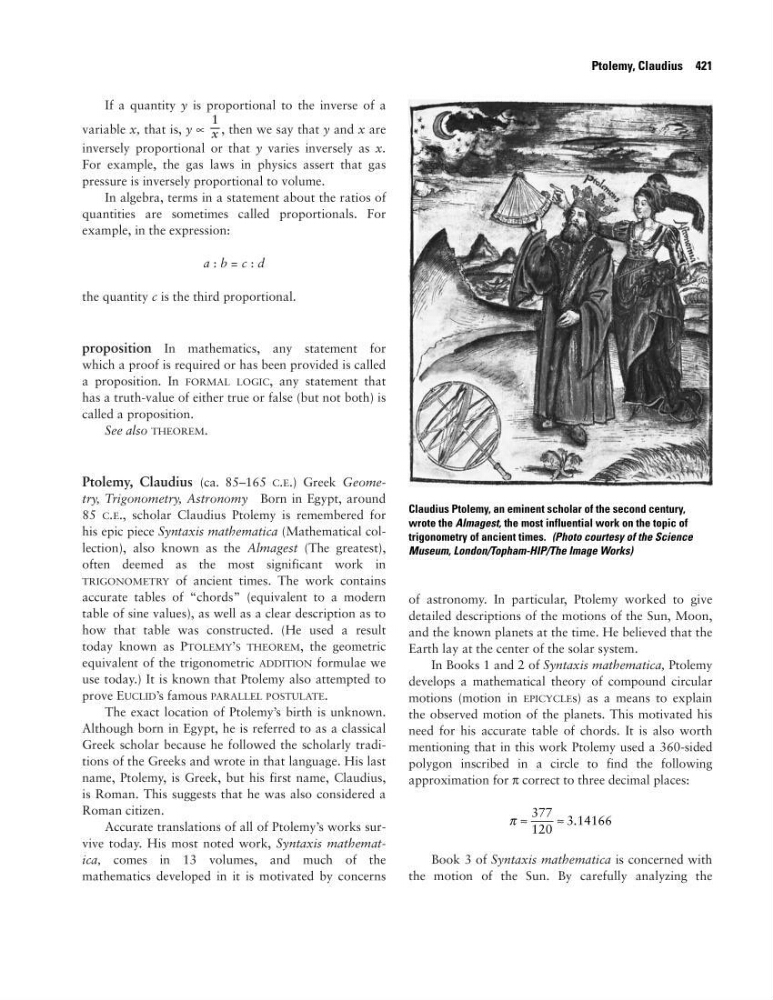
Claudius Ptolemy, an eminent scholar of the second century,
wrote the Almagest, the most influential work on the topic of
trigonometry of ancient times. (Photo courtesy of the Science
Museum, London/Topham-HIP/The Image Works)
variable x, that is, y ∝ , then we say that y and x are
inversely proportional or that y varies inversely as x.
For example, the gas laws in physics assert that gas
pressure is inversely proportional to volume.
In algebra, terms in a statement about the ratios of
quantities are sometimes called proportionals. For
example, in the expression:
a : b = c : d
the quantity c is the third proportional.
proposition In mathematics, any statement for
which a proof is required or has been provided is called
a proposition. In FORMAL LOGIC, any statement that
has a truth-value of either true or false (but not both) is
called a proposition.
See also THEOREM.
Ptolemy, Claudius (ca. 85–165 C.E.) Greek Geometry, Trigonometry, Astronomy Born in Egypt, around
85 C.E., scholar Claudius Ptolemy is remembered for
his epic piece Syntaxis mathematica (Mathematical collection), also known as the Almagest (The greatest),
often deemed as the most significant work in
TRIGONOMETRY of ancient times. The work contains
accurate tables of “chords” (equivalent to a modern
table of sine values), as well as a clear description as to
how that table was constructed. (He used a result
today known as PTOLEMY’S THEOREM, the geometric
equivalent of the trigonometric ADDITION formulae we
use today.) It is known that Ptolemy also attempted to
prove EUCLID’s famous PARALLEL POSTULATE.
The exact location of Ptolemy’s birth is unknown.
Although born in Egypt, he is referred to as a classical
Greek scholar because he followed the scholarly traditions of the Greeks and wrote in that language. His last
name, Ptolemy, is Greek, but his first name, Claudius,
is Roman. This suggests that he was also considered a
Roman citizen.
Accurate translations of all of Ptolemy’s works survive today. His most noted work, Syntaxis mathematica, comes in 13 volumes, and much of the
mathematics developed in it is motivated by concerns
of astronomy. In particular, Ptolemy worked to give
detailed descriptions of the motions of the Sun, Moon,
and the known planets at the time. He believed that the
Earth lay at the center of the solar system.
In Books 1 and 2 of Syntaxis mathematica, Ptolemy
develops a mathematical theory of compound circular
motions (motion in EPICYCLEs) as a means to explain
the observed motion of the planets. This motivated his
need for his accurate table of chords. It is also worth
mentioning that in this work Ptolemy used a 360-sided
polygon inscribed in a circle to find the following
approximation for π correct to three decimal places:
Book 3 of Syntaxis mathematica is concerned with
the motion of the Sun. By carefully analyzing the
π ≈
≈
377
120
3 14166
.
1
– x
Ptolemy, Claudius 421
Claudius Ptolemy, an eminent scholar of the second century,
wrote the Almagest, the most influential work on the topic of
trigonometry of ancient times. (Photo courtesy of the Science
Museum, London/Topham-HIP/The Image Works)