

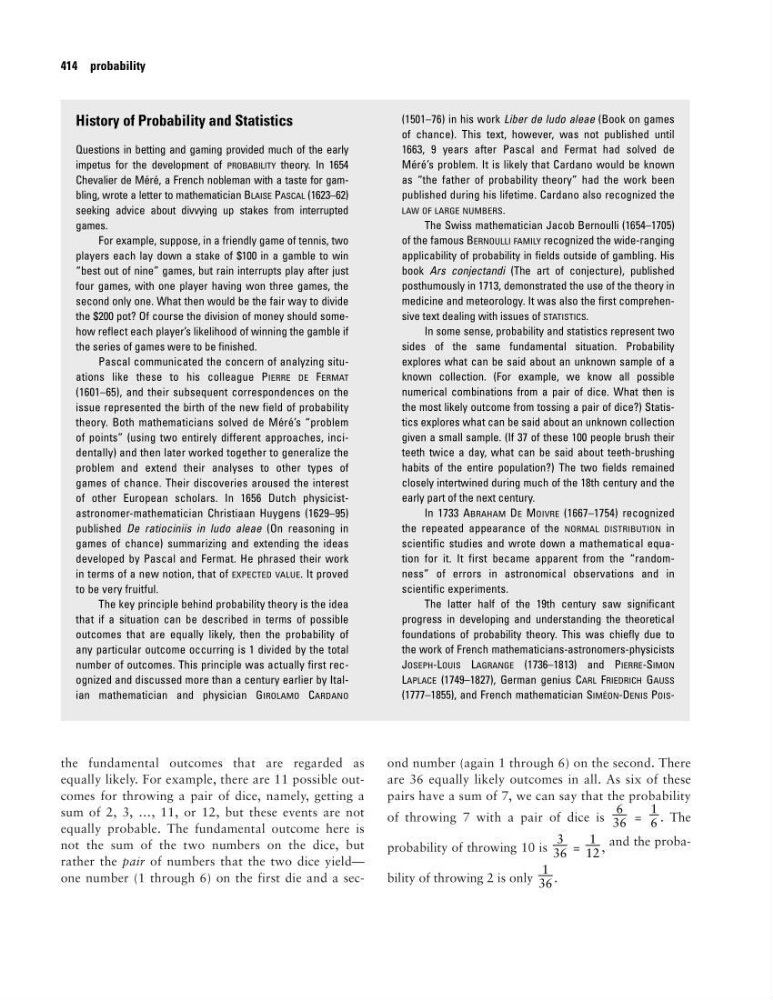
the fundamental outcomes that are regarded as
equally likely. For example, there are 11 possible outcomes for throwing a pair of dice, namely, getting a
sum of 2, 3, …, 11, or 12, but these events are not
equally probable. The fundamental outcome here is
not the sum of the two numbers on the dice, but
rather the pair of numbers that the two dice yield—
one number (1 through 6) on the first die and a second number (again 1 through 6) on the second. There
are 36 equally likely outcomes in all. As six of these
pairs have a sum of 7, we can say that the probability
of throwing 7 with a pair of dice is
= . The
probability of throwing 10 is
=
,
and the probability of throwing 2 is only
.
1
–
36
1
–
12
3
–
36
1
–
6
6
–
36
414 probability
History of Probability and Statistics
Questions in betting and gaming provided much of the early
impetus for the development of PROBABILITY theory. In 1654
Chevalier de Méré, a French nobleman with a taste for gambling, wrote a letter to mathematician BLAISE PASCAL (1623–62)
seeking advice about divvying up stakes from interrupted
games.
For example, suppose, in a friendly game of tennis, two
players each lay down a stake of $100 in a gamble to win
“best out of nine” games, but rain interrupts play after just
four games, with one player having won three games, the
second only one. What then would be the fair way to divide
the $200 pot? Of course the division of money should somehow reflect each player’s likelihood of winning the gamble if
the series of games were to be finished.
Pascal communicated the concern of analyzing situations like these to his colleague PIERRE DE FERMAT
(1601–65), and their subsequent correspondences on the
issue represented the birth of the new field of probability
theory. Both mathematicians solved de Méré’s “problem
of points” (using two entirely different approaches, incidentally) and then later worked together to generalize the
problem and extend their analyses to other types of
games of chance. Their discoveries aroused the interest
of other European scholars. In 1656 Dutch physicistastronomer-mathematician Christiaan Huygens (1629–95)
published De ratiociniis in ludo aleae (On reasoning in
games of chance) summarizing and extending the ideas
developed by Pascal and Fermat. He phrased their work
in terms of a new notion, that of EXPECTED VALUE. It proved
to be very fruitful.
The key principle behind probability theory is the idea
that if a situation can be described in terms of possible
outcomes that are equally likely, then the probability of
any particular outcome occurring is 1 divided by the total
number of outcomes. This principle was actually first recognized and discussed more than a century earlier by Italian mathematician and physician GIROLAMO CARDANO
(1501–76) in his work Liber de ludo aleae (Book on games
of chance). This text, however, was not published until
1663, 9 years after Pascal and Fermat had solved de
Méré’s problem. It is likely that Cardano would be known
as “the father of probability theory” had the work been
published during his lifetime. Cardano also recognized the
LAW OF LARGE NUMBERS.
The Swiss mathematician Jacob Bernoulli (1654–1705)
of the famous BERNOULLI FAMILY recognized the wide-ranging
applicability of probability in fields outside of gambling. His
book Ars conjectandi (The art of conjecture), published
posthumously in 1713, demonstrated the use of the theory in
medicine and meteorology. It was also the first comprehensive text dealing with issues of STATISTICS.
In some sense, probability and statistics represent two
sides of the same fundamental situation. Probability
explores what can be said about an unknown sample of a
known collection. (For example, we know all possible
numerical combinations from a pair of dice. What then is
the most likely outcome from tossing a pair of dice?) Statistics explores what can be said about an unknown collection
given a small sample. (If 37 of these 100 people brush their
teeth twice a day, what can be said about teeth-brushing
habits of the entire population?) The two fields remained
closely intertwined during much of the 18th century and the
early part of the next century.
In 1733 ABRAHAM DE MOIVRE (1667–1754) recognized
the repeated appearance of the NORMAL DISTRIBUTION in
scientific studies and wrote down a mathematical equation for it. It first became apparent from the “randomness” of errors in astronomical observations and in
scientific experiments.
The latter half of the 19th century saw significant
progress in developing and understanding the theoretical
foundations of probability theory. This was chiefly due to
the work of French mathematicians-astronomers-physicists
JOSEPH-LOUIS LAGRANGE (1736–1813) and PIERRE-SIMON
LAPLACE (1749–1827), German genius CARL FRIEDRICH GAUSS
(1777–1855), and French mathematician SIMÉON-DENIS POIS-
equally likely. For example, there are 11 possible outcomes for throwing a pair of dice, namely, getting a
sum of 2, 3, …, 11, or 12, but these events are not
equally probable. The fundamental outcome here is
not the sum of the two numbers on the dice, but
rather the pair of numbers that the two dice yield—
one number (1 through 6) on the first die and a second number (again 1 through 6) on the second. There
are 36 equally likely outcomes in all. As six of these
pairs have a sum of 7, we can say that the probability
of throwing 7 with a pair of dice is
= . The
probability of throwing 10 is
=
,
and the probability of throwing 2 is only
.
1
–
36
1
–
12
3
–
36
1
–
6
6
–
36
414 probability
History of Probability and Statistics
Questions in betting and gaming provided much of the early
impetus for the development of PROBABILITY theory. In 1654
Chevalier de Méré, a French nobleman with a taste for gambling, wrote a letter to mathematician BLAISE PASCAL (1623–62)
seeking advice about divvying up stakes from interrupted
games.
For example, suppose, in a friendly game of tennis, two
players each lay down a stake of $100 in a gamble to win
“best out of nine” games, but rain interrupts play after just
four games, with one player having won three games, the
second only one. What then would be the fair way to divide
the $200 pot? Of course the division of money should somehow reflect each player’s likelihood of winning the gamble if
the series of games were to be finished.
Pascal communicated the concern of analyzing situations like these to his colleague PIERRE DE FERMAT
(1601–65), and their subsequent correspondences on the
issue represented the birth of the new field of probability
theory. Both mathematicians solved de Méré’s “problem
of points” (using two entirely different approaches, incidentally) and then later worked together to generalize the
problem and extend their analyses to other types of
games of chance. Their discoveries aroused the interest
of other European scholars. In 1656 Dutch physicistastronomer-mathematician Christiaan Huygens (1629–95)
published De ratiociniis in ludo aleae (On reasoning in
games of chance) summarizing and extending the ideas
developed by Pascal and Fermat. He phrased their work
in terms of a new notion, that of EXPECTED VALUE. It proved
to be very fruitful.
The key principle behind probability theory is the idea
that if a situation can be described in terms of possible
outcomes that are equally likely, then the probability of
any particular outcome occurring is 1 divided by the total
number of outcomes. This principle was actually first recognized and discussed more than a century earlier by Italian mathematician and physician GIROLAMO CARDANO
(1501–76) in his work Liber de ludo aleae (Book on games
of chance). This text, however, was not published until
1663, 9 years after Pascal and Fermat had solved de
Méré’s problem. It is likely that Cardano would be known
as “the father of probability theory” had the work been
published during his lifetime. Cardano also recognized the
LAW OF LARGE NUMBERS.
The Swiss mathematician Jacob Bernoulli (1654–1705)
of the famous BERNOULLI FAMILY recognized the wide-ranging
applicability of probability in fields outside of gambling. His
book Ars conjectandi (The art of conjecture), published
posthumously in 1713, demonstrated the use of the theory in
medicine and meteorology. It was also the first comprehensive text dealing with issues of STATISTICS.
In some sense, probability and statistics represent two
sides of the same fundamental situation. Probability
explores what can be said about an unknown sample of a
known collection. (For example, we know all possible
numerical combinations from a pair of dice. What then is
the most likely outcome from tossing a pair of dice?) Statistics explores what can be said about an unknown collection
given a small sample. (If 37 of these 100 people brush their
teeth twice a day, what can be said about teeth-brushing
habits of the entire population?) The two fields remained
closely intertwined during much of the 18th century and the
early part of the next century.
In 1733 ABRAHAM DE MOIVRE (1667–1754) recognized
the repeated appearance of the NORMAL DISTRIBUTION in
scientific studies and wrote down a mathematical equation for it. It first became apparent from the “randomness” of errors in astronomical observations and in
scientific experiments.
The latter half of the 19th century saw significant
progress in developing and understanding the theoretical
foundations of probability theory. This was chiefly due to
the work of French mathematicians-astronomers-physicists
JOSEPH-LOUIS LAGRANGE (1736–1813) and PIERRE-SIMON
LAPLACE (1749–1827), German genius CARL FRIEDRICH GAUSS
(1777–1855), and French mathematician SIMÉON-DENIS POIS-