

17.357 and r(1,000,000,000) equals
≈
19.667. As 2.31 is approximately the natural LOGARITHM of 10 this suggested to Gauss that r(n) is behaving as the natural logarithm function. He conjectured:
for large values of n, but was never able to prove this
claim.
One hundred years later JACQUES HADAMARD
(1865–1963) and CHARLES-JEAN DE LA VALLÉE-POUSSIN
(1866–1962) simultaneously, but independently, proved
Gauss’s conjecture using sophisticated techniques from
analytic NUMBER THEORY. The result is known today as
the prime number theorem. It tells us that the nth prime
number has value approximately n · ln(n).
principal See INTEREST.
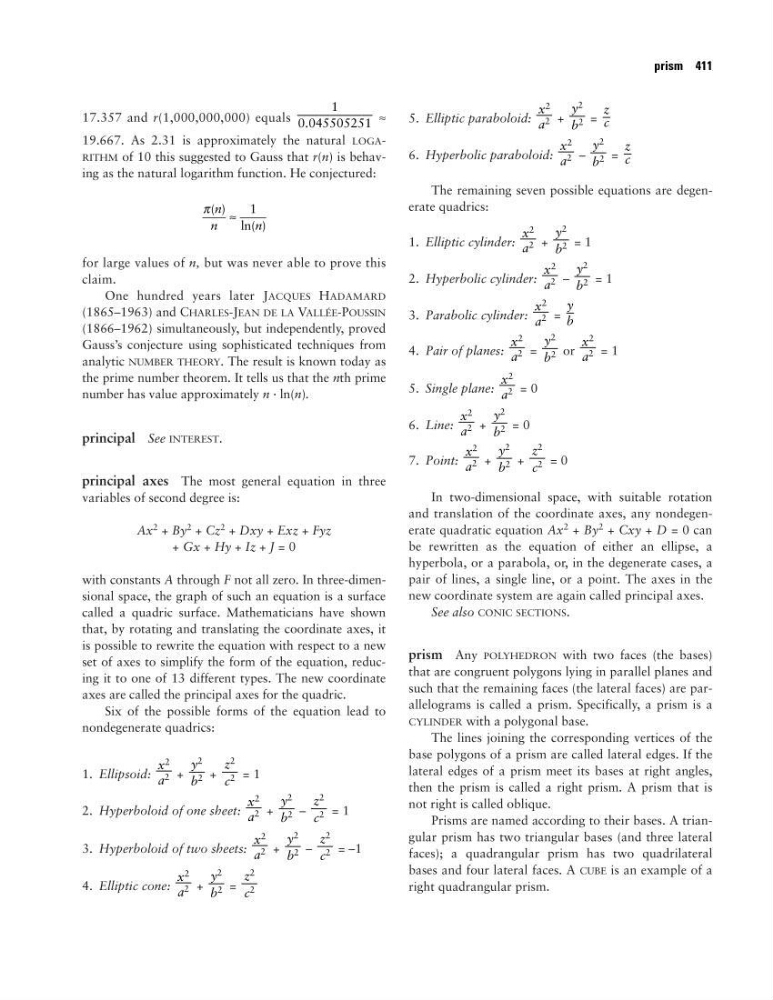
principal axes The most general equation in three
variables of second degree is:
Ax
2 + By
2 + Cz
2 + Dxy + Exz + Fyz
+ Gx + Hy + Iz + J = 0
with constants A through F not all zero. In three-dimensional space, the graph of such an equation is a surface
called a quadric surface. Mathematicians have shown
that, by rotating and translating the coordinate axes, it
is possible to rewrite the equation with respect to a new
set of axes to simplify the form of the equation, reducing it to one of 13 different types. The new coordinate
axes are called the principal axes for the quadric.
Six of the possible forms of the equation lead to
nondegenerate quadrics:
1. Ellipsoid:
+
+
= 1
2. Hyperboloid of one sheet:
+
–
= 1
3. Hyperboloid of two sheets:
+
–
= –1
4. Elliptic cone:
+
=
5. Elliptic paraboloid:
+
=
6. Hyperbolic paraboloid:
–
=
The remaining seven possible equations are degenerate quadrics:
1. Elliptic cylinder:
+
= 1
2. Hyperbolic cylinder:
–
= 1
3. Parabolic cylinder:
=
4. Pair of planes:
=
or
= 1
5. Single plane:
= 0
6. Line:
+
= 0
7. Point:
+
+
= 0
In two-dimensional space, with suitable rotation
and translation of the coordinate axes, any nondegenerate quadratic equation Ax 2 + By
2 + Cxy + D = 0 can
be rewritten as the equation of either an ellipse, a
hyperbola, or a parabola, or, in the degenerate cases, a
pair of lines, a single line, or a point. The axes in the
new coordinate system are again called principal axes.
See also CONIC SECTIONS.
prism Any POLYHEDRON with two faces (the bases)
that are congruent polygons lying in parallel planes and
such that the remaining faces (the lateral faces) are parallelograms is called a prism. Specifically, a prism is a
CYLINDER with a polygonal base.
The lines joining the corresponding vertices of the
base polygons of a prism are called lateral edges. If the
lateral edges of a prism meet its bases at right angles,
then the prism is called a right prism. A prism that is
not right is called oblique.
Prisms are named according to their bases. A triangular prism has two triangular bases (and three lateral
faces); a quadrangular prism has two quadrilateral
bases and four lateral faces. A CUBE is an example of a
right quadrangular prism.
z
2
–
c
2
y
2
–
b
2
x
2
–
a
2
y
2
–
b
2
x
2
–
a
2
x
2
–
a
2
x
2
–
a
2
y
2
–
b
2
x
2
–
a
2
y
–
b
x
2
–
a
2
y
2
–
b
2
x
2
–
a
2
y
2
–
b
2
x
2
–
a
2
z
– c
y
2
–
b
2
x
2
–
a
2
z
– c
y
2
–
b
2
x
2
–
a
2
z
2
–
c
2
y
2
–
b
2
x
2
–
a
2
z
2
–
c
2
y
2
–
b
2
x
2
–
a
2
z
2
–
c
2
y
2
–
b
2
x
2
–
a
2
z
2
–
c
2
y
2
–
b
2
x
2
–
a
2
π( )
ln( )
n
n
n
≈
1
1
–––––––
0.045505251
prism 411
≈
19.667. As 2.31 is approximately the natural LOGARITHM of 10 this suggested to Gauss that r(n) is behaving as the natural logarithm function. He conjectured:
for large values of n, but was never able to prove this
claim.
One hundred years later JACQUES HADAMARD
(1865–1963) and CHARLES-JEAN DE LA VALLÉE-POUSSIN
(1866–1962) simultaneously, but independently, proved
Gauss’s conjecture using sophisticated techniques from
analytic NUMBER THEORY. The result is known today as
the prime number theorem. It tells us that the nth prime
number has value approximately n · ln(n).
principal See INTEREST.
principal axes The most general equation in three
variables of second degree is:
Ax
2 + By
2 + Cz
2 + Dxy + Exz + Fyz
+ Gx + Hy + Iz + J = 0
with constants A through F not all zero. In three-dimensional space, the graph of such an equation is a surface
called a quadric surface. Mathematicians have shown
that, by rotating and translating the coordinate axes, it
is possible to rewrite the equation with respect to a new
set of axes to simplify the form of the equation, reducing it to one of 13 different types. The new coordinate
axes are called the principal axes for the quadric.
Six of the possible forms of the equation lead to
nondegenerate quadrics:
1. Ellipsoid:
+
+
= 1
2. Hyperboloid of one sheet:
+
–
= 1
3. Hyperboloid of two sheets:
+
–
= –1
4. Elliptic cone:
+
=
5. Elliptic paraboloid:
+
=
6. Hyperbolic paraboloid:
–
=
The remaining seven possible equations are degenerate quadrics:
1. Elliptic cylinder:
+
= 1
2. Hyperbolic cylinder:
–
= 1
3. Parabolic cylinder:
=
4. Pair of planes:
=
or
= 1
5. Single plane:
= 0
6. Line:
+
= 0
7. Point:
+
+
= 0
In two-dimensional space, with suitable rotation
and translation of the coordinate axes, any nondegenerate quadratic equation Ax 2 + By
2 + Cxy + D = 0 can
be rewritten as the equation of either an ellipse, a
hyperbola, or a parabola, or, in the degenerate cases, a
pair of lines, a single line, or a point. The axes in the
new coordinate system are again called principal axes.
See also CONIC SECTIONS.
prism Any POLYHEDRON with two faces (the bases)
that are congruent polygons lying in parallel planes and
such that the remaining faces (the lateral faces) are parallelograms is called a prism. Specifically, a prism is a
CYLINDER with a polygonal base.
The lines joining the corresponding vertices of the
base polygons of a prism are called lateral edges. If the
lateral edges of a prism meet its bases at right angles,
then the prism is called a right prism. A prism that is
not right is called oblique.
Prisms are named according to their bases. A triangular prism has two triangular bases (and three lateral
faces); a quadrangular prism has two quadrilateral
bases and four lateral faces. A CUBE is an example of a
right quadrangular prism.
z
2
–
c
2
y
2
–
b
2
x
2
–
a
2
y
2
–
b
2
x
2
–
a
2
x
2
–
a
2
x
2
–
a
2
y
2
–
b
2
x
2
–
a
2
y
–
b
x
2
–
a
2
y
2
–
b
2
x
2
–
a
2
y
2
–
b
2
x
2
–
a
2
z
– c
y
2
–
b
2
x
2
–
a
2
z
– c
y
2
–
b
2
x
2
–
a
2
z
2
–
c
2
y
2
–
b
2
x
2
–
a
2
z
2
–
c
2
y
2
–
b
2
x
2
–
a
2
z
2
–
c
2
y
2
–
b
2
x
2
–
a
2
z
2
–
c
2
y
2
–
b
2
x
2
–
a
2
π( )
ln( )
n
n
n
≈
1
1
–––––––
0.045505251
prism 411