

(431–404 B.C.E.) between Athens and Sparta, and he
traveled through Egypt and Italy once democracy was
restored to Athens. In Egypt, Plato learned of the
water clock and later brought the idea back to Greece.
In Italy he encountered the followers of PYTHAGORAS
and was greatly influenced by the mathematics they
studied. Although Plato made no direct contributions
to mathematics, his respect for the subject was profound, and he wrote about the philosophy of the subject at great lengths in his works.
Around 387 B.C.E. Plato returned to Athens to
found a school devoted to instruction and research in
philosophy and the sciences. He secured a piece of land
from the Greek hero Academos, and the school became
known as the Academy. Plato presided over the institute for the remainder of his life.
Plato wrote a total of 35 dialogues, fictitious conversations between characters, cleverly structured so as
to reveal a philosophical line of thought and investigation. In his dialogue Phaedo, Plato described mathematical objects as perfect forms (a line, for instance,
really is an object possessing no breadth), and professed that the objects we see and can construct in the
physical universe are imperfect imitations of these ideal
forms. He also discussed these ideas in his work the
Republic. It is clear from his dialogues that Plato
regarded mathematics as a source of universal truth
and that the study of mathematics offered the best tool
for fostering intellectual development.
In his work Timaeus, Plato described the five Platonic solids as fundamental units of the universe. He
suggested, for instance, that each of the four “elements”—earth, fire, air, and water—is appropriately
modeled by the shape of a Platonic solid, namely, the
CUBE, the TETRAHEDRON, the octahedron, and the
icosahedron, respectively. The fifth Platonic solid, the
dodecahedron, with its 12 faces matching the 12 signs
of the zodiac, represented the universe itself. German
astronomer JOHANNES KEPLER (1571–1630) was so
smitten with the proposed harmony of the Platonic
solids that he later developed a surprisingly accurate
model of the solar system based upon them.
Plato’s attitude toward, and regard for, the very
nature of mathematical thinking had a lasting influence
on the entire course of scientific progress in the West.
Apart from promoting the value of pure mathematics,
Plato also emphasized the need for rigorous proof,
thereby laying down a philosophical foundation for others, most notably EUCLID, on which to pursue research.
Plato is also credited for limiting the use of geometrical
tools to the compass and straightedge alone.
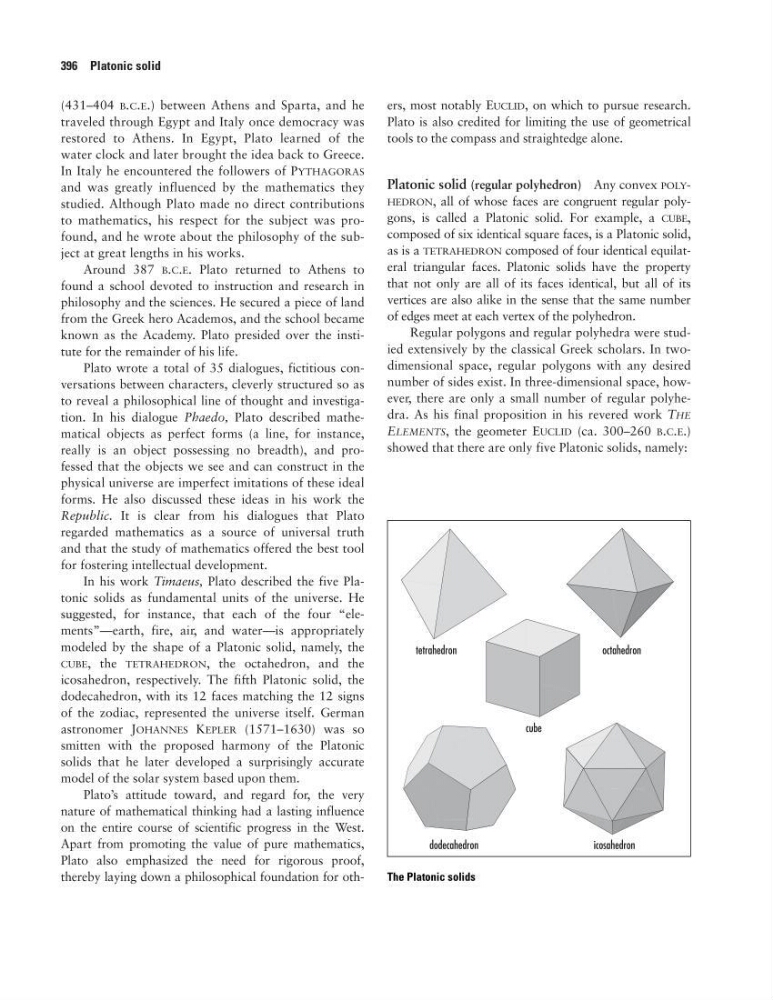
Platonic solid (regular polyhedron) Any convex POLYHEDRON, all of whose faces are congruent regular polygons, is called a Platonic solid. For example, a CUBE,
composed of six identical square faces, is a Platonic solid,
as is a TETRAHEDRON composed of four identical equilateral triangular faces. Platonic solids have the property
that not only are all of its faces identical, but all of its
vertices are also alike in the sense that the same number
of edges meet at each vertex of the polyhedron.
Regular polygons and regular polyhedra were studied extensively by the classical Greek scholars. In twodimensional space, regular polygons with any desired
number of sides exist. In three-dimensional space, however, there are only a small number of regular polyhedra. As his final proposition in his revered work THE
ELEMENTS, the geometer EUCLID (ca. 300–260 B.C.E.)
showed that there are only five Platonic solids, namely:
396 Platonic solid
The Platonic solids
traveled through Egypt and Italy once democracy was
restored to Athens. In Egypt, Plato learned of the
water clock and later brought the idea back to Greece.
In Italy he encountered the followers of PYTHAGORAS
and was greatly influenced by the mathematics they
studied. Although Plato made no direct contributions
to mathematics, his respect for the subject was profound, and he wrote about the philosophy of the subject at great lengths in his works.
Around 387 B.C.E. Plato returned to Athens to
found a school devoted to instruction and research in
philosophy and the sciences. He secured a piece of land
from the Greek hero Academos, and the school became
known as the Academy. Plato presided over the institute for the remainder of his life.
Plato wrote a total of 35 dialogues, fictitious conversations between characters, cleverly structured so as
to reveal a philosophical line of thought and investigation. In his dialogue Phaedo, Plato described mathematical objects as perfect forms (a line, for instance,
really is an object possessing no breadth), and professed that the objects we see and can construct in the
physical universe are imperfect imitations of these ideal
forms. He also discussed these ideas in his work the
Republic. It is clear from his dialogues that Plato
regarded mathematics as a source of universal truth
and that the study of mathematics offered the best tool
for fostering intellectual development.
In his work Timaeus, Plato described the five Platonic solids as fundamental units of the universe. He
suggested, for instance, that each of the four “elements”—earth, fire, air, and water—is appropriately
modeled by the shape of a Platonic solid, namely, the
CUBE, the TETRAHEDRON, the octahedron, and the
icosahedron, respectively. The fifth Platonic solid, the
dodecahedron, with its 12 faces matching the 12 signs
of the zodiac, represented the universe itself. German
astronomer JOHANNES KEPLER (1571–1630) was so
smitten with the proposed harmony of the Platonic
solids that he later developed a surprisingly accurate
model of the solar system based upon them.
Plato’s attitude toward, and regard for, the very
nature of mathematical thinking had a lasting influence
on the entire course of scientific progress in the West.
Apart from promoting the value of pure mathematics,
Plato also emphasized the need for rigorous proof,
thereby laying down a philosophical foundation for others, most notably EUCLID, on which to pursue research.
Plato is also credited for limiting the use of geometrical
tools to the compass and straightedge alone.
Platonic solid (regular polyhedron) Any convex POLYHEDRON, all of whose faces are congruent regular polygons, is called a Platonic solid. For example, a CUBE,
composed of six identical square faces, is a Platonic solid,
as is a TETRAHEDRON composed of four identical equilateral triangular faces. Platonic solids have the property
that not only are all of its faces identical, but all of its
vertices are also alike in the sense that the same number
of edges meet at each vertex of the polyhedron.
Regular polygons and regular polyhedra were studied extensively by the classical Greek scholars. In twodimensional space, regular polygons with any desired
number of sides exist. In three-dimensional space, however, there are only a small number of regular polyhedra. As his final proposition in his revered work THE
ELEMENTS, the geometer EUCLID (ca. 300–260 B.C.E.)
showed that there are only five Platonic solids, namely:
396 Platonic solid
The Platonic solids