

In 1882 German mathematician FERDINAND VON
LINDEMANN proved that π is a TRANSCENDENTAL NUMBER, establishing once and for all that the problem of
SQUARING THE CIRCLE cannot be solved.
With the advent of computing machines in the 20th
century, mathematicians could compute more and more
digits of π. In 1949 JOHN VON NEUMANN used the U.S.
government’s ENIAC computer to compute π to the
2,037th decimal place. (It took 70 hr of machine time.)
In 1981 Japanese scientists Kazunori Miyoshi and
Kazuhiko Nakayama evaluated 2 million decimal places
of π, and in 1991, using a homebuilt supercomputer in a
New York City apartment, brothers Gregory and David
Chudnovsky calculated π to 2,260,321,366 decimal
places. Today over 1.24 × 10
12 digits of π are known.
The sequence of digits 0123456789 appears in
the decimal expansion of π beginning at the
17,387,594,880th decimal place. This is the first, but
not the only, appearance of this sequence. The
9876543210 first appears at the 21,981,157,633rd
decimal place.
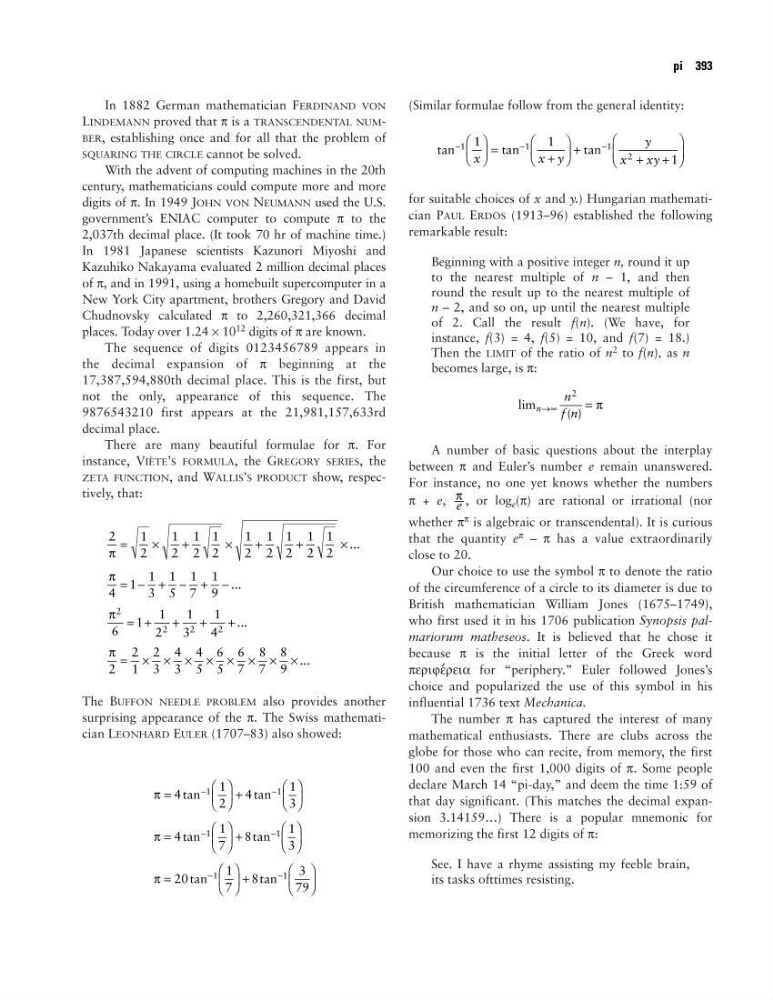
There are many beautiful formulae for π. For
instance, VIÈTE’S FORMULA, the GREGORY SERIES, the
ZETA FUNCTION, and WALLIS’S PRODUCT show, respectively, that:
The BUFFON NEEDLE PROBLEM also provides another
surprising appearance of the π. The Swiss mathematician LEONHARD EULER (1707–83) also showed:
(Similar formulae follow from the general identity:
for suitable choices of x and y.) Hungarian mathematician PAUL ERDÖS (1913–96) established the following
remarkable result:
Beginning with a positive integer n, round it up
to the nearest multiple of n – 1, and then
round the result up to the nearest multiple of
n – 2, and so on, up until the nearest multiple
of 2. Call the result f(n). (We have, for
instance, f(3) = 4, f(5) = 10, and f(7) = 18.)
Then the LIMIT of the ratio of n 2 to f(n), as n
becomes large, is π:
A number of basic questions about the interplay
between π and Euler’s number e remain unanswered.
For instance, no one yet knows whether the numbers
π + e,
, or log e (π) are rational or irrational (nor
whether π
π is algebraic or transcendental). It is curious
that the quantity e
π – π has a value extraordinarily
close to 20.
Our choice to use the symbol π to denote the ratio
of the circumference of a circle to its diameter is due to
British mathematician William Jones (1675–1749),
who first used it in his 1706 publication Synopsis palmariorum matheseos. It is believed that he chose it
because π is the initial letter of the Greek word
περιϕ ′
ερεια for “periphery.” Euler followed Jones’s
choice and popularized the use of this symbol in his
influential 1736 text Mechanica.
The number π has captured the interest of many
mathematical enthusiasts. There are clubs across the
globe for those who can recite, from memory, the first
100 and even the first 1,000 digits of π. Some people
declare March 14 “pi-day,” and deem the time 1:59 of
that day significant. (This matches the decimal expansion 3.14159…) There is a popular mnemonic for
memorizing the first 12 digits of π:
See. I have a rhyme assisting my feeble brain,
its tasks ofttimes resisting.
π
– e
lim
( )
n
n
f n
→∞
=
2
π
tan
tan
tan
−
−
−
=
+
+
+
+
1
1
1
2
1
1
1
x
x y
y
x
xy
π
π
π
=
+
=
+
=
+
−
−
−
−
−
−
4
1
2
4
1
3
4
1
7
8
1
3
20
1
7
8
3
79
1
1
1
1
1
1
tan
tan
tan
tan
tan
tan
2
1
2
1
2
1
2
1
2
1
2
1
2
1
2
1
2
1
2
4
1
1
3
1
5
1
7
1
9
6
1
1
2
1
3
1
4
2
2
1
2
3
4
3
4
5
6
5
6
7
8
7
8
9
2
2
2
2
π
π
π
π
=
×
+
×
+
+
×
= − + − + −
= +
+
+
+
= × × × × × × × ×
...
...
...
...
pi 393
LINDEMANN proved that π is a TRANSCENDENTAL NUMBER, establishing once and for all that the problem of
SQUARING THE CIRCLE cannot be solved.
With the advent of computing machines in the 20th
century, mathematicians could compute more and more
digits of π. In 1949 JOHN VON NEUMANN used the U.S.
government’s ENIAC computer to compute π to the
2,037th decimal place. (It took 70 hr of machine time.)
In 1981 Japanese scientists Kazunori Miyoshi and
Kazuhiko Nakayama evaluated 2 million decimal places
of π, and in 1991, using a homebuilt supercomputer in a
New York City apartment, brothers Gregory and David
Chudnovsky calculated π to 2,260,321,366 decimal
places. Today over 1.24 × 10
12 digits of π are known.
The sequence of digits 0123456789 appears in
the decimal expansion of π beginning at the
17,387,594,880th decimal place. This is the first, but
not the only, appearance of this sequence. The
9876543210 first appears at the 21,981,157,633rd
decimal place.
There are many beautiful formulae for π. For
instance, VIÈTE’S FORMULA, the GREGORY SERIES, the
ZETA FUNCTION, and WALLIS’S PRODUCT show, respectively, that:
The BUFFON NEEDLE PROBLEM also provides another
surprising appearance of the π. The Swiss mathematician LEONHARD EULER (1707–83) also showed:
(Similar formulae follow from the general identity:
for suitable choices of x and y.) Hungarian mathematician PAUL ERDÖS (1913–96) established the following
remarkable result:
Beginning with a positive integer n, round it up
to the nearest multiple of n – 1, and then
round the result up to the nearest multiple of
n – 2, and so on, up until the nearest multiple
of 2. Call the result f(n). (We have, for
instance, f(3) = 4, f(5) = 10, and f(7) = 18.)
Then the LIMIT of the ratio of n 2 to f(n), as n
becomes large, is π:
A number of basic questions about the interplay
between π and Euler’s number e remain unanswered.
For instance, no one yet knows whether the numbers
π + e,
, or log e (π) are rational or irrational (nor
whether π
π is algebraic or transcendental). It is curious
that the quantity e
π – π has a value extraordinarily
close to 20.
Our choice to use the symbol π to denote the ratio
of the circumference of a circle to its diameter is due to
British mathematician William Jones (1675–1749),
who first used it in his 1706 publication Synopsis palmariorum matheseos. It is believed that he chose it
because π is the initial letter of the Greek word
περιϕ ′
ερεια for “periphery.” Euler followed Jones’s
choice and popularized the use of this symbol in his
influential 1736 text Mechanica.
The number π has captured the interest of many
mathematical enthusiasts. There are clubs across the
globe for those who can recite, from memory, the first
100 and even the first 1,000 digits of π. Some people
declare March 14 “pi-day,” and deem the time 1:59 of
that day significant. (This matches the decimal expansion 3.14159…) There is a popular mnemonic for
memorizing the first 12 digits of π:
See. I have a rhyme assisting my feeble brain,
its tasks ofttimes resisting.
π
– e
lim
( )
n
n
f n
→∞
=
2
π
tan
tan
tan
−
−
−
=
+
+
+
+
1
1
1
2
1
1
1
x
x y
y
x
xy
π
π
π
=
+
=
+
=
+
−
−
−
−
−
−
4
1
2
4
1
3
4
1
7
8
1
3
20
1
7
8
3
79
1
1
1
1
1
1
tan
tan
tan
tan
tan
tan
2
1
2
1
2
1
2
1
2
1
2
1
2
1
2
1
2
1
2
4
1
1
3
1
5
1
7
1
9
6
1
1
2
1
3
1
4
2
2
1
2
3
4
3
4
5
6
5
6
7
8
7
8
9
2
2
2
2
π
π
π
π
=
×
+
×
+
+
×
= − + − + −
= +
+
+
+
= × × × × × × × ×
...
...
...
...
pi 393