

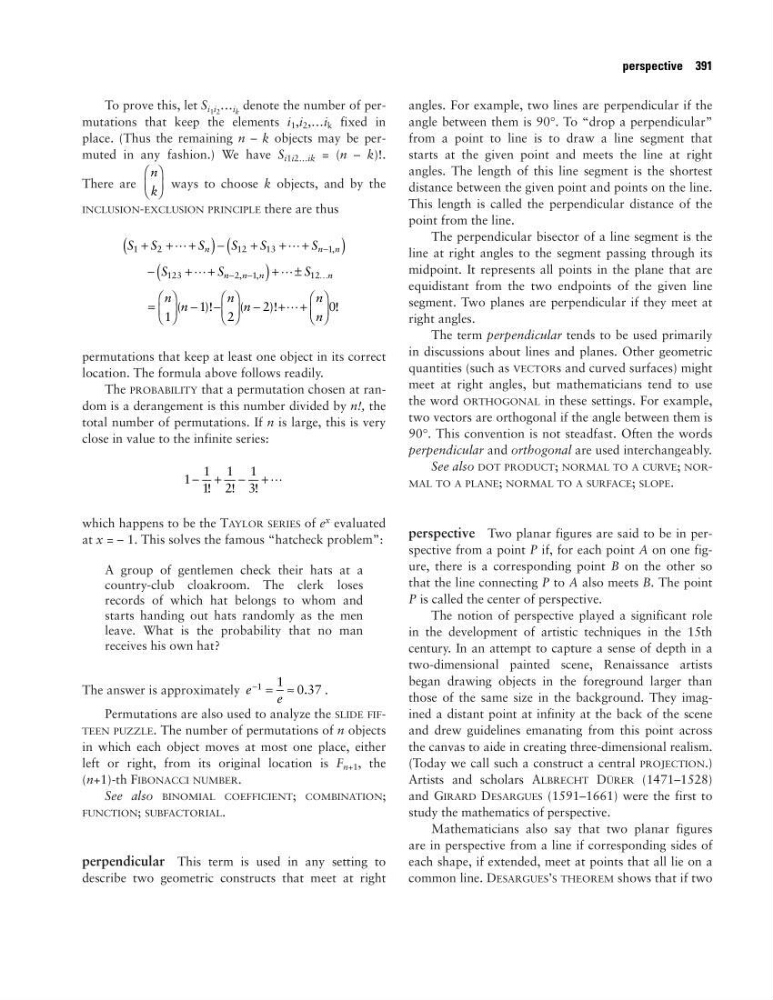
To prove this, let S i 1 i 2 … i k denote the number of permutations that keep the elements i 1 ,i 2 ,…i k fixed in
place. (Thus the remaining n – k objects may be permuted in any fashion.) We have S i1i2…ik = (n – k)!.
There are
ways to choose k objects, and by the
INCLUSION-EXCLUSION PRINCIPLE there are thus
permutations that keep at least one object in its correct
location. The formula above follows readily.
The PROBABILITY that a permutation chosen at random is a derangement is this number divided by n!, the
total number of permutations. If n is large, this is very
close in value to the infinite series:
which happens to be the TAYLOR SERIES of e
x evaluated
at x = – 1. This solves the famous “hatcheck problem”:
A group of gentlemen check their hats at a
country-club cloakroom. The clerk loses
records of which hat belongs to whom and
starts handing out hats randomly as the men
leave. What is the probability that no man
receives his own hat?
The answer is approximately
.
Permutations are also used to analyze the SLIDE FIFTEEN PUZZLE. The number of permutations of n objects
in which each object moves at most one place, either
left or right, from its original location is F n+1 , the
(n+1)-th FIBONACCI NUMBER.
See also BINOMIAL COEFFICIENT; COMBINATION;
FUNCTION; SUBFACTORIAL.
perpendicular This term is used in any setting to
describe two geometric constructs that meet at right
angles. For example, two lines are perpendicular if the
angle between them is 90°. To “drop a perpendicular”
from a point to line is to draw a line segment that
starts at the given point and meets the line at right
angles. The length of this line segment is the shortest
distance between the given point and points on the line.
This length is called the perpendicular distance of the
point from the line.
The perpendicular bisector of a line segment is the
line at right angles to the segment passing through its
midpoint. It represents all points in the plane that are
equidistant from the two endpoints of the given line
segment. Two planes are perpendicular if they meet at
right angles.
The term perpendicular tends to be used primarily
in discussions about lines and planes. Other geometric
quantities (such as VECTORs and curved surfaces) might
meet at right angles, but mathematicians tend to use
the word ORTHOGONAL in these settings. For example,
two vectors are orthogonal if the angle between them is
90°. This convention is not steadfast. Often the words
perpendicular and orthogonal are used interchangeably.
See also DOT PRODUCT; NORMAL TO A CURVE; NORMAL TO A PLANE; NORMAL TO A SURFACE; SLOPE.
perspective Two planar figures are said to be in perspective from a point P if, for each point A on one figure, there is a corresponding point B on the other so
that the line connecting P to A also meets B. The point
P is called the center of perspective.
The notion of perspective played a significant role
in the development of artistic techniques in the 15th
century. In an attempt to capture a sense of depth in a
two-dimensional painted scene, Renaissance artists
began drawing objects in the foreground larger than
those of the same size in the background. They imagined a distant point at infinity at the back of the scene
and drew guidelines emanating from this point across
the canvas to aide in creating three-dimensional realism.
(Today we call such a construct a central PROJECTION.)
Artists and scholars ALBRECHT DÜRER (1471–1528)
and GIRARD DESARGUES (1591–1661) were the first to
study the mathematics of perspective.
Mathematicians also say that two planar figures
are in perspective from a line if corresponding sides of
each shape, if extended, meet at points that all lie on a
common line. DESARGUES’S THEOREM shows that if two
e
e
−
= ≈
1
1 0 37
.
1
1
1
1
2
1
3
− + − +
!
! !
L
S S
S
S
S
S
S
S
S
n n
n n
n
n
n
n n
n
n n
n
1
2
12
13
1
123
2 1
12
1
1
2
2
0
+ + +
(
) − + + +
(
)
−
+ +
(
) + ±
=
⎛
⎝
⎜
⎞
⎠
⎟ − −
⎛
⎝
⎜
⎞
⎠
⎟ − + +
⎛
⎝
⎜
⎞
⎠
⎟
−
−
−
L
L
L
L
L
K
,
,
,
(
)!
(
)!
!
n
k
⎛
⎝
⎜
⎞
⎠
⎟
perspective 391
place. (Thus the remaining n – k objects may be permuted in any fashion.) We have S i1i2…ik = (n – k)!.
There are
ways to choose k objects, and by the
INCLUSION-EXCLUSION PRINCIPLE there are thus
permutations that keep at least one object in its correct
location. The formula above follows readily.
The PROBABILITY that a permutation chosen at random is a derangement is this number divided by n!, the
total number of permutations. If n is large, this is very
close in value to the infinite series:
which happens to be the TAYLOR SERIES of e
x evaluated
at x = – 1. This solves the famous “hatcheck problem”:
A group of gentlemen check their hats at a
country-club cloakroom. The clerk loses
records of which hat belongs to whom and
starts handing out hats randomly as the men
leave. What is the probability that no man
receives his own hat?
The answer is approximately
.
Permutations are also used to analyze the SLIDE FIFTEEN PUZZLE. The number of permutations of n objects
in which each object moves at most one place, either
left or right, from its original location is F n+1 , the
(n+1)-th FIBONACCI NUMBER.
See also BINOMIAL COEFFICIENT; COMBINATION;
FUNCTION; SUBFACTORIAL.
perpendicular This term is used in any setting to
describe two geometric constructs that meet at right
angles. For example, two lines are perpendicular if the
angle between them is 90°. To “drop a perpendicular”
from a point to line is to draw a line segment that
starts at the given point and meets the line at right
angles. The length of this line segment is the shortest
distance between the given point and points on the line.
This length is called the perpendicular distance of the
point from the line.
The perpendicular bisector of a line segment is the
line at right angles to the segment passing through its
midpoint. It represents all points in the plane that are
equidistant from the two endpoints of the given line
segment. Two planes are perpendicular if they meet at
right angles.
The term perpendicular tends to be used primarily
in discussions about lines and planes. Other geometric
quantities (such as VECTORs and curved surfaces) might
meet at right angles, but mathematicians tend to use
the word ORTHOGONAL in these settings. For example,
two vectors are orthogonal if the angle between them is
90°. This convention is not steadfast. Often the words
perpendicular and orthogonal are used interchangeably.
See also DOT PRODUCT; NORMAL TO A CURVE; NORMAL TO A PLANE; NORMAL TO A SURFACE; SLOPE.
perspective Two planar figures are said to be in perspective from a point P if, for each point A on one figure, there is a corresponding point B on the other so
that the line connecting P to A also meets B. The point
P is called the center of perspective.
The notion of perspective played a significant role
in the development of artistic techniques in the 15th
century. In an attempt to capture a sense of depth in a
two-dimensional painted scene, Renaissance artists
began drawing objects in the foreground larger than
those of the same size in the background. They imagined a distant point at infinity at the back of the scene
and drew guidelines emanating from this point across
the canvas to aide in creating three-dimensional realism.
(Today we call such a construct a central PROJECTION.)
Artists and scholars ALBRECHT DÜRER (1471–1528)
and GIRARD DESARGUES (1591–1661) were the first to
study the mathematics of perspective.
Mathematicians also say that two planar figures
are in perspective from a line if corresponding sides of
each shape, if extended, meet at points that all lie on a
common line. DESARGUES’S THEOREM shows that if two
e
e
−
= ≈
1
1 0 37
.
1
1
1
1
2
1
3
− + − +
!
! !
L
S S
S
S
S
S
S
S
S
n n
n n
n
n
n
n n
n
n n
n
1
2
12
13
1
123
2 1
12
1
1
2
2
0
+ + +
(
) − + + +
(
)
−
+ +
(
) + ±
=
⎛
⎝
⎜
⎞
⎠
⎟ − −
⎛
⎝
⎜
⎞
⎠
⎟ − + +
⎛
⎝
⎜
⎞
⎠
⎟
−
−
−
L
L
L
L
L
K
,
,
,
(
)!
(
)!
!
n
k
⎛
⎝
⎜
⎞
⎠
⎟
perspective 391